Key Points
- Cessation evidence: An international expert paper published in JAMA found that nicotine e-cigarettes produce higher quit rates than nicotine replacement therapy and results comparable to some highly effective cessation medicines.
- Product substitution: E-cigarettes must deliver enough nicotine and satisfaction to replace cigarettes; insufficient delivery may trigger compensatory use and undermine cessation.
- Clinical pathway: Adult smokers would not need to fail an approved medicine before considering e-cigarettes, although approved treatments remain the priority when patients have no clear preference.
- Complete switching and risk: The goal is complete cigarette cessation, not prolonged dual use. Switching fully can reduce exposure to combustion-related toxicants, but long-term health risks remain uncertain.
- Broader implications: 2Firsts argues that public-health professionals should reassess relative risk, regulators should balance youth protection with adult cessation needs, and manufacturers should focus on helping smokers stop using cigarettes completely.
2Firsts,
August 3, 2026
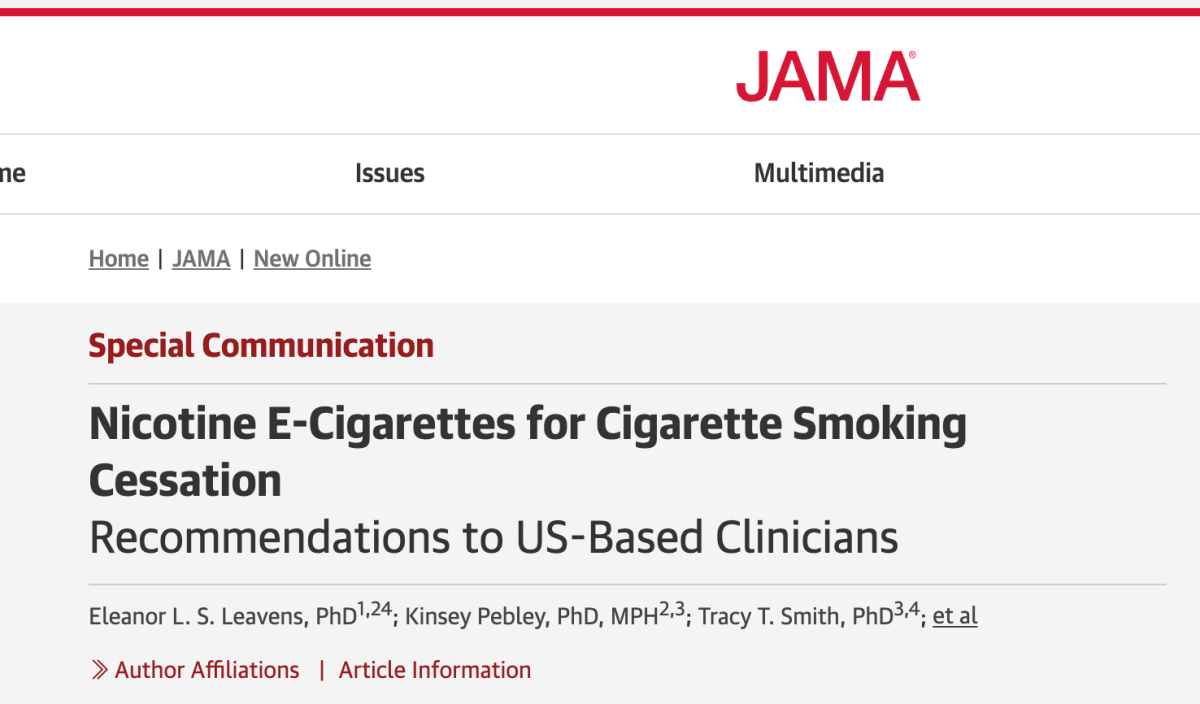
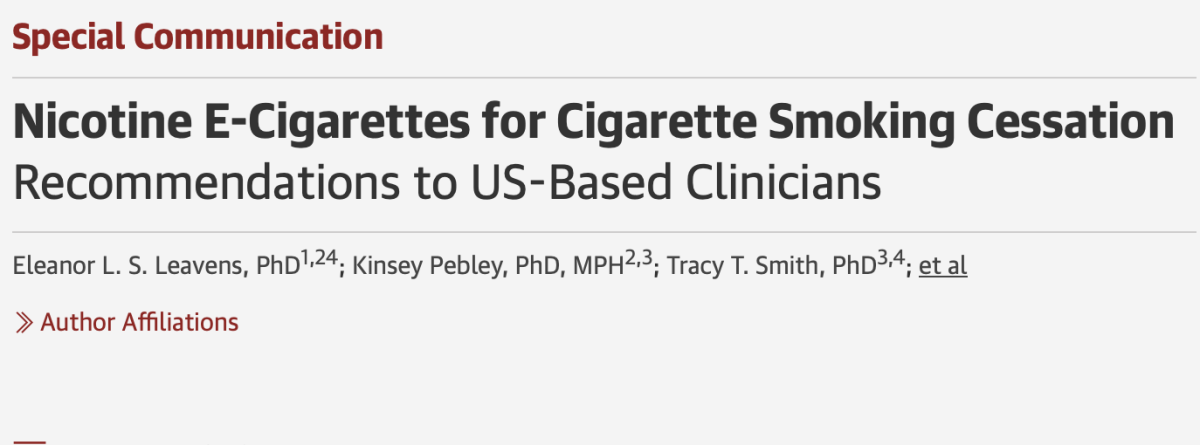
U.S. clinicians should include nicotine e-cigarettes among the options discussed with adult smokers seeking to quit, according to an expert paper published online July 30 in JAMA, the journal of the American Medical Association.
The paper was led by Eleanor L. S. Leavens of the University of Kansas School of Medicine, Kinsey Pebley and Tracy T. Smith of the Medical University of South Carolina. Alana M. Rojewski and Adrienne L. Johnson served as co-senior authors.
It was developed by a 24-member harm reduction workgroup within the Treatment Research Network of the Society for Research on Nicotine and Tobacco and reviewed by the network’s advisory committee and the society’s board.
The publication is a position paper, not a new clinical trial or an official U.S. clinical guideline. It reviews existing evidence and offers practical recommendations for clinicians working with adults who currently smoke.
Its central recommendation is that e-cigarettes should not be reserved only for smokers who have failed with conventional treatments. Patients should be able to consider them alongside nicotine replacement therapy, varenicline, bupropion and other evidence-based options.
The evidence cited by the workgroup shows higher quit rates with nicotine e-cigarettes than with nicotine replacement therapy, with results comparable to some highly effective cessation medicines. No e-cigarette, however, has been approved by the U.S. Food and Drug Administration as a smoking cessation medicine.
Core Evidence and Expert Recommendations
Cochrane is an independent international health evidence network that produces systematic reviews. Its “living” systematic reviews are updated as new evidence becomes available.
(1) Core Evidence
- Higher quit rates than nicotine replacement therapy: A Cochrane living systematic review found high-certainty evidence that nicotine e-cigarettes produce higher quit rates than nicotine patches, gum, lozenges and nasal sprays. In the latest review cited in the paper, approximately one in 10 people who used nicotine e-cigarettes to quit remained abstinent at six months.
- Comparable with some highly effective medicines: Another Cochrane review found cessation rates comparable to varenicline and cytisine. A U.S. cohort study of about 1,600 adults also found that daily e-cigarette use was consistently associated with higher smoking cessation rates.
- Complete switching reduces toxicant exposure: Fully replacing cigarettes with e-cigarettes reduces exposure to carcinogens and other combustion-related toxicants. Levels of some toxicants may be up to about 90% lower than in cigarette smoke, although this does not mean that overall health risk is reduced by 90%.
- Products must be capable of replacing cigarettes: An e-cigarette needs to deliver enough nicotine and provide sufficient satisfaction to reduce cravings and replace smoking. Nicotine delivery that is too low may reduce cessation success and lead to compensatory use.
- Important evidence gaps remain: The best device, brand, flavor and nicotine dose remain unknown. Long-term evidence beyond two years is limited, as is evidence for pregnancy and some major chronic diseases.
(2) Expert Recommendations
- Discuss e-cigarettes from the beginning: Adult smokers should not be required to try or fail an FDA-approved medicine first. When patients have no clear preference, however, approved cessation medicines should remain the priority.
- Move toward complete cigarette substitution: Dual use should be kept as brief as possible, with complete cigarette cessation as the primary goal.
- Provide support and prevent relapse: E-cigarette use should be combined with behavioral counseling and follow-up. Longer-term use may be supported when necessary to maintain cigarette abstinence.

To Support Cessation, E-Cigarettes Must Be Capable of Replacing Cigarettes
Whether an e-cigarette can help a smoker stop using cigarettes depends on more than the nicotine concentration stated on the label. It also depends on actual nicotine delivery, user satisfaction and whether the product can address behavioral aspects of smoking that some people find difficult to give up. E-cigarettes generally deliver nicotine more rapidly than nicotine replacement therapy, which may improve acceptability and substitution but may also increase the potential for continued use and nicotine dependence.
The workgroup said products need to deliver enough nicotine to relieve withdrawal symptoms and cravings. If nicotine delivery is insufficient, users may vape more frequently or inhale more deeply to compensate. This may reduce cessation success while increasing exposure to propylene glycol, vegetable glycerin, flavoring ingredients and their thermal degradation products.
This does not mean that higher nicotine concentrations are inherently better. Cessation value should be assessed through actual nicotine delivery, inhalation behavior, user satisfaction, harmful constituent emissions and the product’s ability to replace cigarettes.
E-Cigarettes Can Be Discussed From the Start, but Complete Cigarette Cessation Remains the Goal
The workgroup recommends that adult smokers should not be required to try or fail an approved cessation medicine before considering an e-cigarette. E-cigarettes could be discussed from the beginning of a quit attempt alongside nicotine replacement therapy, varenicline and bupropion. When patients have no clear preference, FDA-approved cessation medicines should remain the priority.
The paper provides an expert framework based on existing evidence. It does not revise U.S. national clinical guidelines or require clinicians to recommend e-cigarettes broadly. Decisions should reflect the patient’s previous quit attempts, goals and treatment preferences.
The ultimate objective is complete cigarette cessation. Dual use should be treated as a transition because reductions in toxicant exposure depend largely on how much cigarette consumption declines, while some cardiovascular risks persist even at low levels of smoking.
E-cigarette use should be combined with behavioral support and follow-up. If smoking does not decline, clinicians may adjust nicotine levels or frequency of use, or consider another cessation treatment. Longer-term e-cigarette use may be supported when necessary to maintain cigarette abstinence and prevent relapse, with complete nicotine abstinence considered later.
Complete Switching Reduces Toxicant Exposure, but Long-Term Risk Remains Uncertain and No Product Is Approved for Cessation
Tobacco combustion is the main driver of smoking-related harm. For adults who currently smoke, completely switching to e-cigarettes can reduce exposure to many combustion-related toxicants. The paper says levels of some toxicants may be up to about 90% lower than in cigarette smoke.
That figure applies only to certain toxicants and should not be interpreted as evidence that overall health risk is 90% lower. E-cigarettes are not risk-free, and studies have not produced sufficient evidence on use lasting more than two years. Cancer, respiratory disease and cardiovascular disease may take years to develop, while previous smoking complicates long-term risk assessment. Evidence also remains limited for pregnancy and some major chronic diseases.
The recommendations do not change the regulatory status of e-cigarettes in the United States. No e-cigarette has been approved by the FDA as a smoking cessation medicine. The drug pathway can approve products for cessation treatment, while the tobacco product pathway authorizes e-cigarettes for marketing as consumer tobacco products.
According to the authors, no e-cigarette manufacturer is known to have applied through the drug pathway. Some products have received tobacco marketing authorization, but that authorization does not constitute approval as a cessation medicine and should not be presented as FDA recognition of smoking cessation effectiveness.
What the Recommendations Could Change
The following is 2Firsts’ analysis of the broader implications of the paper.
(1)For Clinicians and Public Health Professionals
The paper first requires clinicians and public health professionals to reconsider the place of e-cigarettes within smoking cessation.
E-cigarettes are not risk-free, but for adults who currently smoke, completely switching can substantially reduce exposure to toxicants generated by combustion. Cessation services therefore need to consider the risks of e-cigarette use in comparison with the risks of continued smoking, rather than assessing vaping in isolation.
The recommendations suggest that e-cigarettes should not be viewed only as consumer products requiring regulation. For some adult smokers, they may also serve as practical tools for stopping cigarette use.
Clinicians and public health professionals may therefore need to reconsider how cessation pathways are designed. In addition to nicotine patches, gum and prescription medicines, e-cigarettes could be incorporated into more individualized plans based on previous quit attempts, patient preferences and the product’s actual ability to replace cigarettes.
The central issue is not whether e-cigarettes should be recommended to every smoker. It is whether professionals accurately understand the relative risks of cigarettes and e-cigarettes and help adult smokers identify the approach most likely to achieve complete cigarette cessation.
(2)For Regulators
The paper also suggests that product appeal, satisfaction and acceptability for adult smokers are not separate from public health objectives. They are part of whether an e-cigarette can successfully replace cigarettes.
A product that does not adequately relieve withdrawal, reduce cravings or provide an acceptable experience may fail to support complete switching. Nicotine delivery that is too low may also lead users to vape more frequently or inhale more deeply to compensate.
Regulation therefore requires a more precise balance between two goals: preventing uptake among young people and people who do not smoke, while preserving sufficient appeal and substitution potential for adults seeking to stop smoking.
Restrictions on nicotine concentration, flavors or product experience should not be based only on the assumption that lower, fewer or weaker is always safer. Regulators also need to consider whether such restrictions could reduce a product’s ability to replace cigarettes, prolong dual use or make complete switching more difficult.
(3)For Manufacturers
For manufacturers, the paper points to a product-development objective that goes beyond reducing aerosol emissions. E-cigarettes intended to support cessation must also be capable of helping adult smokers stop using cigarettes completely.
Research and product development may need to focus more directly on real-world outcomes, including:
- whether the product can relieve withdrawal and cravings quickly and consistently;
- whether it provides enough satisfaction for adult smokers to give up cigarettes;
- whether it shortens the period of dual use;
- whether it increases complete switching and sustained abstinence;
- whether it reduces relapse;
- whether nicotine delivery and product experience remain consistent across batches.
Laboratory emissions data remain important, but they cannot by themselves establish cessation value. Companies seeking to demonstrate that value will need evidence showing whether their products reduce smoking, support complete cigarette substitution and help users maintain that outcome over time.
For the latest reporting on global nicotine science, follow 2Firsts. We welcome research findings, contributed articles and interview opportunities. Contact: alan@2firsts.com.
Cover image source: JAMA.

Disclaimer
This article is provided solely for professional research, industry discussion, and informational purposes. Any references to brands, companies, products, technologies, or policies are made for factual reporting and analytical purposes only, and do not constitute endorsement, recommendation, promotion, or advertising by 2Firsts.
Nicotine-containing products, including but not limited to cigarettes, e-cigarettes, heated tobacco products, and nicotine pouches, carry significant health risks. Readers are responsible for complying with all applicable laws and regulations in their respective jurisdictions, including age restrictions and access limitations.
The information contained in this article should not be regarded as investment, legal, medical, regulatory, or commercial advice. While 2Firsts strives to ensure the accuracy and reliability of its content, it does not assume liability for any direct or indirect loss arising from errors, omissions, inaccuracies, or reliance on the information contained herein.
This article is not intended for individuals below the legal age for accessing tobacco or nicotine-related information in their jurisdiction.
Copyright Notice
This article is either original content produced by 2Firsts or content reproduced, translated, summarized, or adapted from third-party sources with attribution where applicable. The intellectual property rights of the original content remain with 2Firsts or the respective original rights holders.
No individual or organization may copy, reproduce, distribute, republish, modify, translate, or otherwise use this content without prior authorization. Any unauthorized use may result in legal action.
For copyright-related inquiries, corrections, or removal requests, please contact: info@2firsts.com.
AI-Assisted Translation and Editing Notice
Portions of this article may have been translated, edited, or reviewed with the assistance of artificial intelligence tools to improve efficiency and readability. Due to the limitations of AI-assisted translation and editing, discrepancies, omissions, or inaccuracies may exist when compared with the original source.
Where applicable, readers are advised to refer to the original source for the most complete and accurate information. If you identify any errors or believe that any content infringes upon your rights, please contact us at info@2firsts.com, and we will review and address the matter promptly.