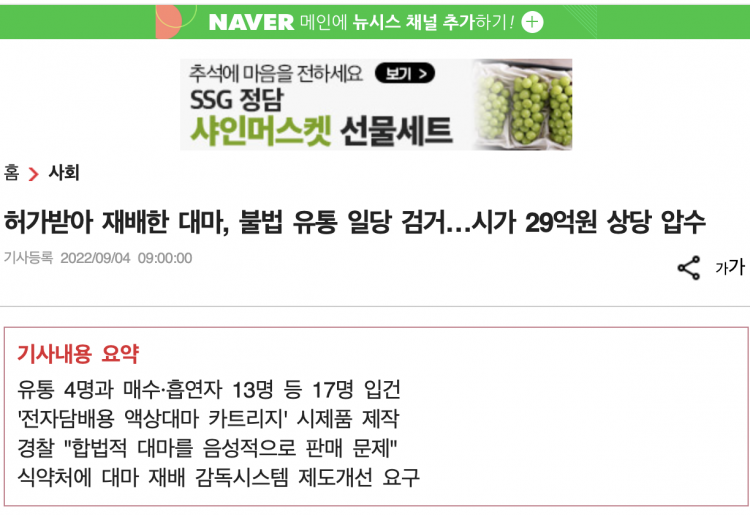
On September 4th, the drug crime investigation team of the Seoul Metropolitan Police Department announced that they have registered charges against four individuals involved in the illegal distribution of marijuana, and 13 individuals involved in purchasing or using marijuana, for violations of drug control laws. Two of the individuals, who were involved in serious offenses, have been arrested.
In addition, the police have seized approximately 29.3 kilograms of marijuana, valued at around 2.9 billion Korean won, as well as stockpiles of 691 cannabis plants. This recent seizure constitutes 59.3% of the total marijuana confiscated last year (49.4 kilograms). The suspects have been accused of illegally cultivating, distributing, and purchasing marijuana in the mountainous region of Gyeongbuk from November 2020 to June 2021.
The police have apprehended a group of individuals who stole a portion of marijuana plants and illegally distributed them.
Four individuals utilized a claim of hemp seed collection to cultivate cannabis on a plot of land measuring 3006 square meters, with permission from the local government. The cannabis plants grown had minimal hallucinogenic properties, therefore avoiding regulatory oversight. It has since been revealed that approximately 30 kilograms of cannabis were harvested in secret prior to inspection by administrative authorities.
One kilogram of cannabis was advertised and sold through Twitter and Telegram. To boost sales, they created advertisements for distributing "liquid cannabis pods for e-cigarettes.
The police have also requested that the Food and Drug Administration improve its system, stating a need to supplement supervision regulations following the approval of cannabis cultivation. In fact, according to the Narcotics Control Law and its implementing regulations, local governments only need to receive reports and conduct inspections during the planting and harvesting of cannabis, making it difficult to monitor actual cultivation levels.
A police officer stated, "The buyers in this case were smoking marijuana in the club and confirmed sales, gifts, and management between guests and entertainment staff. We plan to investigate.
Statement: 1. The content of this article is compiled from third-party information and is only meant for industry-related exchange and learning purposes. 2. This article does not represent the views of 2FIRSTS, and 2FIRSTS is unable to confirm the accuracy or truthfulness of the content. The translation of this article is intended solely for industry-related exchange and research. 3. Due to limitations in the translation process, the compiled article may not fully reflect the original text. Please refer to the original text for accuracy. 4. 2FIRSTS maintains complete alignment with the Chinese government on any domestic, Hong Kong, Macau, Taiwan, or foreign-related expressions and positions. 5. The copyright of the compiled information belongs to the original media and authors. If there is any infringement, please contact us for removal.
Disclaimer
This article is provided solely for professional research, industry discussion, and informational purposes. Any references to brands, companies, products, technologies, or policies are made for factual reporting and analytical purposes only, and do not constitute endorsement, recommendation, promotion, or advertising by 2Firsts.
Nicotine-containing products, including but not limited to cigarettes, e-cigarettes, heated tobacco products, and nicotine pouches, carry significant health risks. Readers are responsible for complying with all applicable laws and regulations in their respective jurisdictions, including age restrictions and access limitations.
The information contained in this article should not be regarded as investment, legal, medical, regulatory, or commercial advice. While 2Firsts strives to ensure the accuracy and reliability of its content, it does not assume liability for any direct or indirect loss arising from errors, omissions, inaccuracies, or reliance on the information contained herein.
This article is not intended for individuals below the legal age for accessing tobacco or nicotine-related information in their jurisdiction.
Copyright Notice
This article is either original content produced by 2Firsts or content reproduced, translated, summarized, or adapted from third-party sources with attribution where applicable. The intellectual property rights of the original content remain with 2Firsts or the respective original rights holders.
No individual or organization may copy, reproduce, distribute, republish, modify, translate, or otherwise use this content without prior authorization. Any unauthorized use may result in legal action.
For copyright-related inquiries, corrections, or removal requests, please contact: info@2firsts.com.
AI-Assisted Translation and Editing Notice
Portions of this article may have been translated, edited, or reviewed with the assistance of artificial intelligence tools to improve efficiency and readability. Due to the limitations of AI-assisted translation and editing, discrepancies, omissions, or inaccuracies may exist when compared with the original source.
Where applicable, readers are advised to refer to the original source for the most complete and accurate information. If you identify any errors or believe that any content infringes upon your rights, please contact us at info@2firsts.com, and we will review and address the matter promptly.