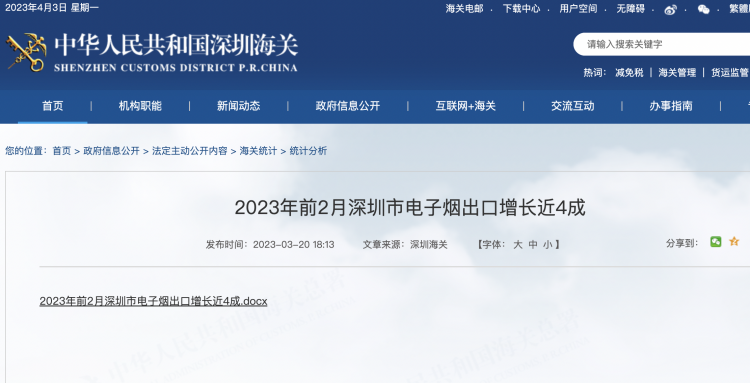
In 2022, Shenzhen exported electronic cigarettes worth ¥46.09 billion, accounting for 68.3% of the country's total export value. In the first two months of this year, Shenzhen's electronic cigarette exports reached ¥7.1 billion, a year-on-year increase of 38.9%, accounting for 66.9% of the country's total electronic cigarette exports. This is the first time that Shenzhen Customs has released data on electronic cigarette exports.
According to customs data, the main characteristics of Shenzhen's electronic cigarette exports are as follows:
First, the majority of exports come from privately-owned businesses, accounting for over 85% of the total export value.
In the first two months of this year, private enterprises in Shenzhen achieved an export value of RMB 6.09 billion, a growth of 42%, accounting for 85.8% of the total export value of electronic cigarettes from Shenzhen during the same period.
Secondly, exports through general trade account for over 90%.
From January to February this year, the main method of exporting electronic cigarettes was through general trade, with a total value of 6.53 billion yuan, a 40.5% increase and accounting for 92.1% of all exports.
The term "general trade" refers to the unilateral import or export of goods by enterprises in China that hold import-export rights. In the export of electronic cigarettes from Shenzhen, China, the general trade method has a relatively high proportion. This means that direct commodity exchanges occur between the electronic cigarette producers in Shenzhen and overseas buyers, rather than through a third-party trade intermediary. This can bring more profit margins and direct market feedback, allowing enterprises to have a better understanding of overseas market demand and trends.
Thirdly, the products are mainly sold to the European and American markets. Over 30% of the products are exported to the United States, but the export value has decreased.
In the first two months of this year, Shenzhen's exports to the United States amounted to RMB 2.29 billion, a decrease of 20.1%, and accounted for 32.3% of the total value of Shenzhen's electronic cigarette exports during the same period. This is a 5.8% decrease from 2022. However, the United States remains the largest market for Shenzhen's electronic cigarette exports.
During the same period, export growth to the European Union, United Kingdom, and Russia increased by 1.9 times, 90%, and 2.7 times respectively, accounting for a total of 40.9%.
Fourthly, exports to Southeast Asia have increased by 1.3 times.
According to customs data, exports to ASEAN reached 420 million yuan in the first two months of this year, an increase of 130%, accounting for 6% of the total export value.
In the first two months prior to 2023, the electronic cigarette export market in Shenzhen city was valued in RMB and categorized as follows: (unit: RMB billion,%,%).
Source of Data: Shenzhen Customs
Reference:
In February of 2023, electronic cigarette exports in Shenzhen grew by nearly 40%.
Disclaimer
This article is provided solely for professional research, industry discussion, and informational purposes. Any references to brands, companies, products, technologies, or policies are made for factual reporting and analytical purposes only, and do not constitute endorsement, recommendation, promotion, or advertising by 2Firsts.
Nicotine-containing products, including but not limited to cigarettes, e-cigarettes, heated tobacco products, and nicotine pouches, carry significant health risks. Readers are responsible for complying with all applicable laws and regulations in their respective jurisdictions, including age restrictions and access limitations.
The information contained in this article should not be regarded as investment, legal, medical, regulatory, or commercial advice. While 2Firsts strives to ensure the accuracy and reliability of its content, it does not assume liability for any direct or indirect loss arising from errors, omissions, inaccuracies, or reliance on the information contained herein.
This article is not intended for individuals below the legal age for accessing tobacco or nicotine-related information in their jurisdiction.
Copyright Notice
This article is either original content produced by 2Firsts or content reproduced, translated, summarized, or adapted from third-party sources with attribution where applicable. The intellectual property rights of the original content remain with 2Firsts or the respective original rights holders.
No individual or organization may copy, reproduce, distribute, republish, modify, translate, or otherwise use this content without prior authorization. Any unauthorized use may result in legal action.
For copyright-related inquiries, corrections, or removal requests, please contact: info@2firsts.com.
AI-Assisted Translation and Editing Notice
Portions of this article may have been translated, edited, or reviewed with the assistance of artificial intelligence tools to improve efficiency and readability. Due to the limitations of AI-assisted translation and editing, discrepancies, omissions, or inaccuracies may exist when compared with the original source.
Where applicable, readers are advised to refer to the original source for the most complete and accurate information. If you identify any errors or believe that any content infringes upon your rights, please contact us at info@2firsts.com, and we will review and address the matter promptly.