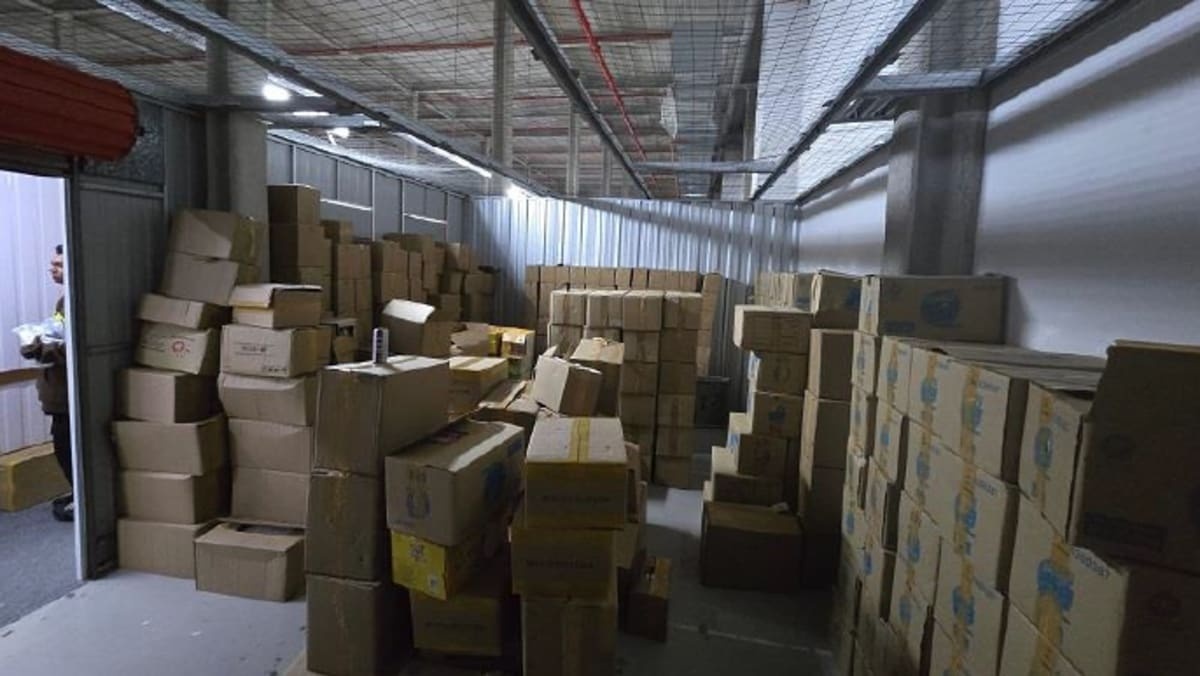
According to Channel News Asia's report on July 4th, the Health Sciences Authority (HSA) in Singapore stated that over 350,000 e-cigarette products were seized in raids across the country in June.
The black market value of these e-cigarette products exceeds 6 million Singapore dollars (approximately 4.44 million US dollars) and were originally planned to be sold through Telegram.
The Health Sciences Authority (HSA) confirmed that a series of raids carried out from June 14 to 18 at three separate locations effectively targeted one of Singapore's largest e-cigarette distribution networks.
Authorities received news on June 14 that a large quantity of e-cigarettes and components were found in a warehouse at Woodlands Loop.
Following that, there were two more raids conducted, one at an apartment unit on Guillemard Crescent on the same day, and another at a warehouse unit in the Woodlands industrial park on June 18th. HSA stated that more e-cigarette products were also found at these two locations.
Additionally, 14 e-cigarettes suspected to contain the controlled substance tetrahydrocannabinol (THC) have been discovered, and these products have been handed over to the Central Narcotics Bureau (CNB) for processing. Four men and women, ranging in age from 34 to 52, are currently assisting in the investigations conducted by the Health Sciences Authority (HSA) and CNB.
The Health Sciences Authority (HSA) has reported seizures of e-cigarette products worth over 18 million Singapore dollars (13.32 million US dollars) since January. Authorities have warned that importing, distributing, selling, or advertising e-cigarette products is illegal.
For the first time offenders found importing, distributing, or selling e-cigarette products, they can be fined up to $10,000 (USD 7401), or face imprisonment for a maximum of 6 months, or both. For second-time offenders and beyond, the maximum fine can reach $20,000 (USD 14,802), or imprisonment for up to 12 months, or both. It is illegal to purchase, use, or possess e-cigarettes, with a maximum fine of $2000 (USD 1480).
Last year, Singapore authorities dealt with around 8,000 cases of e-cigarette-related offenses, a 43% increase from the 5,600 cases in 2022. There were a total of 7,600 recorded offenses in 2021.
In December of last year, authorities announced plans to enhance inspections of e-cigarettes and their components at border checkpoints in Singapore. They also stated that they would increase efforts to combat the use of e-cigarettes in "public hotspots.
From January 1 to March 31, it was discovered that over 2200 people were using or in possession of e-cigarettes.
In May this year, Rahayu Mahzam, the Senior Parliamentary Secretary of the Ministry of Health, stated that the Health Sciences Authority is reviewing legal penalties to enhance deterrence against e-cigarette advertising, importation, and distribution.
She added that the Health and Safety Authority has been monitoring illegal e-cigarette sales on social media, e-commerce, and communication platforms, and taking action to remove e-cigarette-related content.
We welcome news tips, article submissions, interview requests, or comments on this piece.
Please contact us at info@2firsts.com, or reach out to Alan Zhao, CEO of 2Firsts, on LinkedIn
Notice
1. This article is intended solely for professional research purposes related to industry, technology, and policy. Any references to brands or products are made purely for objective description and do not constitute any form of endorsement, recommendation, or promotion by 2Firsts.
2. The use of nicotine-containing products — including, but not limited to, cigarettes, e-cigarettes, nicotine pouchand heated tobacco products — carries significant health risks. Users are responsible for complying with all applicable laws and regulations in their respective jurisdictions.
3. This article is not intended to serve as the basis for any investment decisions or financial advice. 2Firsts assumes no direct or indirect liability for any inaccuracies or errors in the content.
4. Access to this article is strictly prohibited for individuals below the legal age in their jurisdiction.
Copyright
This article is either an original work created by 2Firsts or a reproduction from third-party sources with proper attribution. All copyrights and usage rights belong to 2Firsts or the original content provider. Unauthorized reproduction, distribution, or any other form of unauthorized use by any individual or organization is strictly prohibited. Violators will be held legally accountable.
For copyright-related inquiries, please contact: info@2firsts.com
AI Assistance Disclaimer
This article may have been enhanced using AI tools to improve translation and editorial efficiency. However, due to technical limitations, inaccuracies may occur. Readers are encouraged to refer to the cited sources for the most accurate information.
We welcome any corrections or feedback. Please contact us at: info@2firsts.com