Key Points
- Abuse Liability as an APPH Component: FDA emphasized that abuse liability—defined by nicotine delivery speed, magnitude, and overall exposure—is a critical component of the APPH determination, though it represents only one part of the totality-of-evidence assessment.
- Clinical PK as Core Evidence: The agency underscored that product-specific clinical pharmacokinetic (PK) data, including Cmax, Tmax, and AUC, remain the strongest evidence for evaluating abuse liability, supplemented by subjective measures and use topography data.
- Industry Concerns Over Cost and Uncertainty: Small manufacturers said multi-session PK studies can cost millions of dollars and argued that the absence of defined numeric thresholds creates financial risk and regulatory unpredictability.
- The “Goldilocks” Dilemma: Industry representatives described a regulatory balancing challenge: nicotine delivery that is too high may raise abuse liability concerns, while delivery that is too low may fail to demonstrate switching potential under the APPH standard.
- FDA Response on Bridging and Modeling: FDA stated it may consider scientifically justified bridging strategies but warned that increased product differences complicate such approaches. Officials also noted that PBPK modeling is not currently provided as a primary evidentiary pathway and would require strong product-specific validation.
2Firsts, February 11, 2026
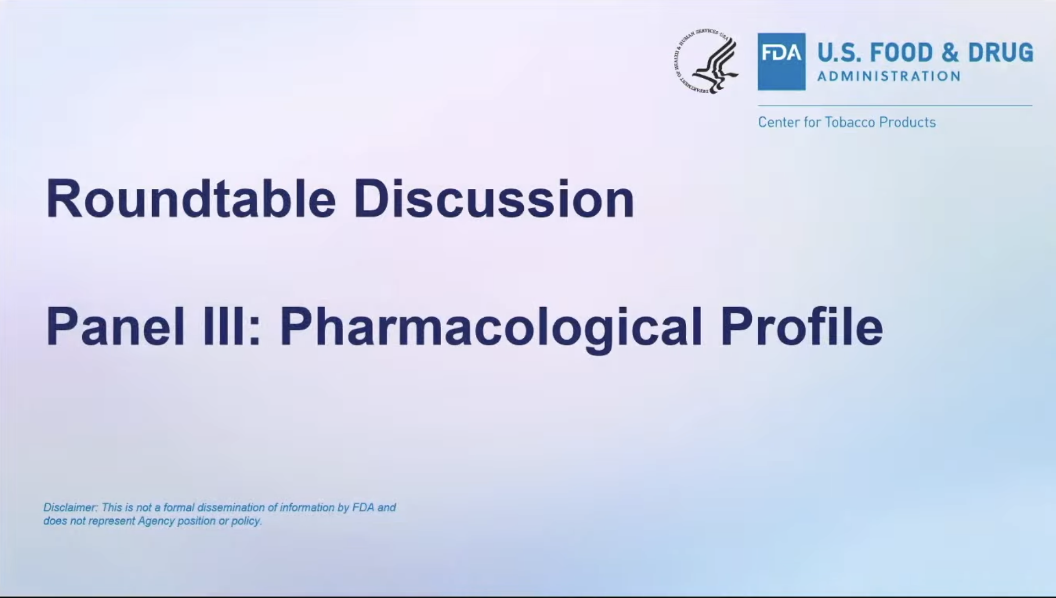
During the Pharmacological Profile panel of the U.S. Food and Drug Administration’s (FDA) PMTA roundtable on February 10, small manufacturers of electronic nicotine delivery systems (ENDS) questioned the cost, feasibility, and predictability of pharmacokinetic (PK) studies used to assess abuse liability, while FDA officials emphasized that addiction potential remains a necessary component of the agency’s determination of whether a product is appropriate for the protection of public health (APPH).

The session, moderated by Lynn Hull, Ph.D., Acting Senior Science Advisor in the Office of Science at FDA’s Center for Tobacco Products (CTP), formed Panel III of the agency’s hybrid roundtable with manufacturers employing fewer than 350 workers. Carolina Ramôa, Ph.D., Supervisory Pharmacologist in CTP’s Division of Individual Health Science, delivered the FDA presentation, followed by a roundtable discussion with agency officials and participating manufacturers.
Industry representatives in the discussion included Ed Carmines, Ph.D., Independent Director at Charlie’s Holdings, Inc.; Eric N. Heyer, Partner at Thompson Hine LLP, representing Maduro Distributors Inc.; Willie J. McKinney, Ph.D., D.A.B.T., CEO of McKinney Regulatory Science Advisors, representing Custom Technologies Inc.; Steven Haddad, J.D., Managing Member of Breeze Smoke, LLC; and Char Owen, CEO of Matrix Minds LLC.
FDA Defines Abuse Liability as a Core Element of Pharmacological Review
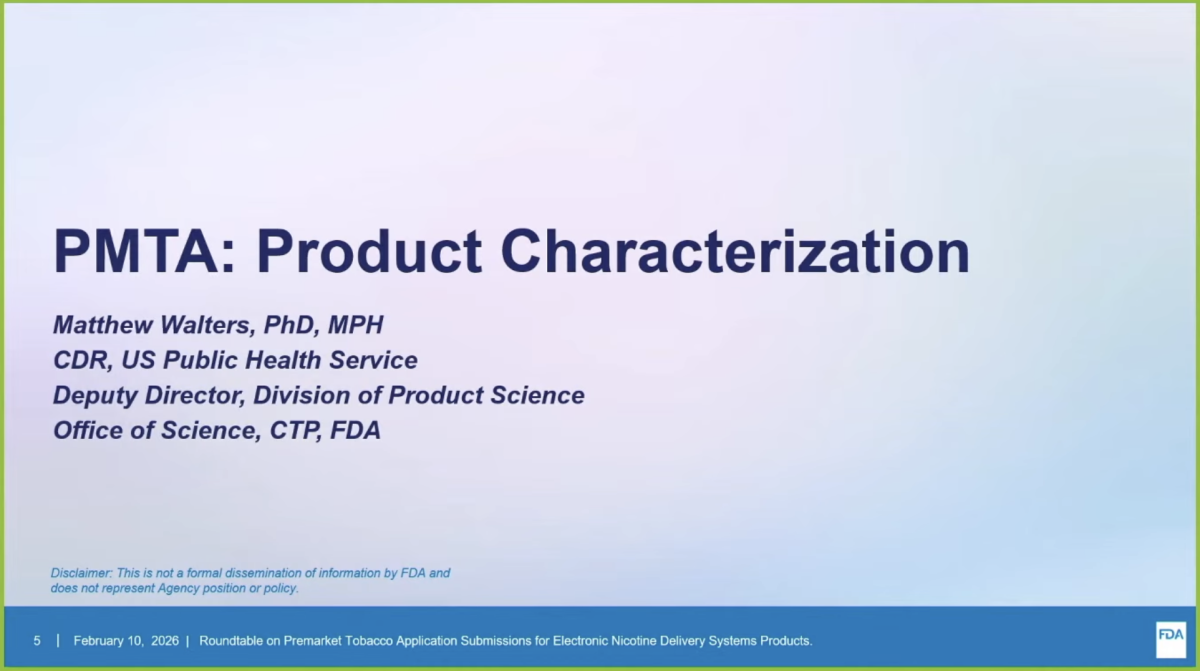
In her presentation, Ramôa outlined how CTP evaluates the pharmacological profile of new tobacco products, focusing on abuse liability and addiction.
“Abuse liability refers to the potential of a substance to result in addiction and be used repeatedly,” Ramôa said, citing definitions consistent with the National Institute on Drug Abuse. She noted that addiction is “a chronic, relapsing disorder characterized by compulsive drug seeking and use despite adverse consequences.”
FDA evaluates abuse liability, she explained, to understand the degree to which users of a tobacco product are likely to develop dependence, continue using the product, and potentially switch from other tobacco products. Abuse liability, she added, is “one piece” of the broader APPH evaluation, which incorporates multiple scientific disciplines.
Ramôa emphasized that nicotine is the primary addictive substance in tobacco products and that “the rate, degree, and total amount” of nicotine delivered to the brain significantly influence abuse liability.
PK Study Design: Quantitative and Qualitative Measures
The agency’s most common clinical approach to evaluating abuse liability involves multi-session, randomized, crossover studies comparing new products to a comparison product with known abuse liability, typically a participant’s usual brand (UB) combustible cigarette.
Such studies measure acute nicotine exposure using pharmacokinetic parameters including:
- Cmax (maximum plasma nicotine concentration),
- Tmax (time to reach Cmax), and
- AUC (area under the plasma nicotine concentration–time curve).
Chronic exposure may also be assessed using Total Nicotine Equivalents (TNE) in blood or urine over multiple days.
But PK metrics alone are insufficient, Ramôa said. Abuse liability assessments rely on “the intersection of quantitative and qualitative measures.” In addition to plasma nicotine levels, studies incorporate validated questionnaires evaluating subjective effects such as drug liking, satisfaction, craving, withdrawal relief, and willingness to use again.
Use topography — including puff number, puff volume, puff duration, and interpuff interval — is also measured. Ramôa noted that experienced ENDS users may achieve higher nicotine exposure from the same device compared with inexperienced users, underscoring the importance of participant selection.
Study Population and Confidence in Findings
Applicants must justify their selected study population, including both the intended user population and the likely user population. Prior experience with ENDS can influence nicotine exposure and subjective responses, affecting how study outcomes are interpreted.
FDA officials also highlighted sample size considerations. Insufficient sample sizes, they said, can reduce confidence in outcome measures and potentially produce misleading results. Study quality and design influence how heavily findings are weighted in the totality-of-evidence assessment.
Product-Specific Information and Bridging
Ramôa described product-specific clinical data as the “strongest source” for determining abuse liability. When such data are not available for every product in a product line, applicants may attempt to bridge data from tested products to untested ones.
Bridging requires identification of product differences and an evidence-based rationale explaining how those differences may — or may not — affect abuse liability measures, including nicotine exposure, subjective effects, and use behavior. If bridging is inappropriate, she said, those data “will not be considered in the review.”
Product characteristics known to influence abuse liability include nicotine concentration and formulation (e.g., freebase versus salts), flavor, device type and power, and PG/VG ratio, among other factors.
Ramôa cautioned that the more product characteristics differ between tested and untested products — such as changes in nicotine concentration, flavor, or device power — the more difficult and complex bridging becomes.
Clinical PK studies and use behavior studies provide the most useful bridging information, though machine-generated aerosol data, ingredient homology, and published literature may be acceptable when supported by explicit scientific justification.
Ramôa illustrated the concept with a hypothetical example in which products at 1%, 3%, and 5% nicotine concentrations were clinically tested and data were bridged to 2% and 4% products, provided that evidence demonstrated representative exposure and use behavior across concentrations.
Manufacturers Press FDA on Cost, Thresholds, and Modeling
During the roundtable discussion, industry representatives raised concerns about the financial and regulatory uncertainty surrounding abuse liability studies.
The “Goldilocks” Dilemma
Eric Heyer described what he called a “Goldilocks problem” facing manufacturers: if a product delivers nicotine at levels similar to or higher than combustible cigarettes, it may be viewed as having excessive abuse liability; if it delivers significantly less nicotine, adult smokers may not fully switch, potentially undermining harm reduction goals.
“Is there a line?” Heyer asked, referring to whether FDA applies implicit thresholds when evaluating Cmax or other PK metrics.
FDA officials declined to define numeric benchmarks. They stated that no specific nicotine exposure value automatically satisfies or disqualifies a product. Instead, if nicotine exposure exceeds that of combustible cigarettes, applicants should explain why that higher exposure would not pose additional health risk. Abuse liability, officials reiterated, is only one component of APPH and must be considered alongside toxicology, chemistry, and population-level effects.
One participating manufacturer described the uncertainty surrounding these determinations as a “massive frustration” for small businesses facing multi-million-dollar clinical study investments.
Cost, Toxicology, and Predictability
Willie McKinney questioned why products with harmful and potentially harmful constituent (HPHC) and toxicology profiles significantly below those of combustible cigarettes would still be required to undertake high-cost PK studies.
FDA officials responded that abuse liability represents a distinct scientific discipline within the APPH framework. Even if chemistry and toxicology data suggest reduced exposure to harmful constituents, the agency must still understand the product’s potential for addiction and continued use. Abuse liability, they said, cannot be inferred solely from lower HPHC levels.
Several industry participants argued that the lack of defined thresholds makes the process feel “less like a moving target and more like having no target at all.”
FDA representatives reiterated that the ENDS category encompasses a wide range of devices and formulations, making uniform numeric standards difficult to apply. They noted that abuse liability assessments are conducted within a multi-disciplinary framework involving scientists from chemistry, engineering, behavioral science, and other fields. Review decisions, they said, involve multiple layers of clearance and are not made by a single reviewer.
PBPK Modeling and Alternative Approaches
Participants also asked whether physiologically based pharmacokinetic (PBPK) modeling could reduce the need for expensive clinical studies by predicting nicotine exposure based on product characteristics such as pH and aerosol mass.
Industry participants referenced work by researchers such as Saul Shiffman suggesting that physical-chemical properties could be used to model nicotine exposure and inform regulatory assessment.
FDA officials said they do not currently provide such models for applicants to rely on as primary evidence and emphasized that any modeling approach would require strong, product-specific scientific justification demonstrating its applicability.
Transparency and Scientific Dialogue
Some manufacturers expressed concern about perceived subjectivity in review outcomes and variability between applications.
Megan Schroeder, Ph.D., Branch Chief of Behavioral and Clinical Pharmacology, said that abuse liability evaluations undergo extensive internal discussion and review within CTP’s Office of Science. She described the process as iterative, involving multiple levels of scientific review and cross-disciplinary input.
The agency also indicated that it is increasing scientific dialogue with applicants during the review process, particularly within the scientific review phase, to address data gaps before issuing deficiency letters when appropriate.
As the Pharmacological Profile panel concluded, FDA officials reiterated that abuse liability data must be considered in the context of the totality of evidence supporting an APPH determination. While manufacturers pressed for clearer thresholds and greater cost predictability, the agency maintained that product-specific evidence and scientific justification remain central to its evaluation framework.
2Firsts will continue to follow the roundtable discussions and report further developments.
(The cover image is a screenshot from the FDA’s livestream of the PMTA roundtable.)

Click here to read the full coverage

Disclaimer
This article is provided solely for professional research, industry discussion, and informational purposes. Any references to brands, companies, products, technologies, or policies are made for factual reporting and analytical purposes only, and do not constitute endorsement, recommendation, promotion, or advertising by 2Firsts.
Nicotine-containing products, including but not limited to cigarettes, e-cigarettes, heated tobacco products, and nicotine pouches, carry significant health risks. Readers are responsible for complying with all applicable laws and regulations in their respective jurisdictions, including age restrictions and access limitations.
The information contained in this article should not be regarded as investment, legal, medical, regulatory, or commercial advice. While 2Firsts strives to ensure the accuracy and reliability of its content, it does not assume liability for any direct or indirect loss arising from errors, omissions, inaccuracies, or reliance on the information contained herein.
This article is not intended for individuals below the legal age for accessing tobacco or nicotine-related information in their jurisdiction.
Copyright Notice
This article is either original content produced by 2Firsts or content reproduced, translated, summarized, or adapted from third-party sources with attribution where applicable. The intellectual property rights of the original content remain with 2Firsts or the respective original rights holders.
No individual or organization may copy, reproduce, distribute, republish, modify, translate, or otherwise use this content without prior authorization. Any unauthorized use may result in legal action.
For copyright-related inquiries, corrections, or removal requests, please contact: info@2firsts.com.
AI-Assisted Translation and Editing Notice
Portions of this article may have been translated, edited, or reviewed with the assistance of artificial intelligence tools to improve efficiency and readability. Due to the limitations of AI-assisted translation and editing, discrepancies, omissions, or inaccuracies may exist when compared with the original source.
Where applicable, readers are advised to refer to the original source for the most complete and accurate information. If you identify any errors or believe that any content infringes upon your rights, please contact us at info@2firsts.com, and we will review and address the matter promptly.