Smaller International and China Bank Sign Deposit Agreement

Jan.09.2023
Smaller International and China Bank Sign Deposit Agreement
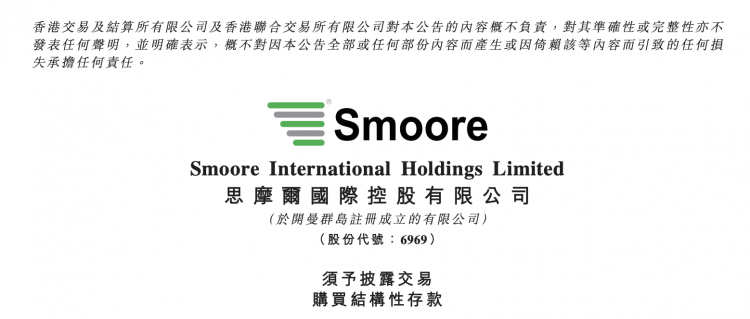
Simaor International signs structured deposit agreement with China Bank for RMB35 billion, to be paid from available cash reserves.

Simo International announced on the Hong Kong Stock Exchange that its wholly-owned subsidiary, Shenzhen Mackwell, has updated its structured deposit agreement with China Bank, effective January 5, 2023. As per the agreement, Shenzhen Mackwell will purchase two structured deposits for a total of RMB 3.5 billion, with amounts of RMB 1.76 billion and RMB 1.74 billion each, respectively, after redeeming RMB 1.5 billion on December 28, 2022. The subscription will be funded by the group's existing cash reserves and free cash flow.


2FIRSTS will continue to follow the developments and bring you updates. Stay tuned.


Disclaimer

This article is provided solely for professional research, industry discussion, and informational purposes. Any references to brands, companies, products, technologies, or policies are made for factual reporting and analytical purposes only, and do not constitute endorsement, recommendation, promotion, or advertising by 2Firsts.

Nicotine-containing products, including but not limited to cigarettes, e-cigarettes, heated tobacco products, and nicotine pouches, carry significant health risks. Readers are responsible for complying with all applicable laws and regulations in their respective jurisdictions, including age restrictions and access limitations.

The information contained in this article should not be regarded as investment, legal, medical, regulatory, or commercial advice. While 2Firsts strives to ensure the accuracy and reliability of its content, it does not assume liability for any direct or indirect loss arising from errors, omissions, inaccuracies, or reliance on the information contained herein.

This article is not intended for individuals below the legal age for accessing tobacco or nicotine-related information in their jurisdiction.


Copyright Notice

This article is either original content produced by 2Firsts or content reproduced, translated, summarized, or adapted from third-party sources with attribution where applicable. The intellectual property rights of the original content remain with 2Firsts or the respective original rights holders.

No individual or organization may copy, reproduce, distribute, republish, modify, translate, or otherwise use this content without prior authorization. Any unauthorized use may result in legal action.

For copyright-related inquiries, corrections, or removal requests, please contact: info@2firsts.com.


AI-Assisted Translation and Editing Notice

Portions of this article may have been translated, edited, or reviewed with the assistance of artificial intelligence tools to improve efficiency and readability. Due to the limitations of AI-assisted translation and editing, discrepancies, omissions, or inaccuracies may exist when compared with the original source.

Where applicable, readers are advised to refer to the original source for the most complete and accurate information. If you identify any errors or believe that any content infringes upon your rights, please contact us at info@2firsts.com, and we will review and address the matter promptly.

Ohio Supreme Court Weighs Whether State Consumer Law Can Restrict Flavored Vape Sales
The Ohio Supreme Court is hearing a case involving flavored vape sales and whether state authorities can use consumer protection laws to take action against retailers selling unauthorized vape products. Ohio officials argue that selling unauthorized flavored vapes may constitute consumer deception, while retailers argue that tobacco product regulation falls under federal Food and Drug Administration (FDA) authority and that states cannot impose additional restrictions through consumer laws. The case could affect the scope of state-level vape regulation across the United States.
Aug.06
South Korea Vape Strategies Diverge as BAT Reconsiders Exit and PMI Takes VEEV to About 14,000 Stores
BAT Rothmans says it previously considered exiting South Korea's vaping market because of competitive pressure from unregulated products, but is now reassessing conditions following changes to the country's nicotine regulatory framework. Vuse and other BAT vaping products remain available through existing distribution channels. The statement followed a South Korean media report that interpreted BAT's broader withdrawal from selected Vapour markets as a full exit from South Korea. Meanwhile, Philip Morris International launched VEEV inPRIME in the country in June and began expanding distribution to around 14,000 convenience stores and other retail channels in July. The contrasting moves highlight differing investment strategies as South Korea's regulated vaping market evolves.
Aug.14
California Lawmakers Pass Disposable Nicotine Vape Ban, With Sales Prohibition Set for 2028
According to CBS Los Angeles on August 27, 2026, California lawmakers have passed Assembly Bill 762, which would phase out disposable, battery-embedded nicotine vapes in the state. If signed by Governor Gavin Newsom, manufacturing and importation of the covered products would be prohibited beginning January 1, 2027, followed by a sales ban on January 1, 2028. Driven primarily by concerns over electronic waste, lithium-battery fires and environmental pollution, the legislation would further shift California’s legal vape market toward rechargeable, refillable or replaceable-pod devices.
Aug.28
EU Tobacco Tax Reform Targets November Push as Sweden Holds Nicotine-Pouch Minimum at €20 per Kilogram
The Irish presidency of the Council of the European Union is using bilateral talks to push the bloc’s Tobacco Taxation Directive toward a political agreement in November. According to Law360, citing an EU official, Sweden is unwilling to accept a minimum excise threshold above €20 per kilogram for nicotine pouches. Council negotiations have already lowered the European Commission’s original proposal, but a May 2026 presidency compromise still set the minimum at 10% of the tax-inclusive retail price or €30 per kilogram in 2028-29, with higher levels later.
Market
Sep.17 by 2Firsts Perspectives
F1 Faces Renewed Pressure Over Tobacco and Nicotine Sponsorships as 67 Groups Target ZYN and VELO Ahead of Madrid Race
Ahead of the Formula 1 race in Madrid, 67 Spanish and international public-health, medical and consumer organizations have sent an open letter to F1 President and CEO Stefano Domenicali calling for an end to sponsorships linked to the tobacco and nicotine industry, including nicotine pouches, vaping products and heated tobacco. The letter focuses on Philip Morris International’s ZYN partnership with Ferrari and British American Tobacco’s long-running partnership with McLaren and exposure for VELO. The campaign follows a March letter in which more than 160 organizations worldwide made a similar request to Formula 1.
Sep.10
China Discloses First Criminal Case Over Counterfeit Vapes Disguised as “Medical Nebulizers” and “Zero-Nicotine” Products
Chinese authorities have disclosed the country’s first reported criminal case involving counterfeit vapes marketed as “medical nebulizers” and “zero-nicotine” products. Authorities determined that the products involved were counterfeit vapes and pursued criminal charges for producing and selling counterfeit goods. According to the report, the case resulted in the seizure of 347,000 counterfeit vape pods and 53,700 vape devices, with physical goods valued at 22.13 million yuan.
Aug.04