South Carolina Considers Ban on Local E-cigarette Laws

Feb.22.2023
South Carolina Considers Ban on Local E-cigarette Laws
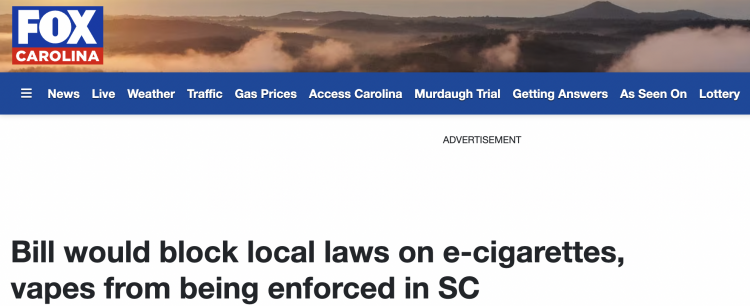
South Carolina state proposes bill to prevent cities and counties from enacting local regulations on e-cigarette sales.

Recently, the South Carolina state legislature proposed a bill that would prohibit cities and counties in South Carolina from creating their own local regulations on e-cigarettes and their sales.


The bill was voted to move forward in the Committee on Medical Affairs and is currently awaiting discussion in the Senate.


Senator Shane Martin, R-Spartanburg, stated, "I believe we need consistent regulations for those selling it, and if these products are not good, they should be banned statewide.


Reference:


A proposed bill aims to prevent the implementation of local ordinances related to e-cigarettes and vapes in South Carolina.


Disclaimer

This article is provided solely for professional research, industry discussion, and informational purposes. Any references to brands, companies, products, technologies, or policies are made for factual reporting and analytical purposes only, and do not constitute endorsement, recommendation, promotion, or advertising by 2Firsts.

Nicotine-containing products, including but not limited to cigarettes, e-cigarettes, heated tobacco products, and nicotine pouches, carry significant health risks. Readers are responsible for complying with all applicable laws and regulations in their respective jurisdictions, including age restrictions and access limitations.

The information contained in this article should not be regarded as investment, legal, medical, regulatory, or commercial advice. While 2Firsts strives to ensure the accuracy and reliability of its content, it does not assume liability for any direct or indirect loss arising from errors, omissions, inaccuracies, or reliance on the information contained herein.

This article is not intended for individuals below the legal age for accessing tobacco or nicotine-related information in their jurisdiction.


Copyright Notice

This article is either original content produced by 2Firsts or content reproduced, translated, summarized, or adapted from third-party sources with attribution where applicable. The intellectual property rights of the original content remain with 2Firsts or the respective original rights holders.

No individual or organization may copy, reproduce, distribute, republish, modify, translate, or otherwise use this content without prior authorization. Any unauthorized use may result in legal action.

For copyright-related inquiries, corrections, or removal requests, please contact: info@2firsts.com.


AI-Assisted Translation and Editing Notice

Portions of this article may have been translated, edited, or reviewed with the assistance of artificial intelligence tools to improve efficiency and readability. Due to the limitations of AI-assisted translation and editing, discrepancies, omissions, or inaccuracies may exist when compared with the original source.

Where applicable, readers are advised to refer to the original source for the most complete and accurate information. If you identify any errors or believe that any content infringes upon your rights, please contact us at info@2firsts.com, and we will review and address the matter promptly.

One Year After UK Disposable Vape Ban: Youth Use Falls to 13%, Adult Use to 8%
among both youth and adults. However, industry groups and regulators warn that the illicit vape market remains a growing concern.
Jun.09
Multi-State Coalition Urges F1 to End Nicotine Sponsorships, Citing Zyn and Velo
Hawaii Attorney General Anne Lopez is co-leading a coalition of 19 states and jurisdictions urging the Fédération Internationale de l’Automobile (FIA) and Formula 1 to end sponsorships involving tobacco and nicotine products, including nicotine pouch brands such as Zyn and Velo.
News
Jun.09
Ispire and Jincheng Pharma Form Joint Venture to Enter Global High-Growth Nicotine Pouch Market
Summary Ispire Technology announced a strategic joint venture with Chinese pharmaceutical company Jincheng Pharma to manufacture and commercialize nicotine pouch products. The partnership combines pharmaceutical-grade production capabilities with Ispire’s global regulatory infrastructure and distribution network as the company expands beyond vaping hardware into oral nicotine products.
Business
May.13
Opinion | As EU Reviews Tobacco Rules, Experts Warn Against Overlooking Smokers’ Alternatives
As the European Commission reviews its tobacco and advertising rules, two experts who provided written comments to 2Firsts argue that future EU policy should not overlook adult smokers’ alternatives. Dr Garrett McGovern and Dr Carmen Escrig say regulators should weigh relative risk, adult switching, flavours, consumer behaviour and scientific uncertainty alongside youth protection.
Industry Insight
Jun.01
Sweden Becomes First EU Country to Reach Smoke-Free Status as Daily Smoking Falls to 4.8%
According to the latest CAN report and multiple media reports, Sweden’s daily smoking rate fell to 4.8% in 2025, below the commonly used 5% smoke-free threshold, making it the first EU country to reach that benchmark.
News
Jun.05
WHO’s First Global Report on Nicotine Pouches: Harm Reduction Questions Remain Amid Global Regulatory Warning
Ahead of World No Tobacco Day 2026, WHO released its first global report on nicotine pouches, warning that rapid market growth, youth-oriented marketing and weak regulation are converging. 2Firsts views the report as an important warning, but not a complete risk assessment, with harm-reduction questions still unresolved.
Special Report
May.17