Key Takeaways
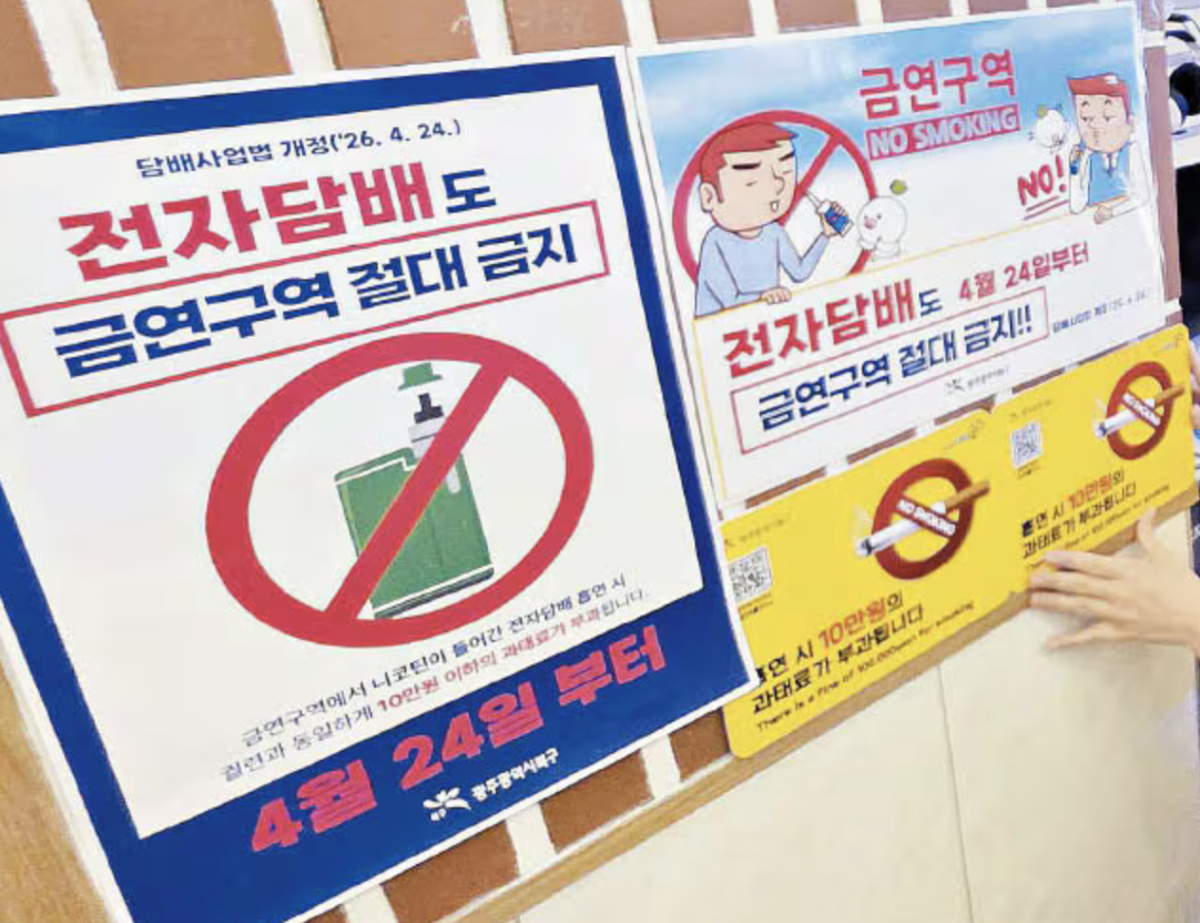
- South Korean local governments had planned to intensively enforce bans on liquid e-cigarette use in smoke-free areas from April 24.
- The revised Tobacco Business Act passed in December last year included liquid e-cigarettes in the legal definition of tobacco and took effect on April 24.
- On the afternoon of April 23, the Ministry of Health and Welfare sent a notice postponing the start of enforcement until after June 23.
- The ministry said the supplementary clause applies only to products reported for shipment or import after April 24, and therefore introduced a two-month guidance period.
- Because of the late policy reversal, some local governments enforced the rules on April 24 while others abandoned enforcement.
2Firsts, April 27,2026
According to Chosun Ilbo, local governments across South Korea recently issued press releases saying they would intensively crack down on the use of liquid e-cigarettes in smoke-free areas.
Previously, liquid e-cigarettes had not been legally classified as tobacco, so enforcement in smoke-free areas had not been possible, with only conventional cigarettes and heated tobacco products subject to such enforcement.
That changed after a revised Tobacco Business Act, passed by the National Assembly in December last year, included liquid e-cigarettes in the legal definition of tobacco and took effect on April 24.
The ministry sent a postponement notice only hours before implementation
However, the report said that on the afternoon of April 23, only hours before the law took effect, the Ministry of Health and Welfare sent an official notice to local governments stating that the start of enforcement would be postponed until after June 23.
This was a reversal from the ministry’s earlier position, as it had sent a notice in February encouraging local governments to carry out field inspections in line with the enforcement date of the revised law.
Local governments were thrown into confusion by the sudden reversal
The local governments that had been preparing for a broad crackdown were thrown into confusion and struggled to clarify the exact meaning of the ministry’s notice. As a result, on April 24 some local governments proceeded with enforcement while others gave it up.
The delay was tied to a supplementary clause in the revised law
The report said the ministry changed its position because of a supplementary clause in the amended law. While the revised law recognizes liquid e-cigarettes as tobacco, it also states that the rule applies only to products reported for shipment or import after the law’s effective date of April 24. The ministry said it would operate a guidance period in order to prevent confusion in the field, since existing inventory not covered by the revised law had not yet been exhausted.
All related regulations were deferred for two months
Under the ministry’s guidance, all regulations related to liquid e-cigarettes were deferred for two months. For example, liquid e-cigarette vending machines are no longer supposed to be installed anywhere without restriction and are required to carry adult-verification devices, but these measures were also delayed by two months.
Local governments questioned the ministry’s preparedness
According to the report, officials at the local level said the supplementary clause had not suddenly appeared and questioned why the ministry had encouraged enforcement two months earlier, only to reverse course one day before implementation.
The report said this was a major policy change related to public health, but the ministry appeared not to have prepared properly for enforcement. It added that some interpretations even suggested the government may have worried about negative public opinion from smoke-free enforcement ahead of the June 3 local elections.
The supplementary clause may continue to cause confusion after the guidance period
The report also said that even after the guidance period ends, the supplementary clause could still create confusion in the field. The main concern is whether it is realistically possible to check the production date of each liquid e-cigarette product during enforcement in smoke-free areas. This could ultimately lead to conflict between enforcement officers and users.
It took nearly a decade for liquid e-cigarettes to be legally recognized as tobacco
The report said it took nearly 10 years for liquid e-cigarettes to be legally recognized as tobacco. During that time, regulation for public health was delayed because of industry lobbying, disagreements among lawmakers on the relevant standing committee, and conflicting interests among government ministries.
The Ministry of Health and Welfare’s decision to introduce a two-month guidance period only hours before the law took effect, according to the report, leaves it open to criticism that it has once again mishandled the issue.
Image Source:
Image source: Chosun Ilbo
We welcome news tips, article submissions, interview requests, or comments on this piece.
Please contact us at info@2firsts.com, or reach out to Alan Zhao, CEO of 2Firsts, on LinkedIn
Notice
1. This article is intended solely for professional research purposes related to industry, technology, and policy. Any references to brands or products are made purely for objective description and do not constitute any form of endorsement, recommendation, or promotion by 2Firsts.
2. The use of nicotine-containing products — including, but not limited to, cigarettes, e-cigarettes, nicotine pouchand heated tobacco products — carries significant health risks. Users are responsible for complying with all applicable laws and regulations in their respective jurisdictions.
3. This article is not intended to serve as the basis for any investment decisions or financial advice. 2Firsts assumes no direct or indirect liability for any inaccuracies or errors in the content.
4. Access to this article is strictly prohibited for individuals below the legal age in their jurisdiction.
Copyright
This article is either an original work created by 2Firsts or a reproduction from third-party sources with proper attribution. All copyrights and usage rights belong to 2Firsts or the original content provider. Unauthorized reproduction, distribution, or any other form of unauthorized use by any individual or organization is strictly prohibited. Violators will be held legally accountable.
For copyright-related inquiries, please contact: info@2firsts.com
AI Assistance Disclaimer
This article may have been enhanced using AI tools to improve translation and editorial efficiency. However, due to technical limitations, inaccuracies may occur. Readers are encouraged to refer to the cited sources for the most accurate information.
We welcome any corrections or feedback. Please contact us at: info@2firsts.com