Key Points
- Proposes a dual-release nicotine system combining immediate and sustained delivery
- Adopts a food-like jelly format, including gel and drinkable forms
- Aims to improve user experience and compliance compared to traditional NRT
- May fall into a regulatory gray zone between food, pharmaceutical, and tobacco categories
- Reflects China Tobacco’s exploration of non-inhalable nicotine formats
2Firsts
Mar 18, 2026,Shenzhen
According to publicly available information on the patent database of China’s National Intellectual Property Administration (CNIPA), China Tobacco Hubei Industrial Co., Ltd. has filed a patent for “a nicotine jelly and its preparation method.”
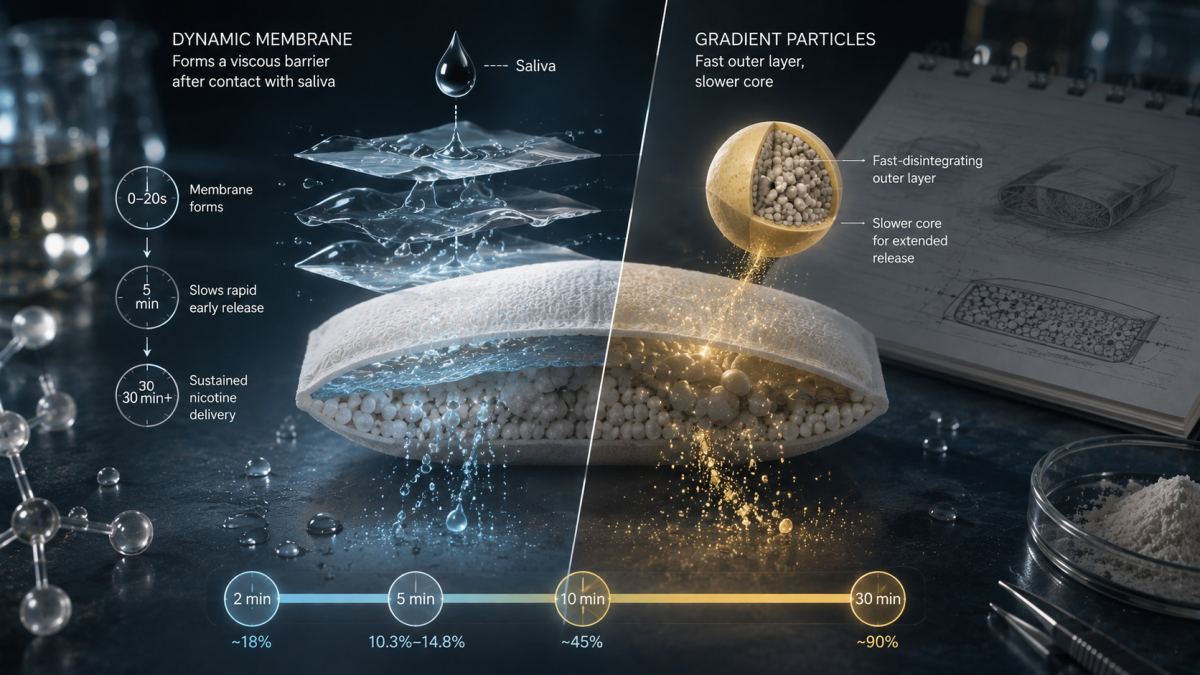
The core innovation lies in a two-component nicotine system consisting of non-encapsulated nicotine for rapid release and microencapsulated nicotine for sustained delivery.
By adjusting the ratio between the two components, ranging from 3:7 to 9:1, the product is designed to modulate nicotine release kinetics in order to address both immediate cravings and baseline dependence. This approach effectively integrates the functional logic of nicotine gum and transdermal patches into a single product format.
From Pouches to Jelly: A New Product Format
The patent describes two primary product forms: a solid gel jelly and a drinkable jelly that can be consumed via a straw or spout.
Each unit is designed to contain approximately 2–4 mg of nicotine, aligning with standard dosage levels commonly used in NRT products.
Compared with inhalable products such as e-cigarettes or heated tobacco, this format represents a shift toward oral, non-inhalable nicotine delivery. The design emphasizes discretion, portability, and improved sensory experience, reflecting broader industry efforts to develop more consumer-friendly product formats.
Ingestible in Form, Oral in Function
Although the product is physically ingestible, its formulation indicates that primary nicotine absorption is intended to occur through the oral mucosa rather than the gastrointestinal tract.
The system incorporates controlled pH conditions, flavoring agents, and gel-based matrices consistent with oral absorption mechanisms. From a pharmacokinetic perspective, nicotine delivered through the gastrointestinal system is subject to first-pass metabolism, which may reduce bioavailability. As a result, the product appears to be designed as an ingestible format with a predominantly oral absorption pathway.
Implications: Convergence Toward NRT Pathways
The patent highlights a broader strategic direction in nicotine product development, moving away from inhalation-based delivery systems toward pharmaceutical-style nicotine delivery approaches.
This suggests an increasing convergence between next-generation nicotine products and NRT, not only in product design but also in potential regulatory positioning.
Limitations and Regulatory Challenges
The product also introduces several technical and regulatory uncertainties, particularly related to its ingestible nature.
First, while the jelly format allows for swallowing, this creates variability in nicotine absorption pathways. Nicotine absorbed through the oral mucosa can provide relatively rapid and predictable delivery, whereas nicotine entering the gastrointestinal tract is subject to first-pass metabolism, potentially reducing bioavailability and leading to inconsistent user experience.
Second, the possibility of swallowing directly affects regulatory classification. If interpreted primarily as an ingestible product, it may fall closer to food or pharmaceutical categories, both of which impose strict restrictions on nicotine-containing products. Conversely, if positioned as an oral mucosal delivery system, it may align more closely with nicotine replacement therapy (NRT) or modern oral products.
This dual characteristic places the product in a regulatory gray zone, where its classification may depend on how regulators interpret its intended use and primary absorption pathway.
In addition, the food-like format, combined with flavoring systems, may raise concerns regarding appeal to minors, while the lack of strict dosing controls typical of medicinal products could increase the risk of overconsumption.
Conclusion
The nicotine jelly patent represents an attempt to integrate controlled nicotine delivery with consumer-oriented product design. Its significance lies not only in its formulation, but also in its indication of a broader shift toward programmable delivery systems and non-inhalable nicotine formats.
Its future development will depend on both technical validation and how regulatory authorities define its classification within the evolving nicotine product landscape.
More updates on the global next-generation nicotine industry are available at 2Firsts.
Cover image generated by AI


Disclaimer
This article is provided solely for professional research, industry discussion, and informational purposes. Any references to brands, companies, products, technologies, or policies are made for factual reporting and analytical purposes only, and do not constitute endorsement, recommendation, promotion, or advertising by 2Firsts.
Nicotine-containing products, including but not limited to cigarettes, e-cigarettes, heated tobacco products, and nicotine pouches, carry significant health risks. Readers are responsible for complying with all applicable laws and regulations in their respective jurisdictions, including age restrictions and access limitations.
The information contained in this article should not be regarded as investment, legal, medical, regulatory, or commercial advice. While 2Firsts strives to ensure the accuracy and reliability of its content, it does not assume liability for any direct or indirect loss arising from errors, omissions, inaccuracies, or reliance on the information contained herein.
This article is not intended for individuals below the legal age for accessing tobacco or nicotine-related information in their jurisdiction.
Copyright Notice
This article is either original content produced by 2Firsts or content reproduced, translated, summarized, or adapted from third-party sources with attribution where applicable. The intellectual property rights of the original content remain with 2Firsts or the respective original rights holders.
No individual or organization may copy, reproduce, distribute, republish, modify, translate, or otherwise use this content without prior authorization. Any unauthorized use may result in legal action.
For copyright-related inquiries, corrections, or removal requests, please contact: info@2firsts.com.
AI-Assisted Translation and Editing Notice
Portions of this article may have been translated, edited, or reviewed with the assistance of artificial intelligence tools to improve efficiency and readability. Due to the limitations of AI-assisted translation and editing, discrepancies, omissions, or inaccuracies may exist when compared with the original source.
Where applicable, readers are advised to refer to the original source for the most complete and accurate information. If you identify any errors or believe that any content infringes upon your rights, please contact us at info@2firsts.com, and we will review and address the matter promptly.