Disclaimer
This article provides an industry-focused overview and analysis of tobacco consumption tax issues for research purposes only. It does not discuss, evaluate or predict Chinese national policy. Any interpretation of China’s national policies should rely on official government releases.
Key Points
- Policy signal: China’s 2026 government work report again called for optimizing the scope and rates of the consumption tax and moving the tax collection stage for some items further downstream.
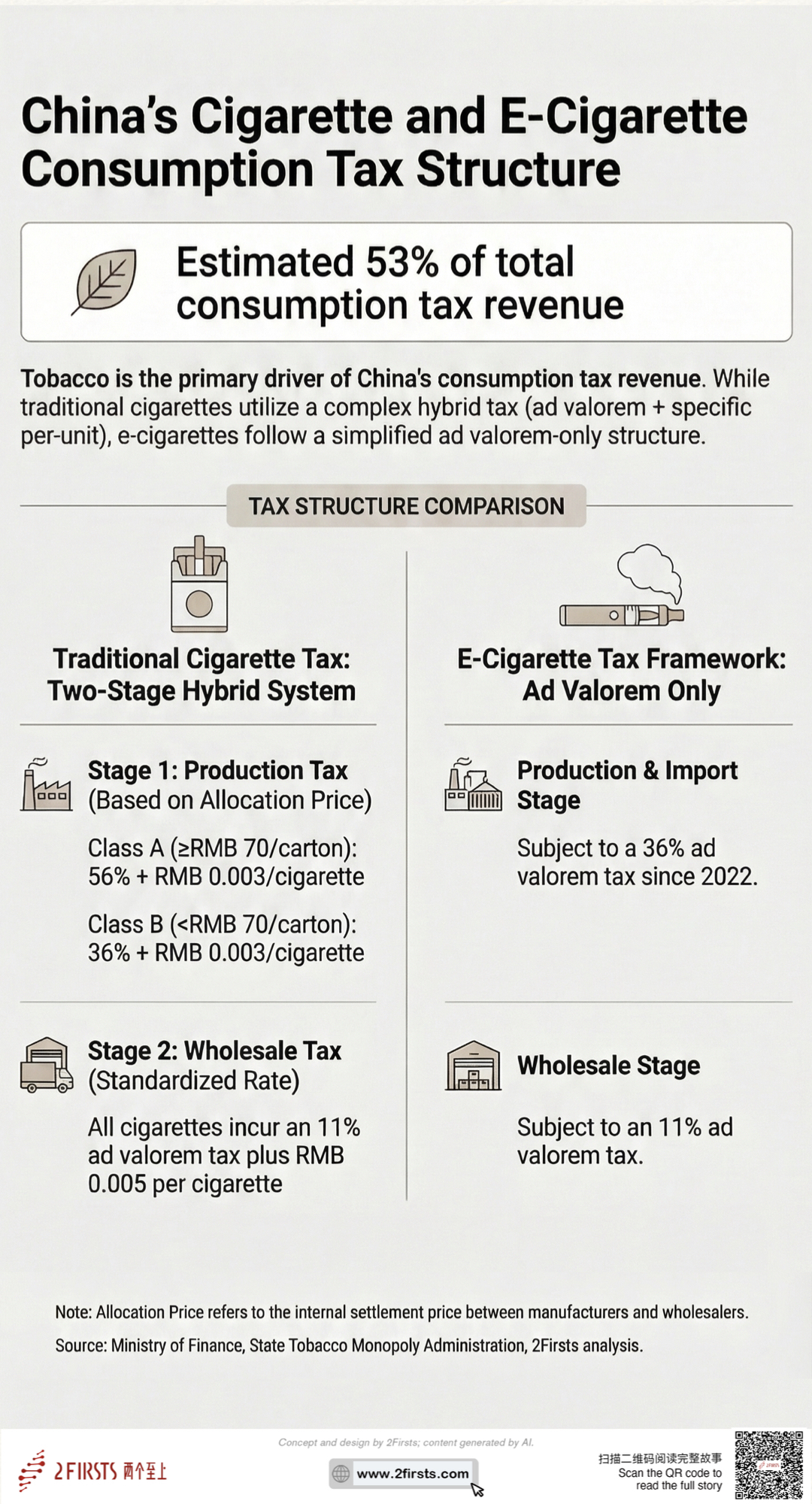
- Tax structure: Tobacco has long been the largest source of China’s consumption tax, accounting for about 53% of total revenue from the tax and representing a significant contributor to state finances.
- Institutional adjustment: China’s most recent major reform of cigarette consumption tax occurred in 2015, when the wholesale-stage ad valorem tax rate was raised from 5% to 11% and a specific tax of RMB 0.005 per cigarette was introduced. The system has remained largely unchanged since then.
- E-cigarette taxation: China began levying consumption tax on e-cigarettes in November 2022, with a 36% rate at the production (or import) stage and 11% at the wholesale stage, formally bringing new tobacco products into the tax framework.
- Policy debate: Academic and tax policy discussions have long examined issues such as shifting the tax collection stage, tax administration complexity, public-health implications and regional fiscal distribution.
- Industry observation: Analysts say that because tobacco remains the largest source of consumption tax revenue, any discussion of its tax structure involves fiscal, industrial and public-health considerations.
2Firsts, March 8, 2026, Shenzhen
During China’s 2026 national “Two Sessions”, consumption tax reform again appeared in the government work report. Premier Li Qiang said on March 5 that China will “improve the local tax system, expand local tax sources, optimize the scope and rates of the consumption tax, and move the tax collection stage for certain items further downstream.”
The report did not specify any particular industry. However, tobacco has long been the largest source of consumption tax revenue in China, meaning discussions about the tax system frequently attract attention from industry participants and policy observers. For domestic and international stakeholders in the tobacco and nicotine sectors, understanding China’s consumption tax framework—and the role of tobacco within it—is an important context for interpreting regulatory and industry developments.
In March 2026, the Fourth Session of the 14th National People’s Congress and the Fourth Session of the 14th Chinese People’s Political Consultative Conference were held in Beijing—collectively known as the “Two Sessions.” The meetings released the annual Government Work Report and reviewed the draft Outline of the 15th Five-Year Plan for National Economic and Social Development. The Two Sessions are widely viewed as a key window for observing China’s macroeconomic policy direction. The renewed reference to consumption tax reform has also drawn attention and media coverage.

Tobacco Remains the Largest Source of China’s Consumption Tax
According to China’s Ministry of Finance Treasury Department report on fiscal revenues and expenditures for 2025, domestic consumption tax revenue reached RMB 1.6857 trillion (about $244 billion, based on an exchange rate of 1 USD = 6.9 RMB) that year.
Regarding the structure of consumption tax revenues, Wang Yi, chief economist at Great Wall Securities, wrote in a study published by Yicai that China’s consumption tax income is highly concentrated. Tobacco accounts for roughly 53% of the total, followed by refined oil products (about 33%), automobile manufacturing (about 7%), and alcohol (about 5%).
Based on that structure, tobacco consumption tax revenue can be estimated at around RMB 890 billion (about $129 billion), making it the single largest contributor within the consumption tax system.
The tobacco sector’s overall fiscal contribution to the Chinese government is even more significant. According to data released by the State Tobacco Monopoly Administration in January 2026, the tobacco industry generated RMB 1.657 trillion (about $240 billion) in combined taxes and profits in 2025, up 3.5% year on year. Total fiscal contributions reached RMB 1.58 trillion (about $229 billion), up 2.3%.
Based on Ministry of Finance data showing China’s general public budget revenue at RMB 21.6045 trillion (about $3.13 trillion) in 2025, the tobacco industry accounted for roughly 7.3% of national fiscal revenue.
Why Consumption Tax Reform Matters for Local Fiscal Policy
Consumption tax reform has been discussed for years in China, partly in the context of broader adjustments to fiscal relations between the central and local governments.
According to a July 2024 report by Caixin, Vice Minister of Finance Wang Dongwei said the ministry was studying plans to move the consumption tax collection stage further downstream and gradually allocate more revenue to local governments, taking into account revenue-sharing arrangements and tax administration capacity.
A March 5, 2026 report by Jiemian News also noted that consumption tax remains one of the few major taxes in China that is still entirely collected by the central government and not shared with local authorities. Some scholars have argued that reforming the tax could help expand local revenue sources.
Against this backdrop, the government work report’s renewed reference to optimizing the consumption tax scope, rates and collection stages is widely viewed as part of China’s ongoing fiscal and tax reform process.
Different Perspectives in the Debate on Consumption Tax Reform
During the Two Sessions, several major Chinese media outlets reported on consumption tax reform and cited expert commentary discussing tobacco consumption tax. In fact, debates over shifting the tax collection stage and adjusting the tobacco consumption tax structure have appeared in policy research for more than a decade.
Within China’s policy and academic discussions, different perspectives have long emerged regarding whether the consumption tax collection stage should be adjusted. These discussions generally focus on three areas: tax administration, public health policy, and regional fiscal distribution.
(1) Tax Administration: Retail Collection Could Increase Enforcement Complexity
According to a 2021 report by China Taxation News, a seminar hosted by the State Taxation Administration’s Tax Science Research Institute on “Deepening Tobacco Consumption Tax Reform” highlighted concerns from tax officials about administrative challenges.
Some researchers from the tax system noted that if tobacco consumption tax were shifted further downstream to the retail level, the number of taxpayers would increase dramatically, potentially raising tax administration costs and complexity. By contrast, collecting the tax at the production and wholesale stages involves a smaller number of taxpayers and allows for more centralized administration.
(2) Public Health Perspective: Tax Structure and Tobacco Control
At the same seminar, Li Weiren, a professor at the University of the Chinese Academy of Social Sciences, presented a perspective from tobacco control policy.
Li noted that the World Health Organization recommends tobacco taxes account for roughly 75% of the retail price of cigarettes. Under that benchmark, he argued that China’s tobacco tax burden still has room to increase.
Citing research data, Li said that between 2016 and 2020 the average cigarette price in China was about RMB 13.5 per pack, representing an increase of less than 10% compared with 2008. After accounting for inflation and rising consumer purchasing power, the real price of cigarettes has effectively declined. From a tobacco control standpoint, Li suggested that increasing the specific (per-unit) tax could be a more effective policy tool.
He also noted that if tobacco consumption tax were moved to the retail stage, local government revenue would become more directly linked to tobacco consumption levels, which could weaken incentives for local governments to promote tobacco control policies.
(3) Fiscal Distribution: Balancing Interests Between Production and Consumption Regions
Another area of discussion concerns how consumption tax revenue would be distributed among different regions.
According to China Taxation News, experts at the same seminar noted that shifting tobacco consumption tax collection to the sales stage and allocating it based on the place of consumption could change the current distribution of tax revenue. Provinces such as Yunnan and Hunan, which are major tobacco production centers, currently contribute a large share of tax revenue, while large consumption regions such as Jiangsu and Zhejiang could potentially receive a greater share under a consumption-based tax model.
In his research, Great Wall Securities chief economist Wang Yi also noted that the design of consumption tax policy involves not only the scale of tax revenue but also broader considerations of fiscal relations between the central and local governments and coordination among regions.
China’s Cigarette Consumption Tax Has Seen No Major Changes in Over a Decade
From a historical perspective, China’s cigarette consumption tax system has remained largely stable in recent years, with the most recent major adjustment occurring in 2015.
Before that, China had already carried out several rounds of reforms to the cigarette consumption tax structure. For example, a 2009 reform adjusted cigarette classification and tax rates. Under the policy at that time, Class A cigarettes—defined as those with an allocation price of RMB 70 per carton or above—were subject to a 56% ad valorem tax, while Class B cigarettes—priced below RMB 70 per carton—were subject to a 36% rate. A 5% ad valorem tax was also introduced at the wholesale stage.
Within China’s tobacco monopoly system, the allocation price refers to the internal settlement price at which tobacco industrial companies (manufacturers) sell cigarettes to tobacco commercial companies (wholesalers). This price serves as the key basis for classifying cigarettes and calculating the consumption tax at the production stage.
The 2015 reform further increased the tax burden at the wholesale stage. According to the Notice on Adjusting the Cigarette Consumption Tax (2015 No. 82) jointly issued by the Ministry of Finance and the State Administration of Taxation, China raised the wholesale-stage ad valorem tax rate from 5% to 11% and introduced a specific tax of RMB 0.005 per cigarette.
Currently, cigarette consumption tax in China is levied at both the production and wholesale stages. At the production stage, the system combines ad valorem and specific taxes: Class A cigarettes are taxed at 56% plus RMB 0.003 per cigarette, while Class B cigarettes are taxed at 36% plus the same specific tax. At the wholesale stage, an 11% ad valorem tax applies, along with the RMB 0.005 per-cigarette specific tax.
Since the 2015 reform, China’s cigarette consumption tax framework has remained broadly unchanged for more than a decade.
E-Cigarettes Have Been Brought into the Consumption Tax Framework
Compared with traditional cigarettes, one of the most significant changes in China’s tobacco taxation system in recent years has been the inclusion of e-cigarettes in the consumption tax regime.
According to the Announcement on the Levying of Consumption Tax on E-Cigarettes (Announcement No. 33 of 2022) issued jointly by the Ministry of Finance, the General Administration of Customs and the State Taxation Administration, China began imposing consumption tax on e-cigarettes on November 1, 2022.
Under the policy, e-cigarettes are subject to a 36% ad valorem tax at the production (or import) stage and an 11% ad valorem tax at the wholesale stage, with the tax base calculated on the basis of sales revenue.
This arrangement effectively brings e-cigarettes into China’s regular consumption tax framework, creating a parallel tax structure alongside that applied to traditional cigarettes.
Unlike e-cigarettes, which are regulated under a framework modeled on cigarette regulation, heated tobacco products (HTPs) and nicotine pouches have been explicitly defined as tobacco products. Their production and distribution in mainland China would therefore follow the same institutional structure as traditional cigarettes and fall within China’s state tobacco monopoly system, under which all such activities are conducted exclusively by the China National Tobacco Corporation (CNTC).
However, as commercial sales of these products have not yet been formally opened in the mainland market, detailed consumption tax policies have not yet been announced.
Industry Perspective: Tobacco Tax Policy Developments Bear Watching
Alan Zhao, co-founder and CEO of 2Firsts, said that tobacco has long been one of the largest sources of consumption tax revenue in China, meaning that developments in the tax policy carry significance for both the industry and the broader fiscal system.
Zhao noted that discussions around tobacco consumption tax reform involve complex considerations. For example, potential adjustments to the tax collection stage could affect the structure of China’s tobacco industrial and commercial systems, and may also influence local government attitudes toward tobacco production and consumption.
He added that it is still too early to draw conclusions about specific policy changes, as factors including macroeconomic conditions, developments in the traditional tobacco sector and changes in the emerging nicotine product market could all influence the direction of policy discussions.
Zhao said it is clear, however, that research and policy debate surrounding tobacco consumption tax will likely continue. These discussions are also linked to broader policy frameworks such as the high-quality development of China’s tobacco industry and the country’s “Healthy China” strategy.
For continuing coverage of China’s tobacco regulation, industry developments and market trends, follow 2Firsts.
Cover image generated by AI

Disclaimer
This article is provided solely for professional research, industry discussion, and informational purposes. Any references to brands, companies, products, technologies, or policies are made for factual reporting and analytical purposes only, and do not constitute endorsement, recommendation, promotion, or advertising by 2Firsts.
Nicotine-containing products, including but not limited to cigarettes, e-cigarettes, heated tobacco products, and nicotine pouches, carry significant health risks. Readers are responsible for complying with all applicable laws and regulations in their respective jurisdictions, including age restrictions and access limitations.
The information contained in this article should not be regarded as investment, legal, medical, regulatory, or commercial advice. While 2Firsts strives to ensure the accuracy and reliability of its content, it does not assume liability for any direct or indirect loss arising from errors, omissions, inaccuracies, or reliance on the information contained herein.
This article is not intended for individuals below the legal age for accessing tobacco or nicotine-related information in their jurisdiction.
Copyright Notice
This article is either original content produced by 2Firsts or content reproduced, translated, summarized, or adapted from third-party sources with attribution where applicable. The intellectual property rights of the original content remain with 2Firsts or the respective original rights holders.
No individual or organization may copy, reproduce, distribute, republish, modify, translate, or otherwise use this content without prior authorization. Any unauthorized use may result in legal action.
For copyright-related inquiries, corrections, or removal requests, please contact: info@2firsts.com.
AI-Assisted Translation and Editing Notice
Portions of this article may have been translated, edited, or reviewed with the assistance of artificial intelligence tools to improve efficiency and readability. Due to the limitations of AI-assisted translation and editing, discrepancies, omissions, or inaccuracies may exist when compared with the original source.
Where applicable, readers are advised to refer to the original source for the most complete and accurate information. If you identify any errors or believe that any content infringes upon your rights, please contact us at info@2firsts.com, and we will review and address the matter promptly.