Key Points
- Russia has scaled back plans for a nationwide vaping ban, proposing instead a pilot ban limited to a single region.
- The policy shift follows internal government debate and sustained pushback from business groups warning of economic damage and rising illegal trade.
- Lawmakers say the regional experiment is intended to test the impact of restrictions in a controlled environment before any broader rollout.
- While a full ban has lost momentum, regulators are moving ahead with tighter packaging and design rules aimed at reducing youth appeal.
2Firsts, January 22, 2026
By Vladislav Vorotnikov
Russian lawmakers have scaled back plans for a nationwide ban on electronic cigarettes, shifting instead toward discussions of a limited regional experiment after sustained pushback from business groups warning of economic damage and a surge in illegal trade.
Draft amendments submitted during the bill’s second reading have fueled debate over whether vape sales should be restricted on a regional basis, with local media and lawmakers citing the Nizhny Novgorod region as a possible pilot area. No final decision has yet been adopted.
The bill, which passed its first reading in November 2025, has undergone several significant revisions.

Originally intended to underpin a nationwide ban, the initiative was later reworked by the Finance Ministry into a broader proposal that would allow Russian regions to impose their own restrictions on vape sales between September 1, 2026 and September 1, 2031. Lawmakers have since discussed narrowing that approach further by testing restrictions in a single region.
The shift — widely viewed as a compromise between tougher measures advocated by the Healthcare Ministry and senior officials, and concerns raised by the government’s financial bloc — has nonetheless continued to draw criticism from small businesses.
Business backlash
Amid sharp criticism from business groups, including Opora Rossii, Russian lawmakers proposed limiting the vaping ban to a single-region pilot.
In a letter to the Russian government, Opora Rossii warned that to give the regions right to ban vapes contradicts the key goal of the reform which is economic cleansing.
“All initiatives to ban vaping will lead to the complete closure of the nicotine-containing product market, worth approximately Rub 280 billion ($3.5 billion),” warned Kirill Kuznetsov, a member of the Opora Rossii’s Presidium.
Russian business cites the example of Kazakhstan and Kyrgyzstan, where restriction on selling vapes, designed to lower their consumption have created a black market of these products, while failing to decrease the number of smokers.
Moreover, the adoption of the amendments allowing Russian regions to independently ban vapes would contradict the basic Russian open market rules.
For example, the law would go against the Law on the Fundamentals of Trade Activity, which guarantees that free movement of goods across the entire Russian territory. In fact, Kuznetsov explained, the proposed changes would require the adopting of an independent federal law that would change the basic rules of trade relations in Russia.
In a separate statement on its website, Opora Rossii also warned that the restrictions on selling vapes will lead to a rise in illegal sales.
For example, such fears were voiced by Alexander Porokhnya, Chairman of the Opora Rossii’s branch in Mari El, a Russian region: "There are legitimate concerns that a ban on the sale of vapes in the region will directly and actively contribute to the growth of their illegal sales. In this case, it is necessary to develop a comprehensive approach to monitoring the sale of such products and take measures to prevent illegal sales, especially to minors."
A controlled environment
The proposed plan to ban vapes in a single region is a reasonable step, Russian analysts believe.
"Any experiment only makes sense when it has a clear methodology, measurable indicators, and the ability to evaluate the results," Artem Kiryanov, member of State Duma, and one of the authors of the initiative told Russian Forbes.
The choice of Nizhny Novgorod makes perfect sense. The anti-vaping campaign is actively supported by the regional authorities. Besides, located in the European part of Russian Nizhny Novgorod is a large metropolitan area, has a developed retail infrastructure, and has the ability to track flows from neighboring territories, Kiryanov explained.
Before the restrictions can be introduced the Russian legislators want to develop specific metrics that need to be measured during the experiment. The key parameters of the initiative success will be the decrease in vaping among teenagers, the shadow market dynamics and other change in consumption patterns.
"When they propose granting authority to all 89 regions at once, it's no longer an experiment; it's chaos. We'll end up with 89 different legal regimes with no way to compare or evaluate anything," Kiryanov said.
After months of debate, lawmakers appear to have settled on a compromise that has drawn support even from some critics of the restrictions, with opponents backing the idea of testing the ban in a limited and controlled setting.
For instance, Evgeny Fedotov, head of the tobacco consulting agency Fedotov Group, said that the experiment is designed to test a hypothesis in a limited controlled environment, collect objective data, establish clear performance metrics, and assess all possible consequences, both planned and unforeseen.
This approach, Fedotov stated, would let to draw definitive conclusions on whether the restrictions can work or not.
According to observers, Russian lawmakers chose a careful approach to proceed with anti-vaping camping after the initiative to impose a dry law in Vologda region embarked on by local authorities in March 2025 brought controversial results.
Various reports indicated that harsh restrictions on selling alcohol in the region triggered a surge in illegal trafficking and a switch of demand to illegal segment of the market with unpredictable product quality.
Against this background, it seems that the idea of a complete ban on selling vapes in Russia, which dominated the agenda during the most part of 2025 is no longer on the table.
"The ban doesn't eliminate demand; it eliminates control,” Kiryanov emphasized. “Products will disappear into the shadows: Telegram channels instead of licensed outlets, counterfeit products with unknown ingredients instead of labeled products, sales to everyone without age verification."
New restrictions on the horizon
While there is no certainty regarding to trade restrictions, Russian tobacco market regulators has recently made it clear it targets to tighten requirements for packaging and design of vapes, according to the Russian state news outlet Tass.
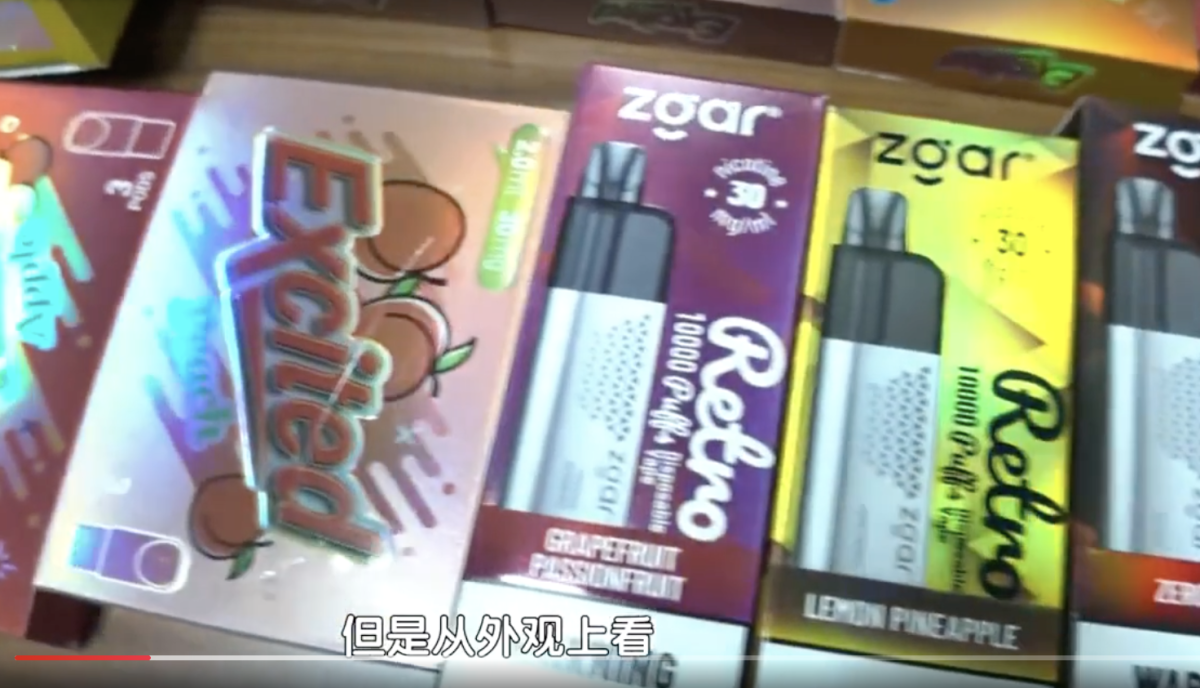
In particular, under the new rules, that are due to be adopted in early 2026, the majority of the packaging should be devoted to information about the negative consequences of smoking, Anton Shalayev, head of Rosstandart, a Russian consumer goods market regulator has revealed. In addition, the design of vapes should not imitate gaming elements.
"Regular cigarettes often have a significant portion of their packaging occupied by negative images depicting the dangers of smoking. This isn't the case with vapes,” Shalayev said, adding that vapes packaging should not contain attention grabbing images.
Additional measures aimed at making vapes less attractive to young consumers are already being discussed, Shalayev said, without providing additional details.
For now, the retreat suggests that a full nationwide ban — once a central plank of Russia’s public health agenda in 2025 — has lost momentum. Yet in Russia’s often unpredictable legislative environment, the shift toward a limited experiment offers no assurance of long-term restraint. As practice shows, major regulatory decisions are frequently revisited as political priorities change, and initiatives shelved under pressure can quickly return to the agenda in a tougher form.
For continued coverage of tobacco and nicotine policy and market developments in Russia and Eastern Europe, follow 2Firsts.
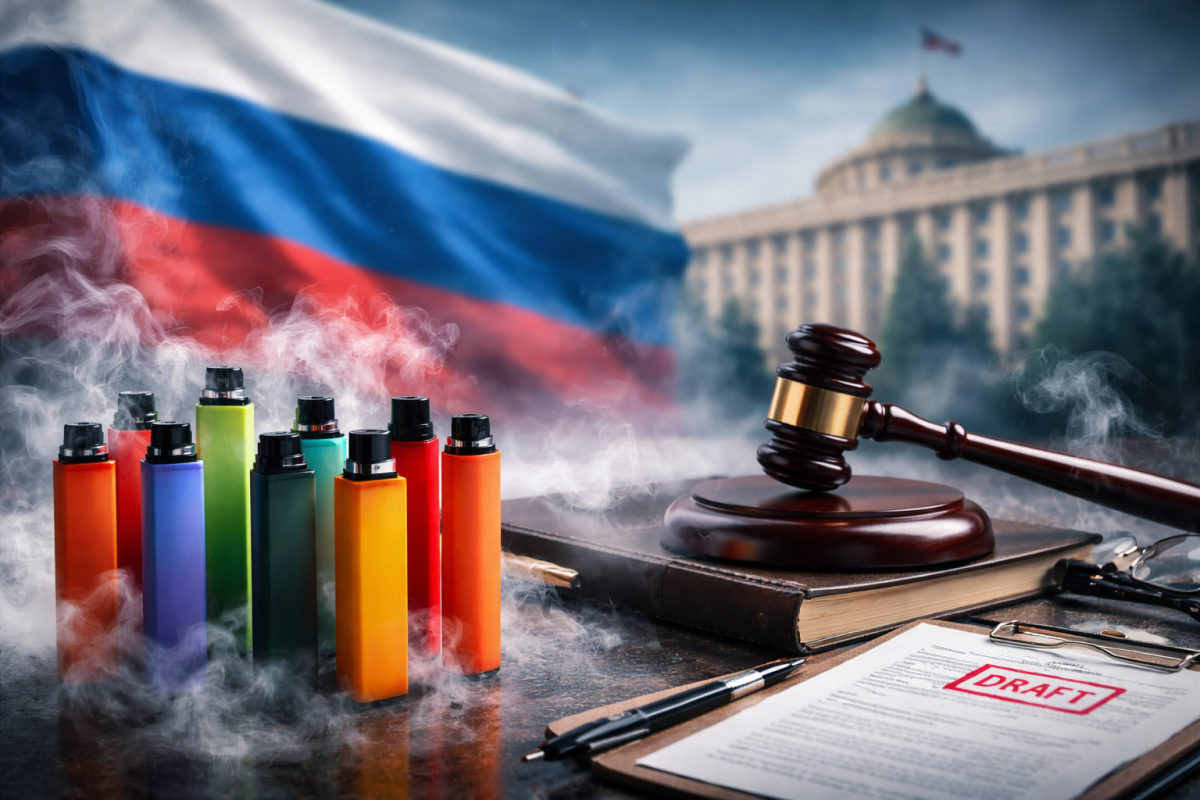
Cover image generated by ChatGPT
Related readings: