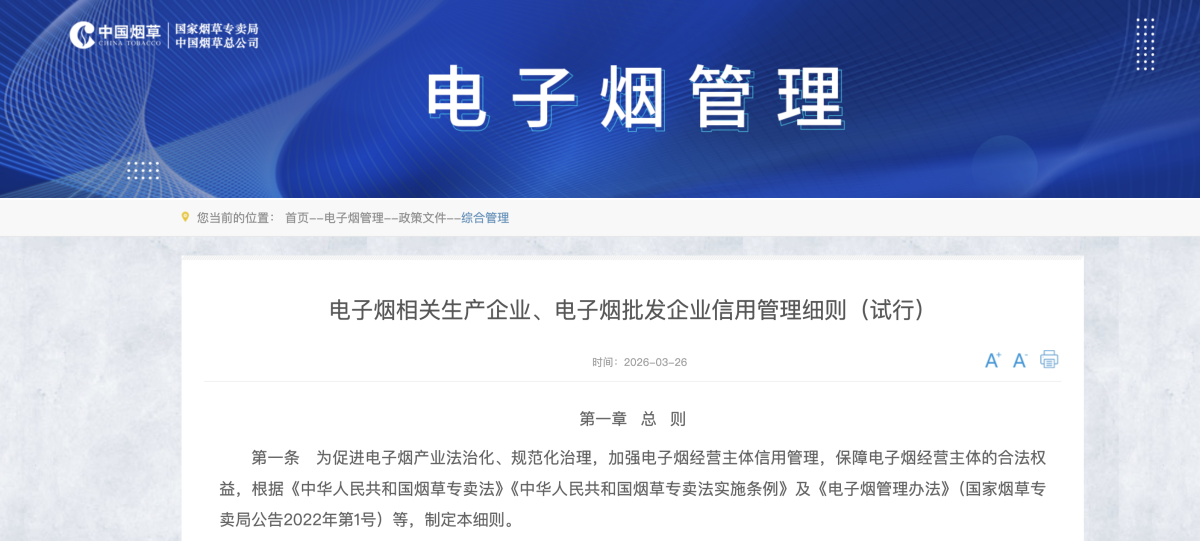
Detailed Rules for Credit Management of E-Cigarette-Related Manufacturing Enterprises and E-Cigarette Wholesale Enterprises (Trial)
Chapter I General Provisions
Article 1
These Detailed Rules are formulated in accordance with the Tobacco Monopoly Law of the People’s Republic of China, the Implementing Regulation of the Tobacco Monopoly Law of the People’s Republic of China, the Measures for the Administration of E-Cigarettes (Announcement No. 1 of 2022 of the State Tobacco Monopoly Administration), and other relevant provisions, in order to promote law-based and standardized governance of the e-cigarette industry, strengthen credit management of e-cigarette business entities, and protect the lawful rights and interests of e-cigarette business entities.
Article 2
These Detailed Rules shall apply to the work of credit recording, credit evaluation, tiered and classified management, credit restoration, and other credit management activities carried out by tobacco monopoly administrations at all levels in the lawful performance of their duties of e-cigarette supervision and administration with respect to e-cigarette-related manufacturing enterprises and e-cigarette wholesale enterprises.
For the purposes of these Detailed Rules, “e-cigarette-related manufacturing enterprises” refer to business entities that have lawfully obtained a tobacco monopoly production enterprise license and are legally qualified to carry out e-cigarette-related production and business operations; “e-cigarette wholesale enterprises” refer to business entities that have lawfully obtained a tobacco monopoly wholesale enterprise license and are legally qualified to carry out e-cigarette wholesale operations. Hereinafter, “enterprises” refers collectively to e-cigarette-related manufacturing enterprises and e-cigarette wholesale enterprises.
For the purposes of these Detailed Rules, “credit information” refers to information that can be used to identify, analyze, and assess the credit status of an enterprise, generally including basic information of the enterprise, public credit information, regulatory information, and information on dishonest conduct.
Article 3
The principles of administration according to law and regulations, protection of rights and interests, coordinated co-governance, and overall advancement shall be upheld to establish an effective enterprise credit management system, give full play to the foundational role of credit in innovating regulatory mechanisms and improving regulatory capacity and standards, and promote honesty and trustworthiness as a value orientation and conscious pursuit of enterprises.
Article 4
The State Tobacco Monopoly Administration shall be responsible for overall coordination of credit management for e-cigarette business entities nationwide, formulating and organizing the implementation of enterprise credit management policies, establishing the Enterprise Credit Management System (hereinafter referred to as the “Credit Management System”) as the principal vehicle for implementing enterprise credit management, and implementing tiered and classified management of enterprises.
Provincial-level tobacco monopoly administrations shall be responsible for coordinating and implementing enterprise credit management within their respective administrative regions; formulating enterprise credit management measures within their respective administrative regions; collecting and recording relevant credit information and dishonest conduct information of enterprises in the lawful performance of regulatory duties; reviewing enterprise credit information within their respective administrative regions; identifying dishonest conduct information of enterprises within their respective administrative regions; verifying relevant objections and appeals of enterprises; reviewing applications for credit restoration; implementing tiered and classified management of enterprises; and guiding subordinate tobacco monopoly administrations in carrying out enterprise credit management.
Municipal- and county-level tobacco monopoly administrations shall be responsible for relevant enterprise credit management work within their respective administrative regions; collecting and recording relevant credit information and dishonest conduct information of enterprises in the lawful performance of regulatory duties; assisting their respective provincial-level administrations in verifying relevant objections and appeals of enterprises, applications for credit restoration, and other such matters; and organizing integrity education for enterprises.
Chapter II Collection of Credit Information and Determination of Dishonest Conduct
Article 5
The collection of enterprise credit information shall follow the principles of legality, propriety, necessity, and data minimization, and shall be carried out in accordance with laws and regulations. Relevant provisions on safeguarding state secrets, protecting trade secrets, and protecting personal privacy shall be strictly observed, and the security protection and privacy protection of credit information shall be strengthened.
Article 6
Sources of enterprise credit information collection include: the National Credit Information Sharing Platform, the “Credit China” website, local credit information sharing platforms and credit websites (hereinafter collectively referred to as “credit platform websites”), as well as enterprise credit information generated and obtained by tobacco monopoly administrations at all levels in the performance of their e-cigarette regulatory duties and provision of public services.
Article 7
Tobacco monopoly administrations at all levels shall collect enterprise credit information lawfully obtained or formed in the course of performing regulatory duties and record such information in the Credit Management System. The scope of enterprise credit information includes:
(1) Basic information, to be collected and recorded by the municipal- and county-level tobacco monopoly administration where the enterprise is located:
Registration information;
Information on obtaining e-cigarette-related administrative licenses.
(2) Public credit information, to be collected and recorded by the municipal- and county-level tobacco monopoly administration where the enterprise is located:
Information on judicial judgments and enforcement;
Information on inclusion in the list of dishonest judgment debtors subject to enforcement and restriction on high consumption;
Information on inclusion in the list of enterprises with abnormal business operations;
Information on inclusion in the list of seriously dishonest entities;
Information on administrative penalties or dispositions imposed for violation of mandatory requirements relating to work safety and other related requirements.
(3) E-cigarette regulatory information, to be collected and recorded by tobacco monopoly administrations at all levels:
Information on administrative penalties or dispositions imposed by tobacco monopoly administrations;
Information on enterprise supervision and inspection, e-cigarette-related quality supervision spot checks, and corresponding handling results conducted by tobacco monopoly administrations;
Information on compliance with e-cigarette laws and regulations, e-cigarette regulatory policies, and e-cigarette industry policies.
(4) Other information, to be collected and recorded by tobacco monopoly administrations at all levels:
Information on the fulfillment of credit commitments made to tobacco monopoly administrations;
Other information reflecting the credit status of enterprises and their employees.
Article 8
“Dishonest conduct” refers to conduct identified by judicial organs or administrative organs as violating relevant laws, administrative regulations, rules, or other provisions, for which administrative penalties or dispositions are imposed in accordance with laws and regulations. Where an enterprise commits any of the following acts, such act shall be identified as dishonest conduct:
Illegally engaging in e-cigarette-related production or business operations, or violating e-cigarette-related laws, regulations, or regulatory policies, or violating mandatory requirements relating to work safety and other related requirements, and being subject to administrative penalties or dispositions;
Refusing to perform or evading the enforcement of an effective judgment or decision made by a judicial organ or administrative organ, and being subject to administrative penalties or dispositions;
In the course of engaging in e-cigarette-related production or business operations, being identified as having engaged in dishonest conduct by other judicial organs or administrative organs, and such conduct being publicly disclosed on “credit platform websites” or notified to a tobacco monopoly administration in accordance with prescribed procedures;
Other conduct that shall be identified as dishonest.
Article 9
Dishonest conduct information shall be subject to classified management according to the severity of dishonesty, and shall be categorized into three classes: minor, general, and serious, with different disclosure periods prescribed respectively. Where the same dishonest conduct information involves multiple types of penalties or dispositions, the disclosure period shall be determined according to the longest applicable period. Where laws, regulations, or policy documents of the CPC Central Committee or the State Council provide otherwise, such provisions shall prevail.
Where an enterprise is determined by judicial organs or administrative organs other than tobacco monopoly administrations to have committed minor, general, or serious dishonest conduct, such classification shall apply; where no classification is explicitly specified, Articles 10, 11, and 12 of these Detailed Rules shall apply.
Article 10
For the purposes of these Detailed Rules, “minor dishonest conduct information” includes:
Information on administrative penalties imposed on an enterprise under summary procedures;
Information on warnings or public criticisms imposed on an enterprise as administrative penalties under ordinary procedures;
Information on administrative penalties imposing fines of less than RMB 50,000 on an enterprise in accordance with relevant provisions;
Information on administrative penalties confiscating unlawful gains of less than RMB 50,000 from an enterprise in accordance with relevant provisions;
Information on lawful inclusion of an enterprise in the list of enterprises with abnormal business operations;
Information on administrative dispositions such as regulatory interviews or orders for rectification imposed by a tobacco monopoly administration for an enterprise’s unlawful or non-compliant conduct;
Other circumstances of minor dishonesty as prescribed by the State Tobacco Monopoly Administration.
In principle, minor dishonest conduct information shall not be publicly disclosed. Where the determining authority deems public disclosure truly necessary, the disclosure period shall not exceed three months.
Article 11
For the purposes of these Detailed Rules, “general dishonest conduct information” includes:
Information on administrative penalties imposing fines of RMB 50,000 or more but less than RMB 200,000 on an enterprise in accordance with relevant provisions;
Information on administrative penalties confiscating unlawful gains of RMB 50,000 or more but less than RMB 200,000 from an enterprise in accordance with relevant provisions;
Information on administrative penalties involving confiscation of illegal property;
Information on administrative dispositions imposed by a tobacco monopoly administration for an enterprise’s unlawful or non-compliant conduct, such as suspension of trading qualifications on the national unified e-cigarette transaction management platform;
Information showing that, within the most recent 12 months, the enterprise has, due to unlawful or non-compliant engagement in e-cigarette-related production or business operations, been subject to more than two administrative dispositions by a tobacco monopoly administration, or to a cumulative total of more than three administrative dispositions by a tobacco monopoly administration and other administrative law enforcement authorities;
Other circumstances of general dishonesty as prescribed by the State Tobacco Monopoly Administration.
In principle, the disclosure period for general dishonest conduct information shall be no less than three months and no more than one year.
Article 12
For the purposes of these Detailed Rules, “serious dishonest conduct information” includes:
Information on lawful inclusion in the list of seriously dishonest entities;
Information on administrative penalties imposing fines of RMB 200,000 or more on an enterprise in accordance with relevant provisions;
Information on administrative penalties confiscating unlawful gains of RMB 200,000 or more from an enterprise in accordance with relevant provisions;
Information on administrative penalties such as temporary suspension of permits or licenses, downgrading of qualification grades, revocation of permits or licenses, restrictions on carrying out production and business activities, orders to suspend production or business operations, orders to close down, or restrictions on practicing an occupation;
Information showing that, within the most recent 12 months, the enterprise has, due to unlawful engagement in e-cigarette-related production or business operations, been subject to more than two administrative penalties by a tobacco monopoly administration, or to a cumulative total of more than three administrative penalties by a tobacco monopoly administration and other administrative law enforcement authorities;
Other circumstances of serious dishonesty as prescribed by the State Tobacco Monopoly Administration.
In principle, the disclosure period for serious dishonest conduct information shall be no less than one year and no more than three years.
Article 13
The collection of enterprise credit information and the determination of enterprise dishonest conduct shall follow the procedures below:
In e-cigarette regulatory work, a tobacco monopoly administration shall collect enterprise credit information in real time by reference to the scope of enterprise credit information collection and record it through the Credit Management System. Where relevant credit information shall be determined as dishonest conduct information, such information shall be recorded concurrently upon collection, thereby forming enterprise credit information records as an important basis for implementing enterprise credit management.
A tobacco monopoly administration shall collect enterprise credit information based on lawful, valid, and sufficient evidentiary materials. Enterprise dishonest conduct information shall be collected based on legally effective documents, including effective judicial judgments and arbitral awards, decision documents on administrative acts such as administrative penalties and administrative rulings, as well as other documents that may serve as the basis for determining dishonest conduct as provided by laws, regulations, or policy documents of the CPC Central Committee or the State Council.
After a provincial-level tobacco monopoly administration reviews and determines enterprise dishonest conduct information in the Credit Management System in accordance with the provisions, the system shall automatically disclose such information and the relevant disclosure period shall take effect.
Chapter III Credit Evaluation and Tiered and Classified Management
Article 14
Enterprise credit grades shall be determined on the basis of enterprise credit information and dishonest conduct information. Enterprise credit grades are divided into four levels: A, B, C, and D, ranked from high to low.
An enterprise with no publicly disclosed dishonest conduct information shall be rated Grade A;
An enterprise with only publicly disclosed minor dishonest conduct information shall be rated Grade B;
An enterprise with publicly disclosed general dishonest conduct information but no serious dishonest conduct information shall be rated Grade C;
An enterprise with publicly disclosed serious dishonest conduct information shall be rated Grade D.
Article 15
Within the scope of their powers, tobacco monopoly administrations at all levels shall implement the following tiered and classified management measures with respect to enterprises’ dishonest conduct:
For enterprises rated Grade B, C, or D, enterprise dishonest conduct information shall be disclosed on the Credit Management System and other credit platform websites in accordance with provisions.
For enterprises rated Grade B, C, or D, enterprise applications shall be subject to strict review in the approval of e-cigarette-related administrative licenses and administrative matters, and the enjoyment of facilitation measures such as notification-and-commitment arrangements shall be restricted.
For enterprises rated Grade C or D, tobacco monopoly administrations at all levels shall include them as key regulatory targets and increase the proportion and frequency of random inspections and examinations in law enforcement work such as routine e-cigarette regulation, market supervision, and quality supervision.
At the stage of approval for license renewal (replacement), for enterprises rated Grade C, in principle the approved validity period of the license shall not exceed one year; for enterprises rated Grade D other than those rated Grade D due to the circumstances specified in Item 1, Paragraph 1 of Article 12 of these Detailed Rules, in principle the approved validity period of the license shall not exceed six months.
For enterprises rated Grade C or D, during the disclosure period, applications for fixed asset investment, increases in approved e-cigarette-related production capacity, and approved production scale shall be subject to strict examination and approval.
For enterprises rated Grade D due to the circumstances specified in Item 1, Paragraph 1 of Article 12 of these Detailed Rules, where they apply for matters relating to a tobacco monopoly production enterprise license such as new issuance (re-application), alteration, or renewal (replacement), no license shall be issued in accordance with the relevant provisions of the Detailed Rules for the Administration of Tobacco Monopoly Licenses for E-Cigarette-Related Production Enterprises and Wholesale Enterprises.
Other measures. For enterprises rated Grade B, C, or D, corresponding management measures shall be adopted in accordance with laws, administrative regulations, and policy documents of the CPC Central Committee or the State Council.
Article 16
Upon expiration of the maximum disclosure period for dishonest conduct information, the Credit Management System shall in principle automatically cease disclosure, and the impact of the relevant dishonest conduct information on the enterprise’s credit grade shall be correspondingly removed. Where dishonest conduct information has reached the maximum disclosure period but the enterprise has not corrected the dishonest conduct or has not fully performed the relevant obligations, disclosure of such dishonest conduct information shall not cease. Where dishonest conduct information involves a penalty or disposition with an attached term, disclosure of such dishonest conduct information shall not cease before expiration of the relevant term. Where laws, administrative regulations, or policy documents of the CPC Central Committee or the State Council provide otherwise, such provisions shall prevail.
Article 17
An enterprise that has engaged in dishonest conduct shall conscientiously make corrections within the prescribed period. Within the scope of their powers, tobacco monopoly administrations shall supervise and urge enterprises to make corrections and eliminate adverse effects. Where an enterprise refuses to comply with the decisions set forth in administrative instruments or fails to make corrections within the prescribed period, further penalties or dispositions shall be imposed in accordance with laws and regulations, and such further penalties or dispositions shall be recorded in the enterprise’s credit information and dishonest conduct information in accordance with these Detailed Rules.
Article 18
Tobacco monopoly administrations at all levels shall incorporate enterprise credit grades into regulatory activities such as the “Double Random, One Public” supervision regime, special operations, and law enforcement inspections, and shall establish and improve a differentiated regulatory mechanism based on credit grading and classification. For enterprises rated Grade A, the proportion and frequency of random inspections may be reasonably reduced, and facilitation measures such as notification-and-commitment arrangements may be implemented as appropriate.
Article 19
All types of e-cigarette business entities may, in accordance with laws and regulations, inquire into and use enterprise credit information publicly disclosed in the Credit Management System, and may refer to and use such information in market activities such as e-cigarette-related production and business operations, supplier selection, purchase and sales transactions, and product introduction and placement, so as to jointly guide and foster an environment of honest business operation.
Chapter IV Credit Restoration and Protection of Rights and Interests
Article 20
For the purposes of these Detailed Rules, “credit restoration” means that, in order to actively improve its own credit status, an enterprise, after correcting its dishonest conduct and performing relevant obligations, has the tobacco monopoly administration cease public disclosure, cease sharing, and cease use of dishonest conduct information in accordance with the provisions, and simultaneously lift tiered and classified management measures in accordance with laws and regulations.
Article 21
Where an enterprise applies for credit restoration before the expiration of the disclosure period for dishonest conduct information, it shall simultaneously meet the following conditions:
It has corrected the dishonest conduct and has fully performed the obligations prescribed in connection with the dishonest conduct, including administrative penalties or dispositions, inclusion in the list of enterprises with abnormal business operations, or the list of seriously dishonest entities;
For minor dishonest conduct information, an application for restoration may be made once the statutory liabilities have been fully performed; for general dishonest conduct information and serious dishonest conduct information, the minimum disclosure period for dishonest conduct information as prescribed in these Detailed Rules shall have been reached;
It has made a credit commitment, the content of which shall include a commitment that the submitted materials are true and valid, and a clear willingness to bear the corresponding liability for breach of the commitment;
Other conditions required by laws, administrative regulations, departmental rules, and the like.
Credit restoration shall not be granted under any of the following circumstances:
Fraud, fabrication, concealment of facts, or other such conduct exists in the process of applying for credit restoration;
The enterprise is again determined to have engaged in dishonest conduct during the process of applying for credit restoration;
The enterprise has been determined by another judicial organ or administrative organ to have engaged in dishonest conduct and such determination has not yet been lifted;
Credit restoration is expressly prohibited by laws, administrative regulations, or policy documents of the CPC Central Committee or the State Council.
Article 22
Where an enterprise seeks credit restoration before the expiration of the disclosure period for dishonest conduct information, the following procedures shall apply:
Application. The enterprise may submit an application for restoration of credit information to the provincial-level tobacco monopoly administration at the place of its domicile by on-site submission, mailing of materials, or other means. Application materials shall include supporting materials proving full performance of statutory liabilities and obligations, as well as a letter of credit commitment. The application materials shall explain the correction of dishonest conduct, the performance of relevant obligations, and the establishment and implementation of measures and related management systems for preventing dishonest conduct, and shall bear the applicant’s official seal on each page.
Acceptance. The provincial-level tobacco monopoly administration shall make a decision on whether to accept the application within three working days from the date of receipt of the application for credit restoration. Where the application materials are complete and meet the requirements, the application shall be accepted. Where the application materials are incomplete or do not meet the requirements, the applicant for credit restoration shall be informed in a one-time notice of the materials that need to be supplemented or corrected. Where a decision is made not to accept the application, the applicant shall be informed and the reasons shall be explained.
Review. Upon receiving application materials that satisfy the formal requirements, the provincial-level tobacco monopoly administration shall conduct a review in accordance with laws and regulations. Where credit restoration is not approved, the reasons shall be explained; where credit restoration is approved, the relevant information shall be promptly synchronized to the Credit Management System. The provincial-level tobacco monopoly administration shall make a decision on credit restoration within seven working days from the date of acceptance of the application for credit restoration; where the circumstances are complex or verification is required and a decision cannot be made within the prescribed period, the period may be extended by ten working days.
Restoration. After the provincial-level tobacco monopoly administration approves the enterprise’s credit restoration, the Credit Management System shall remove the corresponding dishonest conduct information of the enterprise and adjust the credit rating simultaneously.
Article 23
Where an applicant for credit restoration has objections to a decision not to accept a credit restoration application, a decision not to grant restoration, or errors in the publicly disclosed content of dishonest conduct information or non-compliance of the disclosure period with the relevant provisions, it may file an objection or appeal with the provincial-level tobacco monopoly administration at the place of its domicile and submit relevant supporting materials.
The provincial-level tobacco monopoly administration shall complete verification within seven working days from the date of acceptance of the objection or appeal application and issue the handling result. Where the circumstances are complex and the verification period needs to be extended, the provincial-level tobacco monopoly administration shall notify the applicant in advance.
Article 24
Upon completion of credit restoration, the enterprise’s credit grade shall be adjusted accordingly, and the corresponding management measures and impacts on the enterprise’s credit status shall be removed accordingly.
Article 25
An enterprise shall have the right to inquire into its own credit information, dishonest conduct information, and credit grade through the Credit Management System.
Article 26
Where a provincial-level tobacco monopoly administration discovers that enterprise credit information, the determination of dishonest conduct, or the enterprise credit grading is inaccurate, it shall promptly conduct verification. Where errors are found upon verification, it shall promptly cease disclosure, make corrections, or revoke the relevant information in the Credit Management System. Where management measures taken in error have harmed the lawful rights and interests of an enterprise, active measures shall be taken to restore its reputation and eliminate adverse effects.
Chapter V Supplementary Provisions
Article 27
Provincial-, municipal-, and county-level tobacco monopoly administrations may formulate enterprise credit management measures in light of the actual circumstances of enterprises within their respective administrative regions, and shall proactively cooperate with local governments in advancing joint incentives for trustworthiness and joint disciplinary actions for dishonesty.
Article 28
The term “or more” as used in these Detailed Rules includes the number itself.
Article 29
These Detailed Rules shall be interpreted by the State Tobacco Monopoly Administration.
Article 30
These Detailed Rules shall come into force as of the date of promulgation.
Further reading:
We welcome news tips, article submissions, interview requests, or comments on this piece.
Please contact us at info@2firsts.com, or reach out to Alan Zhao, CEO of 2Firsts, on LinkedIn
Notice
1. This article is intended solely for professional research purposes related to industry, technology, and policy. Any references to brands or products are made purely for objective description and do not constitute any form of endorsement, recommendation, or promotion by 2Firsts.
2. The use of nicotine-containing products — including, but not limited to, cigarettes, e-cigarettes, nicotine pouchand heated tobacco products — carries significant health risks. Users are responsible for complying with all applicable laws and regulations in their respective jurisdictions.
3. This article is not intended to serve as the basis for any investment decisions or financial advice. 2Firsts assumes no direct or indirect liability for any inaccuracies or errors in the content.
4. Access to this article is strictly prohibited for individuals below the legal age in their jurisdiction.
Copyright
This article is either an original work created by 2Firsts or a reproduction from third-party sources with proper attribution. All copyrights and usage rights belong to 2Firsts or the original content provider. Unauthorized reproduction, distribution, or any other form of unauthorized use by any individual or organization is strictly prohibited. Violators will be held legally accountable.
For copyright-related inquiries, please contact: info@2firsts.com
AI Assistance Disclaimer
This article may have been enhanced using AI tools to improve translation and editorial efficiency. However, due to technical limitations, inaccuracies may occur. Readers are encouraged to refer to the cited sources for the most accurate information.
We welcome any corrections or feedback. Please contact us at: info@2firsts.com