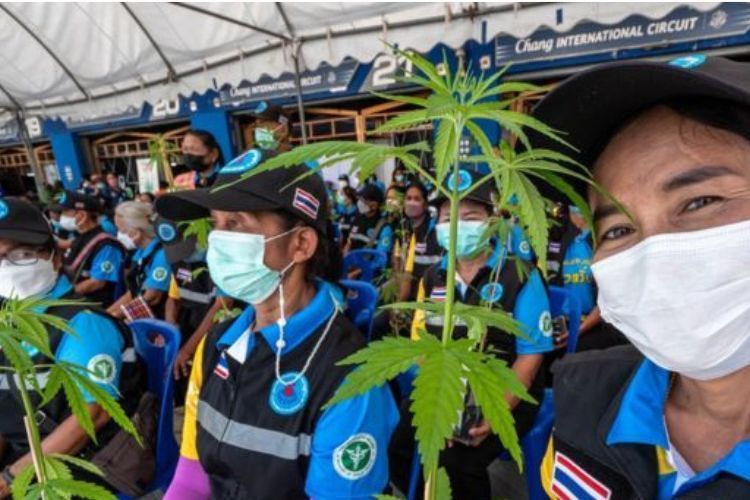
Thailand Reverses Marijuana Legalization Amidst New Government

Regulations by 2FIRSTS.ai
Jan.11.2024
Thailand Reverses Marijuana Legalization Amidst New Government
Thailand's newly elected prime minister announces plans to re-ban recreational marijuana use within six months of taking office.

According to a report by hsbnoticias, Thailand's historic decision to legalize recreational marijuana seems to be in jeopardy as the country prepares for a government change in September 2023. The newly elected Prime Minister, Srettha Thavisin, has made a pact with the elite class and has promised to re-ban the recreational use of marijuana within the first six months of his term.


On January 9, 2024, the Ministry of Health in Thailand issued a legislation proposing fines or even imprisonment for violators. However, the consumption of cannabis in public places remains prohibited, and a complete industry has emerged around the recreational use of cannabis, including advertising and marketing.


Former Thai Minister of Health Anutin Charnvirakul stated that the intention behind the legalization of cannabis was not to encourage Thai people to consume it.


Thailand to Implement Medical Cannabis Policy. We never intended to endorse the recreational use of cannabis or promote its use in a manner that may cause discomfort to others," he stated.


We welcome news tips, article submissions, interview requests, or comments on this piece.

Please contact us at info@2firsts.com, or reach out to Alan Zhao, CEO of 2Firsts, on LinkedIn


Notice

1.  This article is intended solely for professional research purposes related to industry, technology, and policy. Any references to brands or products are made purely for objective description and do not constitute any form of endorsement, recommendation, or promotion by 2Firsts.

2.  The use of nicotine-containing products — including, but not limited to, cigarettes, e-cigarettes, nicotine pouchand heated tobacco products — carries significant health risks. Users are responsible for complying with all applicable laws and regulations in their respective jurisdictions.

3.  This article is not intended to serve as the basis for any investment decisions or financial advice. 2Firsts assumes no direct or indirect liability for any inaccuracies or errors in the content.

4.  Access to this article is strictly prohibited for individuals below the legal age in their jurisdiction.


Copyright


This article is either an original work created by 2Firsts or a reproduction from third-party sources with proper attribution. All copyrights and usage rights belong to 2Firsts or the original content provider. Unauthorized reproduction, distribution, or any other form of unauthorized use by any individual or organization is strictly prohibited. Violators will be held legally accountable.

For copyright-related inquiries, please contact: info@2firsts.com


AI Assistance Disclaimer


This article may have been enhanced using AI tools to improve translation and editorial efficiency. However, due to technical limitations, inaccuracies may occur. Readers are encouraged to refer to the cited sources for the most accurate information.

We welcome any corrections or feedback. Please contact us at: info@2firsts.com

Japan’s Heated Tobacco Tax Reform Drives Price Increase as JT Raises All Ploom Sticks by ¥40
Japan Tobacco Inc. (JT) has applied to Japan’s finance minister for approval to revise retail prices of its Ploom heated tobacco sticks following planned changes to the heated tobacco tax system from October 1, 2026. If approved, all 31 Ploom stick products will increase by ¥40. After the adjustment, EVO products will cost ¥620 per 20-stick pack, MEVIUS products ¥590 and CAMEL products ¥570. JT said the price revision is intended to respond to tax changes while maintaining product quality and brand value. The tax reform is expected to narrow the tax gap between combustible cigarettes and heated tobacco products, potentially reshaping pricing strategies in Japan’s heated tobacco market.
Jul.22
Sesh touts independence, 8VC backing and retail reach as it challenges tobacco-owned pouch brands
U.S. nicotine pouch brand Sesh has emphasized its independence from Altria, Philip Morris International and British American Tobacco, along with backing from investors including 8VC, celebrity supporters and a retail footprint of more than 7,500 stores, as it seeks to differentiate itself in a market where major pouch brands are owned by large tobacco companies.
Regulations
Jul.07 by 2Firsts Perspectives
PMI Q2 Call: ZYN Growth, IQOS Pricing and a Diverging Global Tobacco Market
Philip Morris International’s second-quarter earnings call offered new detail on its smoke-free strategy. Management said it would increase U.S. investment behind nicotine pouch brand ZYN, keep IQOS focused on volume before stronger pricing, and use SENTIA, DELIA, LEVIA, VEEV and ZYN to manage tax and regulatory pressure across Japan and Europe. Analysts from Goldman Sachs, Morgan Stanley, UBS and other firms also pressed PMI on profitability, market share, cigarette resilience and the durability of its global transformation over coming quarters.
Jul.24
Australia’s One Nation Proposes 75% Tobacco Tax Cut, Says Lower Prices Could Hit Illicit Market
Australia’s One Nation party has proposed cutting tobacco excise by 75%, arguing that lower legal cigarette prices could narrow the gap with illicit tobacco and reduce demand for black-market products. The proposal comes as Australia continues expanding enforcement against illicit tobacco supply chains through border controls, retail inspections and organised-crime investigations. Supporters argue high taxes have contributed to illicit-market growth, while opponents warn that lower tobacco prices could undermine public-health goals. The proposal is a party policy position and has not been adopted by the Australian government.
Aug.18
Global Tobacco Control Faces Regional Adaptation Test as Nicotine Markets Evolve, Asian Specialist Says
As e-cigarettes, heated tobacco products and nicotine pouches expand across global markets, a central question is gaining urgency: can tobacco control rely on a universal policy model? In an interview with 2Firsts, Asian public health and addiction medicine specialist Dr. Rashidi Mohamed bin Pakri Mohamed says Western experience remains relevant, but policies must be adapted to local culture, healthcare systems, enforcement capacity, illicit markets and clinical evidence.
Jul.08
Data|China’s January-May Vape Exports: U.S. Shipments Fall 13.8% as Japan Posts Fastest Growth
According to China Customs export data analyzed by 2Firsts, the United States remained China’s largest destination for vape-related exports during January-May 2026 despite a 13.82% year-on-year decline in export value. Meanwhile, exports to Japan, Russia, Indonesia and the United Arab Emirates recorded strong growth, highlighting continued diversification across China’s export markets.
Special Report
Jun.29