The Future Development of E-Cigarette Market: Opportunities and Challenges

Aug.29.2024
The Future Development of E-Cigarette Market: Opportunities and Challenges
Dongguan Weiwante Intelligent Technology Co., Ltd. pointed out at the 5th Atomization Components Technology Forum that cotton net cores are rapidly developing.

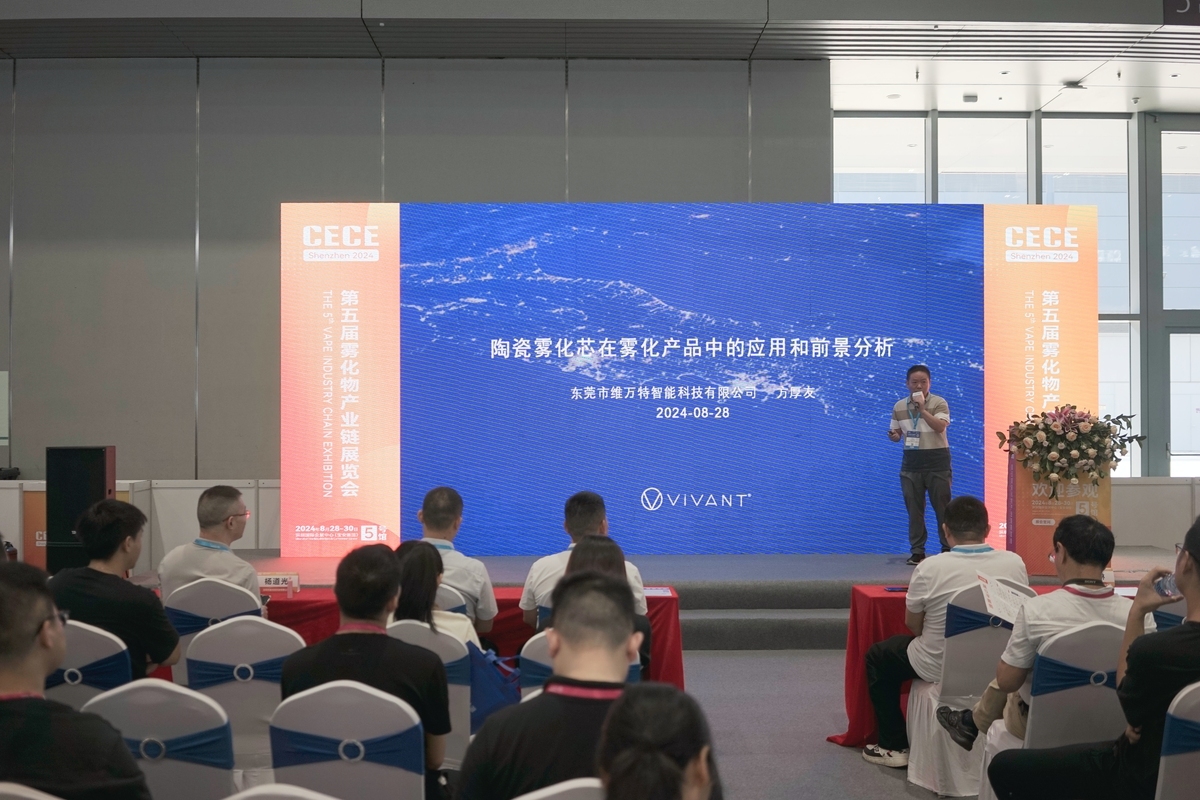
On the morning of August 28, Fang Houyou, General Manager of the Business Division of Dongguan Weiwant Intelligent Technology Co., Ltd., pointed out at the Aerosol Component Technology Forum of the 5th Aerosol Industry Chain Exhibition that cotton wick cores, with their efficient taste and advantages suitable for large capacity and high power, are rapidly developing alongside the rise of disposable cigarettes and open-pod vaping devices, and are expected to reach their peak by 2024.

The Future Development of E-Cigarette Market: Opportunities and Challenges


Currently, the mainstream atomization cores in the market, whether for disposable e-cigarettes or refillable open-system products, have a cotton mesh core structure.


Meanwhile, ceramic cores are mainly used in closed-bolt systems. However, closed-bolt systems have not yet been widely adopted in the European and American markets, and the demand for these products is decreasing.


During the exhibition, Fang Houyou shared the latest industry data and future predictions at the forum. He pointed out that according to the relevant data, countries with global sales exceeding $1 billion in 2023 include the United States ($59.6 billion), the United Kingdom ($33 billion), Canada ($21.4 billion), and France ($12.6 billion). Among them, the global sales of open system reached $76.6 billion, accounting for 36.7% of the total e-cigarette sales.


Fang Houyou expressed optimistic expectations for the market development in the next 5 years. He predicts that the global e-cigarette market will grow fivefold in the next five years, with sales expected to surpass $100 billion. However, he also emphasized the differences in market prospects for different product types. The 2ml pod system is expected to become very popular in the future due to its ease of passing the US PMTA review and low single-use cost. In contrast, the market opportunities for large-capacity disposable e-cigarettes are limited.


We welcome news tips, article submissions, interview requests, or comments on this piece.

Please contact us at info@2firsts.com, or reach out to Alan Zhao, CEO of 2Firsts, on LinkedIn


Notice

1.  This article is intended solely for professional research purposes related to industry, technology, and policy. Any references to brands or products are made purely for objective description and do not constitute any form of endorsement, recommendation, or promotion by 2Firsts.

2.  The use of nicotine-containing products — including, but not limited to, cigarettes, e-cigarettes, nicotine pouchand heated tobacco products — carries significant health risks. Users are responsible for complying with all applicable laws and regulations in their respective jurisdictions.

3.  This article is not intended to serve as the basis for any investment decisions or financial advice. 2Firsts assumes no direct or indirect liability for any inaccuracies or errors in the content.

4.  Access to this article is strictly prohibited for individuals below the legal age in their jurisdiction.


Copyright


This article is either an original work created by 2Firsts or a reproduction from third-party sources with proper attribution. All copyrights and usage rights belong to 2Firsts or the original content provider. Unauthorized reproduction, distribution, or any other form of unauthorized use by any individual or organization is strictly prohibited. Violators will be held legally accountable.

For copyright-related inquiries, please contact: info@2firsts.com


AI Assistance Disclaimer


This article may have been enhanced using AI tools to improve translation and editorial efficiency. However, due to technical limitations, inaccuracies may occur. Readers are encouraged to refer to the cited sources for the most accurate information.

We welcome any corrections or feedback. Please contact us at: info@2firsts.com

Bringing Tax and Insurance Into Nicotine Regulation: Insights From a Tobacco Harm-Reduction Report
A smoke-free nicotine policy report argues that tobacco harm reduction should move beyond product bans and health warnings into tax policy, insurance pricing and risk-based regulation. While some projections remain open to debate, the report highlights a wider challenge: nicotine products, technologies and consumer behavior have changed sharply over the past decade, and regulatory systems may need new tools to better align tobacco control with harm-reduction goals.
Jun.08
AP Questions FDA Rationale as Glas Fruit-Flavored Vapes Won Authorization Without Added Cessation Benefit
The U.S. Food and Drug Administration (FDA) recently authorized two fruit-flavored vaping products from Glas, but a newly released agency memo shows the products did not demonstrate greater smoking-cessation benefits than tobacco-flavored e-cigarettes. The Associated Press said the findings are likely to raise further questions about the FDA’s regulatory rationale and standards for flavored vaping products.
Jun.12
U.S. Senator Durbin Criticizes FDA’s First Flavored Vape Authorization, Says Trump Administration Conceded to Big Tobacco
U.S. Senator Dick Durbin on May 13 criticized the Trump Administration’s Food and Drug Administration for approving the sale and marketing of fruit-flavored e-cigarettes for the first time, while also allowing some illegal vaping products to remain on the market. He also linked the regulatory shift to the departure of FDA Commissioner Marty Makary, saying White House pressure on regulators to approve tobacco product applications could create serious public-health consequences.
Regulations
May.15
U.S. Military Nicotine Policy Sparks Debate as Nicotine Pouches Enter Discussion
An opinion article published by Stars and Stripes argued that the Pentagon’s January nicotine clinical guidelines overemphasize abstinence, fail to reflect the reality that about 30% of active-duty personnel use nicotine, and do not address nicotine pouches as potential harm-reduction products.
Industry Insight
Jun.08
 FDA Begins Review of 22nd Century’s VLN MRTP Renewal Applications
FDA Begins Review of 22nd Century’s VLN MRTP Renewal Applications
The U.S. Food and Drug Administration (FDA) has initiated scientific review of renewal applications for 22nd Century Group’s VLN reduced-nicotine cigarettes under the Modified Risk Tobacco Product (MRTP) pathway, with current authorizations set to expire in December 2026.
News
May.13
AIR Shares Drop 18.6% in Nasdaq Debut, Testing Hookah’s Move Toward Public Markets
AIR Global’s Nasdaq debut under ticker AIIR ended with a 18.6% first-day decline, giving the global hookah industry a rare public-market reference point. Beyond one company’s share move, the listing raises a broader question: can a culturally rooted, fragmented and venue-based category evolve into a more scalable and investable consumer sector?
Special Report
May.19