Trulieve Faces Lawsuit Over Employee Firings in Florida

Dec.14.2022
Trulieve Faces Lawsuit Over Employee Firings in Florida
Trulieve, a multi-state marijuana operator based in Florida, faces a collective lawsuit for allegedly not providing adequate notice prior to employee layoffs.

Trulieve, a multi-state cannabis operator headquartered in Florida, recently terminated some of its employees in Gadsden County. This resulted in affected workers filing a collective lawsuit alleging that the company did not provide sufficient notice before their termination.


Trulieve, a Florida-based cannabis company, operates two cultivation sites in Quincy and a processing plant on Midway Island in Gadsden County. The company has not disclosed the number of employees who have been terminated but has stated that the move is aimed at reducing layoffs as the company continues to grow, according to the Tallahassee Democrat.


According to Trulieve spokesperson Steve Vancore, affected employees have been offered alternative jobs at the company's other factories in Jefferson and Madison counties. Those employees who were ultimately not able to secure another position will receive severance pay.


Vancore informed Democratic lawmakers in Tallahassee that the layoffs ultimately stemmed from Trulieve's acquisition of Harvest Health and Recreation, which is based in Arizona.


We merged and acquired Harvest a year ago," Vancore told the news media. "This was part of our consolidation strategy as we continue to develop in areas of redundancy and inefficiency. When you have 9,000 employees, this is indeed a measure to improve efficiency.


Last week, employees affected by layoffs filed a class-action lawsuit against Trulieve, alleging that the company failed to provide the required Worker Adjustment and Retraining Notification (WARN) Act notice regarding their termination.


According to Democrats in Tallahassee, the lawsuit alleges that if a company lays off "50 or more employees (excluding any part-time employees) at a single worksite within any 30-day period," it must provide a notice under the WARN Act.


According to a report by the Tampa Bay Times, the lawsuit was originally filed by attorney Tiffany Cruz on behalf of Langel O'Neil, who worked at Trulieve's Quincy facility. The plaintiff is seeking monetary compensation equivalent to the total amount of unpaid wages, salaries, commissions, bonuses, accrued vacation pay, accrued sick pay, and other benefits within 60 days after termination. This has been reported in the media.


Trulieve has contested these allegations, according to Tallahassee attorney and partner at Stearns Weaver Miller, Glenn Burhans Jr., who told the news media that Trulieve "has complied with all state and federal laws regarding the reduction of force.


In possible scenarios, Trulieve offers affected employees new positions at the same location or other locations within the area," he told the Tampa Bay Times. "If relocation is not feasible or not accepted, employees will receive severance pay.


In another statement provided to the news media, Trulieve expressed its commitment to the northwest region of Florida and highlighted the construction of a 750,000-square-foot facility in Jefferson County by the company.


According to a statement released by the company to the Tampa Bay Times, Trulieve has approximately 9,000 employees in the United States and is currently hiring for "additional positions in various fields".


Disclaimer

This article is provided solely for professional research, industry discussion, and informational purposes. Any references to brands, companies, products, technologies, or policies are made for factual reporting and analytical purposes only, and do not constitute endorsement, recommendation, promotion, or advertising by 2Firsts.

Nicotine-containing products, including but not limited to cigarettes, e-cigarettes, heated tobacco products, and nicotine pouches, carry significant health risks. Readers are responsible for complying with all applicable laws and regulations in their respective jurisdictions, including age restrictions and access limitations.

The information contained in this article should not be regarded as investment, legal, medical, regulatory, or commercial advice. While 2Firsts strives to ensure the accuracy and reliability of its content, it does not assume liability for any direct or indirect loss arising from errors, omissions, inaccuracies, or reliance on the information contained herein.

This article is not intended for individuals below the legal age for accessing tobacco or nicotine-related information in their jurisdiction.


Copyright Notice

This article is either original content produced by 2Firsts or content reproduced, translated, summarized, or adapted from third-party sources with attribution where applicable. The intellectual property rights of the original content remain with 2Firsts or the respective original rights holders.

No individual or organization may copy, reproduce, distribute, republish, modify, translate, or otherwise use this content without prior authorization. Any unauthorized use may result in legal action.

For copyright-related inquiries, corrections, or removal requests, please contact: info@2firsts.com.


AI-Assisted Translation and Editing Notice

Portions of this article may have been translated, edited, or reviewed with the assistance of artificial intelligence tools to improve efficiency and readability. Due to the limitations of AI-assisted translation and editing, discrepancies, omissions, or inaccuracies may exist when compared with the original source.

Where applicable, readers are advised to refer to the original source for the most complete and accurate information. If you identify any errors or believe that any content infringes upon your rights, please contact us at info@2firsts.com, and we will review and address the matter promptly.

Japan's Heated Tobacco Use Rises From 0.1% to 14.9% Over a Decade as Growth Extends Beyond Cigarette Switching
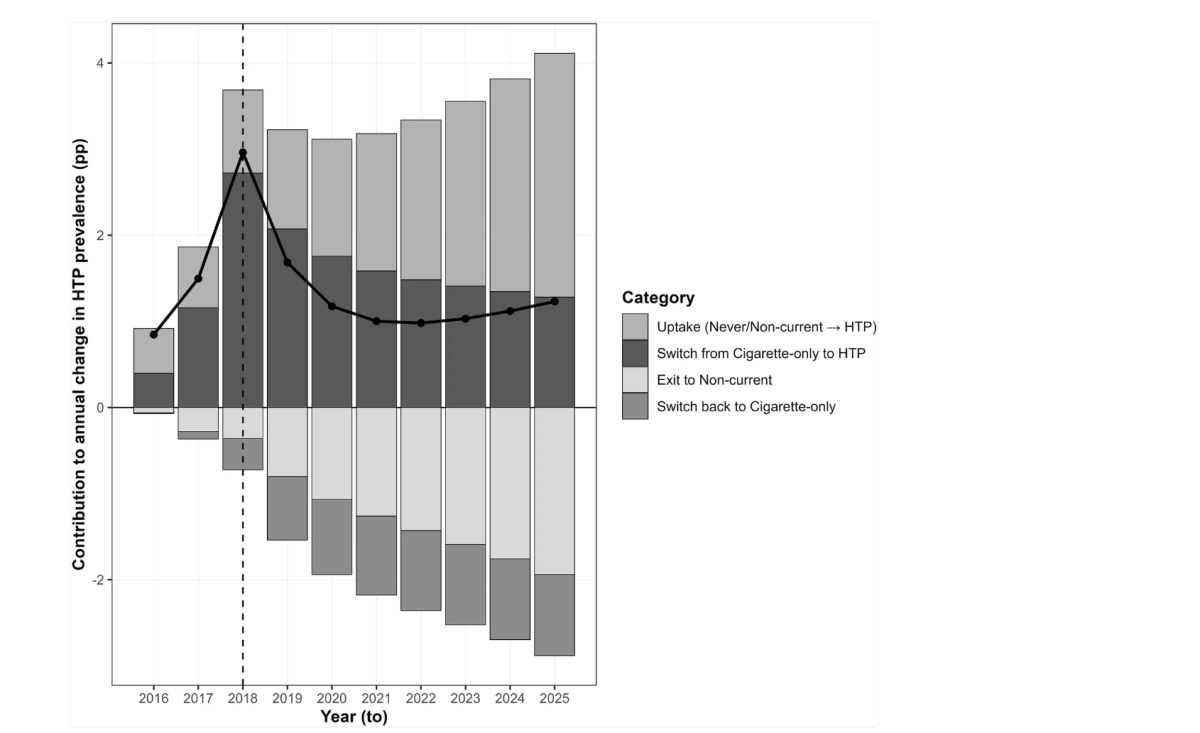
A decade-long study published in The Lancet Regional Health – Western Pacific found that heated tobacco product use in Japan increased from 0.1% in 2015 to 14.9% in 2025, although growth slowed after 2018. Switching from conventional cigarettes remained an important source of HTP uptake, while the contribution from previously non-current users increased. Approximately 56% of HTP users also smoked conventional cigarettes in 2025. Separate industry data show that Japan's heated tobacco sales reached 73.4 billion units in fiscal 2025, approaching conventional cigarette sales of 78.2 billion units.
SCIENCE
Nov.10
On-Site Report | CTP Details PMTA Backlog, 180-Day Review Goal and sPMTA Process
FDA’s Center for Tobacco Products detailed new PMTA review data and process changes at the 2026 FDLI conference. Pending PMTAs fell from about 450,000 at the start of 2025 to 135,000 by September 2026. CTP also discussed its 180-day review goal, current sPMTA pilot, alternate-supplier planning, more than 50,300 pending SE reports, and lessons from the nicotine pouch pilot already being applied to ENDS review.
Regulations
Oct.07
Product | BAT Revises Japan's VELO Convenience Store Lineup, Adding ¥380 Mango Pouches as Selected SKUs Exit
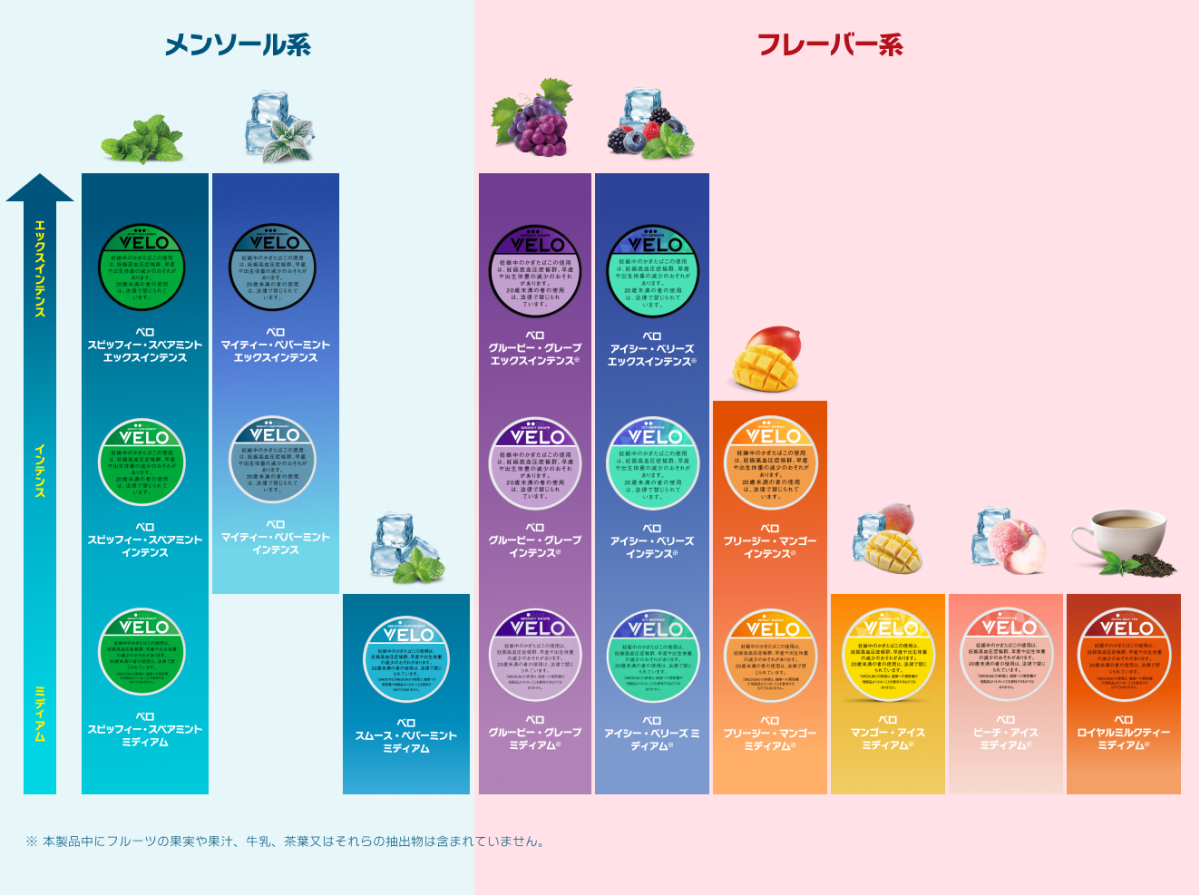
British American Tobacco's Japanese subsidiary, BAT Japan, launched VELO Mango Ice Medium on November 2, 2026, with distribution expanding to selected 7-Eleven, FamilyMart, NewDays and Seicomart stores from November 3. The new oral tobacco product contains 15 pouches per can and retails for ¥380, featuring a mango and cooling flavor profile at Medium intensity. At the same time, BAT Japan raised prices on multiple existing VELO products from ¥360 to ¥380 per can and withdrew selected SKUs from convenience store distribution without discontinuing them entirely. The changes affect product assortment, pricing and retail channel allocation.
product
Nov.04
Indonesia's Influential Islamic Body MUI Urges Vape Permit Freeze, Raising Uncertainty for 200 Manufacturers
Indonesia's Ulema Council (MUI) published Fatwa No. 131/2026 on November 9, declaring electronic cigarette use, production and trade haram under Islamic religious rules. The council urged the Industry Ministry to prohibit the issuance of vape industry permits and review licensing policies, while calling on the president and parliament to enact a comprehensive ban. On November 10, the Constitutional Court heard a challenge to provisions of the 2023 Health Law seeking a prohibition on vape production, importation, distribution and use. The Health Ministry said on November 11 it was studying stronger restrictions, including a possible ban on circulation, while industry association APVI called for tighter oversight rather than a total ban. Indonesia's Industry Ministry previously estimated the sector comprises about 200 companies, Rp31 trillion ($1.7 billion) in cumulative investment and approximately 100,000 supply-chain jobs. No nationwide statutory ban has been enacted.
Regulations
Nov.12
Product | PMI Launches Three IQOS ILUMA i BEYOND Limited Editions in Japan, Retaining REMIX Pricing and Retail Channel Structure
Philip Morris Japan (PMJ) began launching three IQOS ILUMA i BEYOND limited-edition heated tobacco devices in Japan on November 18, 2026, covering PRIME, the standard ILUMA i and ONE. Suggested retail prices are ¥11,980, ¥7,980 and ¥4,980, respectively, matching the REMIX limited-edition collection introduced in June. BEYOND features blue finishes, translucent components and differentiated surface materials while retaining the existing IQOS ILUMA i device architecture. As with REMIX, all three models are available through official and specialist retail channels, while the subsequent convenience store rollout covers only the standard ILUMA i and ONE versions. The two collections share the same pricing tiers and retail distribution structure, with their principal differences in exterior design.
product
Nov.20
Why Does JPMorgan Favor BAT Over Philip Morris Despite Forecasting Slower Growth of 3.9% Versus 6.2%?
JPMorgan resumed equity research coverage of British American Tobacco (BAT), Philip Morris International (PMI) and Imperial Brands in November 2026, assigning BAT an Overweight rating and the other two companies Neutral ratings. The bank forecasts like-for-like sales growth of 3.9% for BAT and 6.2% for PMI in 2027, but estimates the two companies will trade at approximately 11 times and 21 times 2027 earnings, respectively. JPMorgan cited BAT's improving position in US nicotine pouches and vaping products as a driver of its investment outlook. BAT reported a 220% constant-currency increase in US modern oral nicotine revenue in the first half of 2026, while PMI's ZYN US shipments returned to growth in the third quarter. Imperial expects NGPs to represent 4% to 5% of sales and has expanded its oral portfolio through acquisitions.
Capital Markets
Nov.12