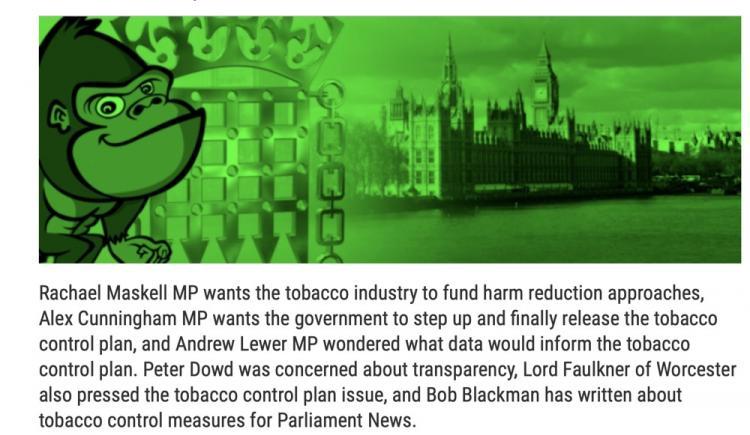
Rachael Maskell, a Labour representative from York, asked the Chancellor whether he intends to utilize the alcohol and tobacco tax in order to support plans aimed at reducing the harms caused by these products.
In response to the Prime Minister, James Cartlidge of South Suffolk County in the United Kingdom stated, "The government is constantly reviewing tax rates during the annual budget process with the aim of balancing the impact on businesses with its public health objectives.
Justice Secretary Alex Cunningham has called for the release of a new tobacco control plan in response to the autumn statement.
Stoke North MP is the Deputy Chairman of the All-Party Parliamentary Group on Smoking and Health. He has been criticized for the government's "lack of action in addressing health inequality issues.
He also wants to know why the government is not taxing the tobacco industry to provide funding for the long-delayed tobacco control plan.
Andrew Lewer, a representative from the southern part of Northampton, has questioned the Secretary of State for Health and Social Care about whether the data on adult smoking habits in the National Statistics Office report will be used to inform tobacco control plans.
Neil O'Brien, the Minister for Primary Care and Public Health, stated that the government is considering independent recommendations from the Khan Review and an updated tobacco control plan to determine the most appropriate response. O'Brien added that the plan, if released, will take into account the latest information from the Office for National Statistics on smoking habits among UK adults.
Peter Dowd asked the Secretary of State whether he would release data on the UK's progress towards achieving its adult smoking targets as planned.
Neil O'Brien responded by stating that the UK government set a target as part of the 2017 Tobacco Control Plan to reduce the adult smoking rate to 12% or lower by the end of 2022. The smoking rate was 19.8% in 2011 and 13.9% in 2019. Due to the COVID-19 pandemic, data for 2020 cannot be compared to previous years. However, based on the trend from 2019, it is expected that the target for 2022 will be achieved.
The smoking prevalence data for the year 2022 in the United Kingdom is set to be published in the "Adult Smoking Habits in the UK" publication by the National Statistics Office in 2023.
The House of Lords in the UK has received verbal questions regarding the tobacco control plan. Lord Faulkner of Worcester, Vice Chairman of the All-Party Parliamentary Group on Smoking and Health, asked the government when they plan to release the tobacco control plan, and if England still intends to achieve a smoke-free status by 2030.
The Deputy Secretary of State for Health and Social Welfare, Lord Markham, reiterated the government's commitment to the 2030 targets.
Finally, Bob Blackman, the Conservative MP for Harrow East and Chair of the All-Party Parliamentary Group on Smoking and Health, wrote an article about tobacco control issues in the political magazine Parliament.
2FIRSTS will continue to report on this topic, with further updates available on the '2FIRSTS APP.' Scan the QR code below to download the app.
Disclaimer
This article is provided solely for professional research, industry discussion, and informational purposes. Any references to brands, companies, products, technologies, or policies are made for factual reporting and analytical purposes only, and do not constitute endorsement, recommendation, promotion, or advertising by 2Firsts.
Nicotine-containing products, including but not limited to cigarettes, e-cigarettes, heated tobacco products, and nicotine pouches, carry significant health risks. Readers are responsible for complying with all applicable laws and regulations in their respective jurisdictions, including age restrictions and access limitations.
The information contained in this article should not be regarded as investment, legal, medical, regulatory, or commercial advice. While 2Firsts strives to ensure the accuracy and reliability of its content, it does not assume liability for any direct or indirect loss arising from errors, omissions, inaccuracies, or reliance on the information contained herein.
This article is not intended for individuals below the legal age for accessing tobacco or nicotine-related information in their jurisdiction.
Copyright Notice
This article is either original content produced by 2Firsts or content reproduced, translated, summarized, or adapted from third-party sources with attribution where applicable. The intellectual property rights of the original content remain with 2Firsts or the respective original rights holders.
No individual or organization may copy, reproduce, distribute, republish, modify, translate, or otherwise use this content without prior authorization. Any unauthorized use may result in legal action.
For copyright-related inquiries, corrections, or removal requests, please contact: info@2firsts.com.
AI-Assisted Translation and Editing Notice
Portions of this article may have been translated, edited, or reviewed with the assistance of artificial intelligence tools to improve efficiency and readability. Due to the limitations of AI-assisted translation and editing, discrepancies, omissions, or inaccuracies may exist when compared with the original source.
Where applicable, readers are advised to refer to the original source for the most complete and accurate information. If you identify any errors or believe that any content infringes upon your rights, please contact us at info@2firsts.com, and we will review and address the matter promptly.