Ukrainian Antitrust Agency Sues Philip Morris over Misleading Claims

Jan.05.2023
Ukrainian Antitrust Agency Sues Philip Morris over Misleading Claims
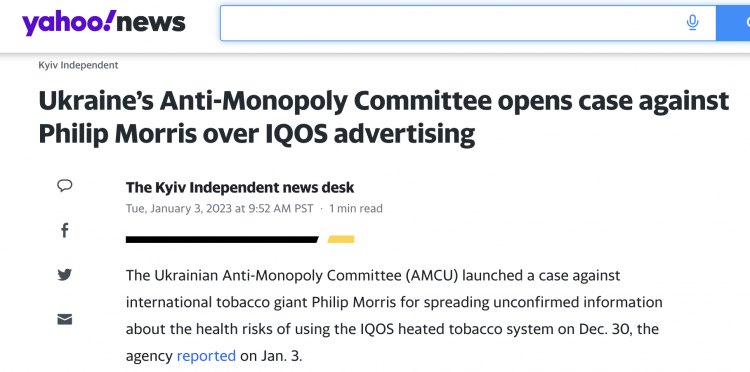
Ukraine's Antimonopoly Committee (AMCU) sues tobacco giant Philip Morris International for making unverified health claims about its IQOS products.

The Ukrainian Antimonopoly Committee (AMCU) has recently filed a lawsuit against international tobacco giant Philip Morris International, accusing them of promoting unverified health risk information about their IQOS heated tobacco product.


The company has been accused of disseminating misleading information regarding the use of IQOS products, claiming they pose lower health risks compared to traditional cigarettes. This violation allegedly violates Article 151 of the Anti-Unfair Competition Law.


The AMCU case involves a consumer who used HEETS tobacco products manufactured by Philip Morris International for their IQOS product between 2018 and 2021. The consumer believed these products were a safer alternative to traditional cigarettes, but found no conclusive evidence to support this claim.


The committee stated that Phillip Morris did not provide them with documents to prove the validity of their statements made in Ukraine, including "completely switching to IQOS poses less risk to your health compared to continued smoking" and "IQOS emissions contain 95% less harmful chemicals than cigarettes.


The Association of Mineworkers and Construction Union (AMCU) believes that disseminating these claims without appropriate verification constitutes a violation of unfair competition laws by spreading misleading information.


The Ukrainian Ministry of Health has stated that international studies show that any tobacco heating product poses a danger and does not reduce the risk of smoking.


Disclaimer

This article is provided solely for professional research, industry discussion, and informational purposes. Any references to brands, companies, products, technologies, or policies are made for factual reporting and analytical purposes only, and do not constitute endorsement, recommendation, promotion, or advertising by 2Firsts.

Nicotine-containing products, including but not limited to cigarettes, e-cigarettes, heated tobacco products, and nicotine pouches, carry significant health risks. Readers are responsible for complying with all applicable laws and regulations in their respective jurisdictions, including age restrictions and access limitations.

The information contained in this article should not be regarded as investment, legal, medical, regulatory, or commercial advice. While 2Firsts strives to ensure the accuracy and reliability of its content, it does not assume liability for any direct or indirect loss arising from errors, omissions, inaccuracies, or reliance on the information contained herein.

This article is not intended for individuals below the legal age for accessing tobacco or nicotine-related information in their jurisdiction.


Copyright Notice

This article is either original content produced by 2Firsts or content reproduced, translated, summarized, or adapted from third-party sources with attribution where applicable. The intellectual property rights of the original content remain with 2Firsts or the respective original rights holders.

No individual or organization may copy, reproduce, distribute, republish, modify, translate, or otherwise use this content without prior authorization. Any unauthorized use may result in legal action.

For copyright-related inquiries, corrections, or removal requests, please contact: info@2firsts.com.


AI-Assisted Translation and Editing Notice

Portions of this article may have been translated, edited, or reviewed with the assistance of artificial intelligence tools to improve efficiency and readability. Due to the limitations of AI-assisted translation and editing, discrepancies, omissions, or inaccuracies may exist when compared with the original source.

Where applicable, readers are advised to refer to the original source for the most complete and accurate information. If you identify any errors or believe that any content infringes upon your rights, please contact us at info@2firsts.com, and we will review and address the matter promptly.

South Korean Lawmaker Jeong Jin-wook Pushes Synthetic Nicotine Vape Probe, Highlighting Supply Chain and Tax Concerns
South Korean lawmaker Jeong Jin-wook has again called for stronger government action against liquid synthetic nicotine vape manufacturers and sellers, alleging that some businesses may have avoided regulation through product labeling changes and corporate restructuring. According to Newsworks, JNILBO and other Korean reports, Jeong has held his third press conference on the issue, calling for a government-wide investigation. The dispute involves whether synthetic nicotine products should fall under tobacco regulations, tax implications and supply-chain transparency. South Korean government agencies have previously said some estimates of potential tax losses cannot be verified due to limited sales data.
Jul.27
UK PM Andy Burnham Shifts Business Rates Policy, Supporting Hospitality While Raising Pressure on Vape Shops
UK Prime Minister Andy Burnham’s government is adjusting business rates policy to support hospitality businesses while some other sectors, including vape retailers, face higher operating cost pressures. According to Streamline Feed, AJ Bell and other reports, the policy shift reflects a redistribution of business rate burdens as the government seeks to support sectors facing economic pressure. For UK vape shops, the change comes amid a broader regulatory environment shaped by the disposable vape ban, the upcoming Vaping Products Duty and increased compliance requirements.
News
Jul.24
Japan’s Heated Tobacco Tax Reform Drives Price Increase as JT Raises All Ploom Sticks by ¥40
Japan Tobacco Inc. (JT) has applied to Japan’s finance minister for approval to revise retail prices of its Ploom heated tobacco sticks following planned changes to the heated tobacco tax system from October 1, 2026. If approved, all 31 Ploom stick products will increase by ¥40. After the adjustment, EVO products will cost ¥620 per 20-stick pack, MEVIUS products ¥590 and CAMEL products ¥570. JT said the price revision is intended to respond to tax changes while maintaining product quality and brand value. The tax reform is expected to narrow the tax gap between combustible cigarettes and heated tobacco products, potentially reshaping pricing strategies in Japan’s heated tobacco market.
Jul.22
Shopify Requires Merchants to Remove All Vape Products by July 8, Reshaping Online Sales Channels
Shopify has instructed merchants using its web-hosting services to remove vape products from their online stores by July 8, 2026. The policy expands beyond illegal products and applies to all electronic nicotine delivery systems (ENDS), marking a broader shift in online platform oversight of nicotine sales.
Innovation
Jul.14 by 2Firsts Perspectives
Germany Expands Take-Back Rules for Disposable Vapes From July 1
Germany has expanded take-back obligations for disposable vapes from July 1, 2026, requiring consumers to be able to return used devices at stores that sell such products, including kiosks, petrol stations and vape shops, as e-cigarette regulation extends from sales to waste management and lithium-battery safety.
Market
Jul.06 by 2Firsts Perspectives
Indiana’s Foreign-Made Vape Ban Takes Effect, Forcing Brands and Retailers to Adjust Supply Chains
A new Indiana law restricting the sale of foreign-made vape products has taken effect, requiring retailers to adjust inventory and sourcing practices. According to The Sun, WDRB and other reports, some local vape shops are reviewing product origins and supplier information to comply with the new requirements. The measure represents a broader shift in U.S. vape regulation, with oversight expanding beyond product authorization and sales rules toward manufacturing origin and supply-chain management.
Jul.24