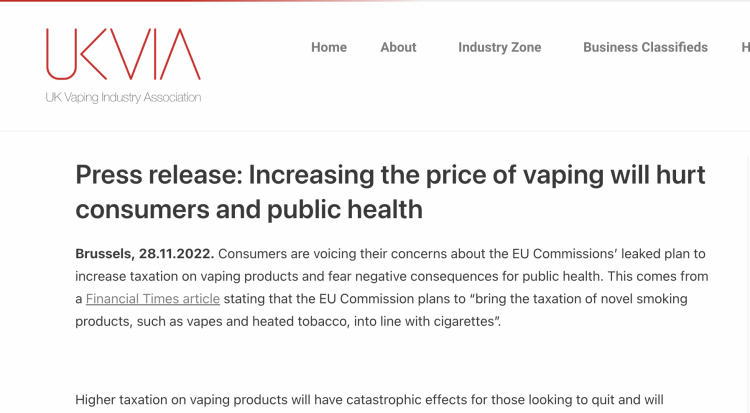
The UK Vaping Industry Association (UKVIA) has expressed concern about the European Commission's leaked plan to tax electronic cigarette products, citing worries that this could have a negative impact on public health. According to an article in the Financial Times, the plan aims to "bring the taxation of new smoking products, such as e-cigarettes and heated tobacco, into line with that of cigarettes.
Michael Landl, Director of the World Vaping Alliance, warns that imposing higher taxes on e-cigarette products will have a devastating impact on those attempting to quit smoking, and will likely result in a significant increase in the black market for e-cigarette products.
The committee claims that increasing taxes will improve public health, but in fact the opposite is true. For regular smokers trying to quit, lower-risk alternatives such as electronic cigarettes must be affordable. If the committee wants to alleviate the burden of smoking on public health, they must make e-cigarettes cheaper and more accessible, not less so.
The differing taxation of traditional cigarette and electronic cigarette products is essential for many people. Furthermore, high taxes on electronic cigarette products are particularly harmful to those in poor economic conditions because they are less likely to switch to electronic cigarettes, and this demographic represents the largest proportion of current smokers.
High taxes have the most impact on the most vulnerable groups. During times of multiple crises and people struggling to make ends meet, making e-cigarettes more expensive is the opposite of what we need. Policymakers must understand that taxing e-cigarettes will force people to resume smoking or turn to the black market, which is an undesirable situation. In times of crisis, people should not be subjected to unscientific and ideological anti-e-cigarette efforts. This needs to stop." Randall said.
The World Vapers’ Alliance has urged the European Union Commission and its member states to follow scientific evidence and avoid imposing higher taxes on e-cigarette products if they want to reduce the burden of smoking on public health. Availability and affordability of e-cigarette products must be ensured.
Instead of cracking down on e-cigarettes, the EU must ultimately accept reducing tobacco harm. What we need is risk-based regulation. The harm of e-cigarettes is 95% lower than smoking, so they cannot be treated the same way as traditional smoking," Landl added.
2FIRSTS will continue to provide coverage on this topic, with further updates available on the '2FIRSTS APP'. Scan the QR code below to download the app.
Disclaimer
This article is provided solely for professional research, industry discussion, and informational purposes. Any references to brands, companies, products, technologies, or policies are made for factual reporting and analytical purposes only, and do not constitute endorsement, recommendation, promotion, or advertising by 2Firsts.
Nicotine-containing products, including but not limited to cigarettes, e-cigarettes, heated tobacco products, and nicotine pouches, carry significant health risks. Readers are responsible for complying with all applicable laws and regulations in their respective jurisdictions, including age restrictions and access limitations.
The information contained in this article should not be regarded as investment, legal, medical, regulatory, or commercial advice. While 2Firsts strives to ensure the accuracy and reliability of its content, it does not assume liability for any direct or indirect loss arising from errors, omissions, inaccuracies, or reliance on the information contained herein.
This article is not intended for individuals below the legal age for accessing tobacco or nicotine-related information in their jurisdiction.
Copyright Notice
This article is either original content produced by 2Firsts or content reproduced, translated, summarized, or adapted from third-party sources with attribution where applicable. The intellectual property rights of the original content remain with 2Firsts or the respective original rights holders.
No individual or organization may copy, reproduce, distribute, republish, modify, translate, or otherwise use this content without prior authorization. Any unauthorized use may result in legal action.
For copyright-related inquiries, corrections, or removal requests, please contact: info@2firsts.com.
AI-Assisted Translation and Editing Notice
Portions of this article may have been translated, edited, or reviewed with the assistance of artificial intelligence tools to improve efficiency and readability. Due to the limitations of AI-assisted translation and editing, discrepancies, omissions, or inaccuracies may exist when compared with the original source.
Where applicable, readers are advised to refer to the original source for the most complete and accurate information. If you identify any errors or believe that any content infringes upon your rights, please contact us at info@2firsts.com, and we will review and address the matter promptly.