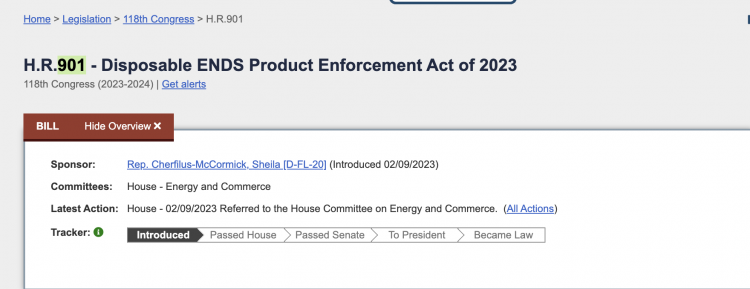
On March 13th, it was reported that the full text of the proposal for the "Disposable ENDS Product Enforcement Act of 2023" has been made public on the official website of the United States Congress. The bill was introduced by Sheila Cherfilus McCormick, a member of the House of Representatives from Florida, and has been assigned to the House Energy and Commerce Committee.
Hillary Schefter-McCormick | Source: Official website of the United States Congress
The bill cites a study released by the U.S. Food and Drug Administration in 2022 that indicates disposable e-cigarettes are the most commonly used type of device among underage individuals in the United States.
Based on this premise, the bill requires that within 90 days of its passage, the Department of Health and Human Services (HHS) must update its enforcement priorities for electronic nicotine delivery systems (ENDS) and other deemed products that have not been authorized for pre-market sale, as outlined in its April 2020 publication. The updated regulations must include measures on how to prioritize enforcement actions against disposable ENDS products, including non-tobacco derived nicotine products.
According to reports, as of March 10, there are four co-sponsors of the bill, all of whom are Democratic members of the House of Representatives, as listed on Congress's website. The House is majority-controlled by Republicans, with 222 seats, while Democrats hold 213 seats. Previously, Republican Kevin McCarthy faced opposition from far-right conservative members before ultimately winning the election as Speaker of the House after 15 rounds of voting, marking the most rounds of voting in a House Speaker election since 1923.
References:
HR901 - One-time Enforcement of ENDS Products Act in 2023.
Additional reading:
A new US bill is pressuring the FDA to crack down on disposable e-cigarettes.
Disclaimer
This article is provided solely for professional research, industry discussion, and informational purposes. Any references to brands, companies, products, technologies, or policies are made for factual reporting and analytical purposes only, and do not constitute endorsement, recommendation, promotion, or advertising by 2Firsts.
Nicotine-containing products, including but not limited to cigarettes, e-cigarettes, heated tobacco products, and nicotine pouches, carry significant health risks. Readers are responsible for complying with all applicable laws and regulations in their respective jurisdictions, including age restrictions and access limitations.
The information contained in this article should not be regarded as investment, legal, medical, regulatory, or commercial advice. While 2Firsts strives to ensure the accuracy and reliability of its content, it does not assume liability for any direct or indirect loss arising from errors, omissions, inaccuracies, or reliance on the information contained herein.
This article is not intended for individuals below the legal age for accessing tobacco or nicotine-related information in their jurisdiction.
Copyright Notice
This article is either original content produced by 2Firsts or content reproduced, translated, summarized, or adapted from third-party sources with attribution where applicable. The intellectual property rights of the original content remain with 2Firsts or the respective original rights holders.
No individual or organization may copy, reproduce, distribute, republish, modify, translate, or otherwise use this content without prior authorization. Any unauthorized use may result in legal action.
For copyright-related inquiries, corrections, or removal requests, please contact: info@2firsts.com.
AI-Assisted Translation and Editing Notice
Portions of this article may have been translated, edited, or reviewed with the assistance of artificial intelligence tools to improve efficiency and readability. Due to the limitations of AI-assisted translation and editing, discrepancies, omissions, or inaccuracies may exist when compared with the original source.
Where applicable, readers are advised to refer to the original source for the most complete and accurate information. If you identify any errors or believe that any content infringes upon your rights, please contact us at info@2firsts.com, and we will review and address the matter promptly.