Key Points
- A U.S. federal court in Florida denied Philip Morris International’s motion to dismiss, allowing the plaintiffs’ claims under the Florida Deceptive and Unfair Trade Practices Act (FDUTPA) to proceed.
- Plaintiffs allege that Zyn nicotine pouches were marketed as “tobacco-free,” misleading consumers and downplaying addiction risks.
- The court held that FDUTPA constitutes an independent cause of action and is not equivalent to the previously dismissed common-law fraud claims.
- The ruling emphasized that FDUTPA does not require proof of “intent to deceive” and therefore is not subject to the heightened pleading standard of Federal Rule of Civil Procedure 9(b).
- The plaintiffs’ prior fraud claims were dismissed twice for insufficient pleading detail.
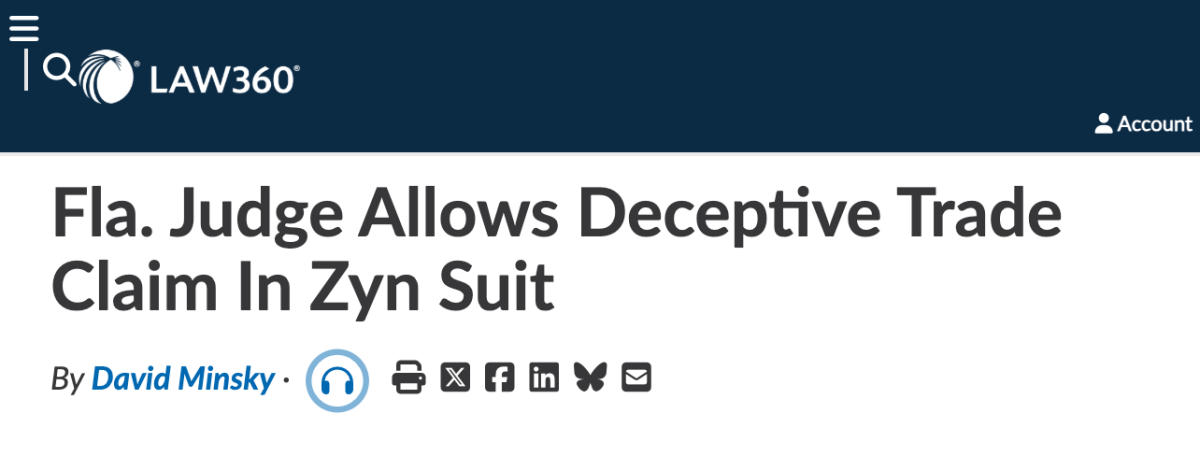
2Firsts, December 15, 2025 — According to Law360, U.S. District Judge William P. Dimitrouleas of the Southern District of Florida ruled on December 12 that Philip Morris International (PMI) and its subsidiaries’ motion to dismiss should be denied, allowing claims brought by plaintiff Kovadis Palmer under the Florida Deceptive and Unfair Trade Practices Act (FDUTPA) to proceed.
The case arises from a lawsuit filed by Palmer in April 2024 against Philip Morris International and its subsidiary Swedish Match North America LLC. Palmer alleges that the defendants marketed Zyn nicotine pouches as “tobacco-free,” implying a lower risk of addiction, even though the nicotine is derived from tobacco. He contends that the marketing was misleading and that he developed nicotine dependence as a result of using Zyn.
Previously, Palmer asserted common-law fraud claims. However, in rulings issued in August 2024 and March 2025, the court dismissed those claims, finding that they failed to meet the particularity requirements for fraud under Federal Rule of Civil Procedure 9(b).
In October 2025, Palmer amended his complaint again, withdrawing the fraud claims and instead asserting claims for deceptive or unfair business practices under FDUTPA. The defendants moved once more to dismiss, arguing that the FDUTPA claims were merely a “repackaging” of the earlier fraud allegations and relied on nearly identical factual assertions.
The court rejected that argument, explaining that FDUTPA claims do not necessarily depend on allegations of intentional deception. Rather, they focus on whether a deceptive or unfair practice occurred, whether there is a causal connection, and whether actual damages resulted. As such, FDUTPA claims are not subject to Rule 9(b)’s heightened pleading standard for fraud.
The court concluded that the FDUTPA claim “is not simply fraud under another name, but advances a new legal theory,” and noted that the allegations do not assert that the defendants acted with intent to mislead consumers.
Cover image source: Law360
We welcome news tips, article submissions, interview requests, or comments on this piece.
Please contact us at info@2firsts.com, or reach out to Alan Zhao, CEO of 2Firsts, on LinkedIn
Notice
1. This article is intended solely for professional research purposes related to industry, technology, and policy. Any references to brands or products are made purely for objective description and do not constitute any form of endorsement, recommendation, or promotion by 2Firsts.
2. The use of nicotine-containing products — including, but not limited to, cigarettes, e-cigarettes, nicotine pouchand heated tobacco products — carries significant health risks. Users are responsible for complying with all applicable laws and regulations in their respective jurisdictions.
3. This article is not intended to serve as the basis for any investment decisions or financial advice. 2Firsts assumes no direct or indirect liability for any inaccuracies or errors in the content.
4. Access to this article is strictly prohibited for individuals below the legal age in their jurisdiction.
Copyright
This article is either an original work created by 2Firsts or a reproduction from third-party sources with proper attribution. All copyrights and usage rights belong to 2Firsts or the original content provider. Unauthorized reproduction, distribution, or any other form of unauthorized use by any individual or organization is strictly prohibited. Violators will be held legally accountable.
For copyright-related inquiries, please contact: info@2firsts.com
AI Assistance Disclaimer
This article may have been enhanced using AI tools to improve translation and editorial efficiency. However, due to technical limitations, inaccuracies may occur. Readers are encouraged to refer to the cited sources for the most accurate information.
We welcome any corrections or feedback. Please contact us at: info@2firsts.com