Key Points
- The U.S. House passed H.R. 8800, the FY2027 NDAA, by 216-212 on July 22; Section 707 authorizes a one-year military smoking-cessation pilot.
- Six options are listed: counseling, nicotine gum, nicotine patches, "electric nicotine delivery systems," nicotine pouches and heat-not-burn products.
- In a 2023 military health assessment, about 115,500 active-component service members reported recent e-cigarette use, the largest single product category recorded.
- A Washington Examiner op-ed cited ZYN as an example of a nicotine pouch, but the bill does not name ZYN, Swedish Match, PMI or any other commercial supplier.
2Firsts
September 20, 2026
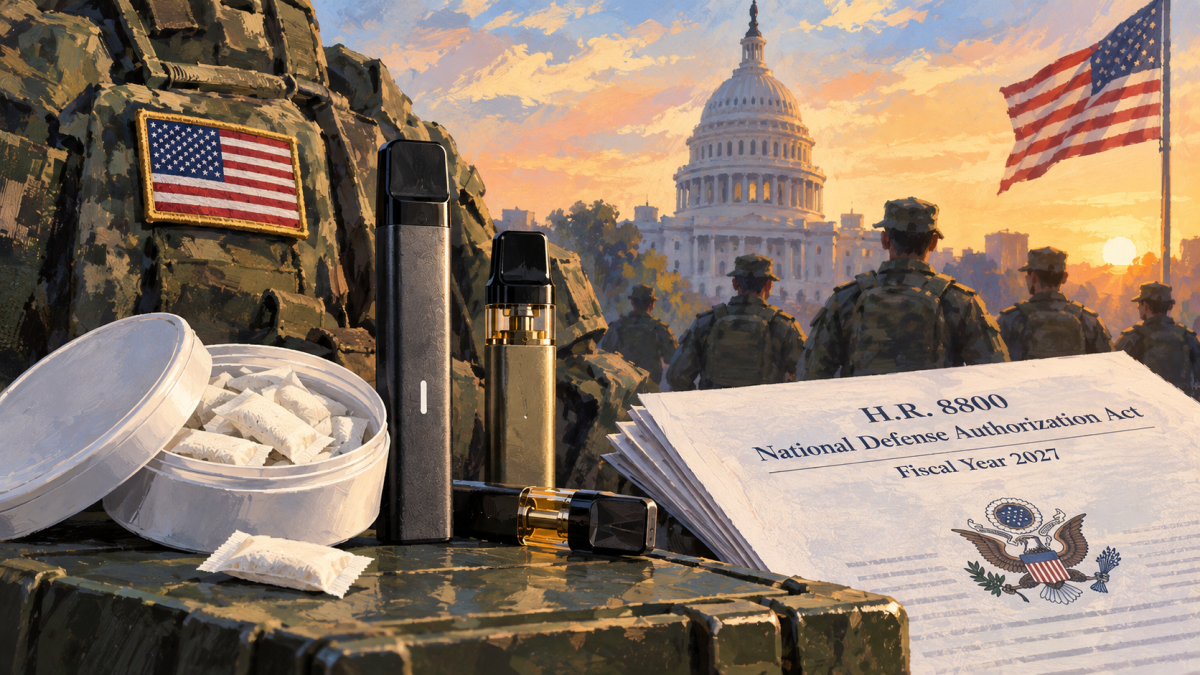
The House-passed version of the National Defense Authorization Act for Fiscal Year 2027 includes a provision authorizing the defense secretary to test several smoking alternatives for active-duty service members, including nicotine pouches, nicotine delivery systems and heat-not-burn products.
The House passed H.R. 8800 by a 216-212 vote on July 22. Section 707 of the engrossed House bill says the secretary of defense may begin a one-year pilot no later than 180 days after enactment to help eligible service members stop smoking and improve their health.
Six Smoking Alternatives Listed in Pilot
Section 707 lists six alternatives:
- counseling;
- nicotine gum;
- nicotine patches;
- "electric nicotine delivery systems";
- nicotine pouches; and
- heat-not-burn products.
"Electric nicotine delivery systems" is the wording used in the House-passed legislative text.
The provision says the defense secretary "may carry out" the pilot, giving the department authority rather than requiring implementation.
Eligible participants would be active-duty members of the Army, Navy, Marine Corps, Air Force or Space Force who smoke at least one cigarette or other combustible tobacco product per week.
If implemented, the pilot must operate in at least one covered service and at at least one military installation where covered members exceed national averages for combustible-tobacco smoking and for the populations of Black Americans, Asian and Pacific Islander Americans, Hispanic Americans and Appalachian Americans.
Within one year after the pilot ends, the defense secretary would report to the House and Senate Armed Services Committees on whether participants stopped smoking, which alternatives were most effective, gaps in health care services affecting the specified populations, and whether the program should be expanded, extended or made permanent.
The legislation does not identify any specific product, brand, manufacturer or supplier.
About 115,500 Service Members Reported Recent E-Cigarette Use
Military health surveillance indicates continued use of tobacco and nicotine products among active-duty personnel.
A Military Health System study published in April 2026 found that 921,394 active-component service members completed a Periodic Health Assessment in 2023. Of those, 22.0%, or 203,156 personnel, self-reported recent tobacco or nicotine use.
Reported use within the previous 30 days included:
- electronic cigarettes: 115,486;
- cigarettes: 47,325;
- chewing tobacco: 45,777;
- cigars: 21,517; and
- other tobacco products: 9,630.
Electronic cigarettes represented the largest single self-reported product category in the assessment.
Combining PHA responses with medical-record diagnostic codes for nicotine dependence and tobacco use raised the estimated recent-use rate from 22.0% to 28.7%, or 264,194 service members.
The military study also noted the growing popularity of nicotine pouches in the United States. It cited a convenience-based, self-reported survey indicating nicotine pouch use among U.S. military personnel may be about 10 times that of the general adult population.
The study itself did not separately measure nicotine pouch use. It noted that 9,630 service members selected "other tobacco products" in the 2023 assessment and said analysis of free-text responses could provide more information about emerging products.
ZYN Named in Commentary, Not in Legislation
On September 19, Washington Examiner published an op-ed by Andrea Ruth titled "Want to cut $4 billion in defense spending? Give troops Zyns and vapes," arguing in favor of the Section 707 pilot.
The article used ZYN as a commercial example of a nicotine pouch. Section 707 itself refers only to the product category "nicotine pouches" and does not identify ZYN.
ZYN is manufactured by Swedish Match USA. Philip Morris International acquired Swedish Match in 2022.
In January 2025, the U.S. Food and Drug Administration authorized the marketing of 20 ZYN nicotine pouch products.
On June 30, 2026, FDA issued Modified Risk Tobacco Product orders for those 20 products, allowing them to be marketed with a specified risk-modification claim.
The authorized claim states that using ZYN instead of cigarettes puts users at lower risk of mouth cancer, heart disease, lung cancer, stroke, emphysema and chronic bronchitis.
On August 21, FDA issued marketing granted orders for another 11 ZYN ULTRA nicotine pouch products made by Swedish Match USA, including multiple 9 mg variants and one 11 mg variant.
Those FDA decisions concern the marketing and specified risk claims of particular tobacco products. They do not authorize ZYN as a smoking-cessation drug, and Section 707 does not designate ZYN, Swedish Match USA or PMI as a supplier to the proposed military pilot.
$4 Billion Figure Is Not an Official Estimate in the Bill
The Washington Examiner commentary linked broader smoking-cessation options to potential reductions in military health and related spending and cited a potential $4 billion savings figure in its headline.
Section 707 contains no $4 billion savings estimate.
The legislation requires the Department of Defense to evaluate smoking-cessation outcomes, the relative effectiveness of the tested alternatives and gaps in health care services, but establishes no specific fiscal-savings target.
Provision Has Not Become Law
Section 707 currently appears in the House-passed version of H.R. 8800.
The Senate Armed Services Committee's reported FY2027 NDAA, S. 4784, contains no corresponding smoking-cessation pilot and no matching references to "nicotine" or "smoking."
On July 14, the Senate voted 50-46 on cloture for the motion to proceed to S. 4784, falling short of the required threshold.
As of September 20, the Section 707 military smoking-cessation pilot has not become law, and its inclusion in the final FY2027 NDAA remains unresolved.
Follow 2Firsts for timely updates on global tobacco and nicotine regulations, market developments and industry trends.
Cover Image generated by AI
Disclaimer
This article is provided solely for professional research, industry discussion, and informational purposes. Any references to brands, companies, products, technologies, or policies are made for factual reporting and analytical purposes only, and do not constitute endorsement, recommendation, promotion, or advertising by 2Firsts.
Nicotine-containing products, including but not limited to cigarettes, e-cigarettes, heated tobacco products, and nicotine pouches, carry significant health risks. Readers are responsible for complying with all applicable laws and regulations in their respective jurisdictions, including age restrictions and access limitations.
The information contained in this article should not be regarded as investment, legal, medical, regulatory, or commercial advice. While 2Firsts strives to ensure the accuracy and reliability of its content, it does not assume liability for any direct or indirect loss arising from errors, omissions, inaccuracies, or reliance on the information contained herein.
This article is not intended for individuals below the legal age for accessing tobacco or nicotine-related information in their jurisdiction.
Copyright Notice
This article is either original content produced by 2Firsts or content reproduced, translated, summarized, or adapted from third-party sources with attribution where applicable. The intellectual property rights of the original content remain with 2Firsts or the respective original rights holders.
No individual or organization may copy, reproduce, distribute, republish, modify, translate, or otherwise use this content without prior authorization. Any unauthorized use may result in legal action.
For copyright-related inquiries, corrections, or removal requests, please contact: info@2firsts.com.
AI-Assisted Translation and Editing Notice
Portions of this article may have been translated, edited, or reviewed with the assistance of artificial intelligence tools to improve efficiency and readability. Due to the limitations of AI-assisted translation and editing, discrepancies, omissions, or inaccuracies may exist when compared with the original source.
Where applicable, readers are advised to refer to the original source for the most complete and accurate information. If you identify any errors or believe that any content infringes upon your rights, please contact us at info@2firsts.com, and we will review and address the matter promptly.