Disclaimer: This article is adapted from a publicly available opinion piece. The views expressed are solely those of the original author and do not necessarily reflect the views of 2Firsts or its editorial team.
Key Points
- 30% of troops use nicotine;
- Author criticizes DoD guidance;
- Nicotine pouches omitted;
- Article urges harm reduction.
2Firsts
June 4, 2026
According to an opinion article published by Stars and Stripes, Timothy Vermillion, a clinical social worker and service-disabled veteran, argued that the U.S. Department of Defense (DoD) has a clear disconnect between its nicotine policy and the reality of military service.
Vermillion specializes in trauma and readjustment therapy for military and veteran populations and served in Iraq with the Army National Guard.
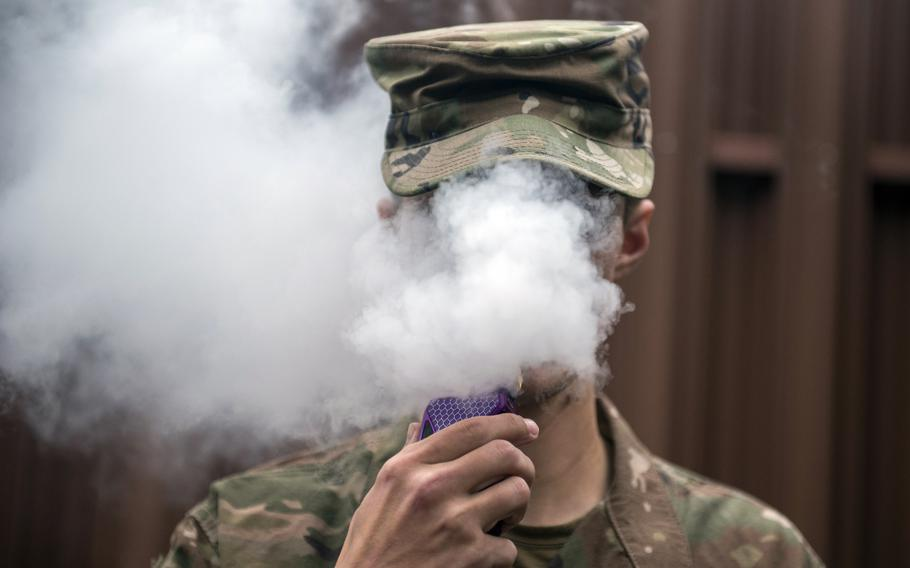
The article said DoD data show that 30% of active-duty military personnel use nicotine.
The author argued that these are service members often operating under extreme pressure, sleep deprivation and combat conditions, and that nicotine has long been part of how some troops manage that reality.
The article said the Pentagon’s January 2026 clinical guidelines prioritize abstinence and raise concerns about vaping and cancer risk, but remain silent on nicotine pouches, a smokeless and combustion-free product category.
Vermillion argued that the guidance fails to reflect operational reality and does not align with public comments from some senior DoD leaders regarding nicotine use and harm reduction.
The article noted that Air Force Gen. Dan Caine, chairman of the Joint Chiefs of Staff, has spoken publicly about the prevalence of nicotine use in combat environments.
The author said this should not be read as an endorsement of nicotine use, but as an acknowledgment of operational reality.
The article also said Assistant Secretary of Defense Dr. Stephen Ferrara had discussed the idea of helping service members move from combustible products to less harmful alternatives.
Vermillion argued that this represents a more rational harm-reduction framework.
He wrote that the main danger in tobacco comes primarily from combustion, rather than nicotine itself, and that alternatives such as nicotine pouches and vapor products are generally lower-risk than cigarettes.
The article criticized the DoD for sending three conflicting messages: senior military leadership recognizing nicotine use in the field, senior officials discussing harm reduction, and clinical guidance continuing to focus on abstinence.
Vermillion argued that when official guidance conflicts with operational reality and leadership signals, the guidance loses credibility.
He said service members are unlikely to stop using nicotine because of a clinical bulletin, and may instead stop taking such health guidance seriously.
The article also made a readiness argument, saying that if the DoD’s goal is military readiness, it should manage nicotine use that is likely to continue rather than assume one-third of the force will quit in the near term.
The author said combustible tobacco is the main problem and that helping troops transition to lower-risk alternatives is both more realistic and more consistent with readiness goals.
Vermillion specifically noted that nicotine pouches involve no combustion, smoke or secondhand exposure, which he said is relevant in confined environments such as submarines and aircraft.
He also said the U.S. Food and Drug Administration (FDA) has authorized marketing of at least one such product with reference to reduced risk.
The author argued that the DoD should acknowledge that decades of abstinence-first military tobacco policy have not produced abstinence and should explicitly incorporate harm reduction into its policy framework.
The article concluded that the Pentagon should treat nicotine pouches as a legitimate subject of guidance and resolve the contradiction between public leadership statements and written clinical policy.
The article is an opinion piece and reflects the author’s views, not an official position of the U.S. Department of Defense.
Cover image:Stars and Stripes
Disclaimer
This article is provided solely for professional research, industry discussion, and informational purposes. Any references to brands, companies, products, technologies, or policies are made for factual reporting and analytical purposes only, and do not constitute endorsement, recommendation, promotion, or advertising by 2Firsts.
Nicotine-containing products, including but not limited to cigarettes, e-cigarettes, heated tobacco products, and nicotine pouches, carry significant health risks. Readers are responsible for complying with all applicable laws and regulations in their respective jurisdictions, including age restrictions and access limitations.
The information contained in this article should not be regarded as investment, legal, medical, regulatory, or commercial advice. While 2Firsts strives to ensure the accuracy and reliability of its content, it does not assume liability for any direct or indirect loss arising from errors, omissions, inaccuracies, or reliance on the information contained herein.
This article is not intended for individuals below the legal age for accessing tobacco or nicotine-related information in their jurisdiction.
Copyright Notice
This article is either original content produced by 2Firsts or content reproduced, translated, summarized, or adapted from third-party sources with attribution where applicable. The intellectual property rights of the original content remain with 2Firsts or the respective original rights holders.
No individual or organization may copy, reproduce, distribute, republish, modify, translate, or otherwise use this content without prior authorization. Any unauthorized use may result in legal action.
For copyright-related inquiries, corrections, or removal requests, please contact: info@2firsts.com.
AI-Assisted Translation and Editing Notice
Portions of this article may have been translated, edited, or reviewed with the assistance of artificial intelligence tools to improve efficiency and readability. Due to the limitations of AI-assisted translation and editing, discrepancies, omissions, or inaccuracies may exist when compared with the original source.
Where applicable, readers are advised to refer to the original source for the most complete and accurate information. If you identify any errors or believe that any content infringes upon your rights, please contact us at info@2firsts.com, and we will review and address the matter promptly.