Vape Company Takes FDA to Court for Stalling Premarket Decision for Half a Decade

Nov.26.2025
Vape Company Takes FDA to Court for Stalling Premarket Decision for Half a Decade
California-based vape manufacturer Schwartz E-Liquid (USA Vape Lab) has sued the U.S. Food and Drug Administration (FDA) in federal court, alleging the agency unlawfully failed to issue a decision on its premarket application for flavored e-cigarette products for more than five years. The company is seeking a court order compelling the FDA to act within 90 days.

Key Points


  • Plaintiff: Schwartz E-Liquid (USA Vape Lab)
  • Defendant: U.S. Food and Drug Administration (FDA)
  • Court: U.S. District Court for the District of Columbia
  • Case Number: 1:25-cv-04093
  • Main Allegation: FDA violated federal law by failing to rule on a PMTA within the required 180 days
  • Requested Relief: Court order requiring FDA to issue a decision within 90 days
  • Counsel: Thompson Hine LLP represents Schwartz


2Firsts, November 26, 2025 — According to Law360,California vape company Schwartz E-Liquid, doing business as USA Vape Lab, has filed a lawsuit against the U.S. Food and Drug Administration (FDA) in the U.S. District Court for the District of Columbia, accusing the agency of unlawfully delaying its decision on flavored e-cigarette products for five years — far beyond the 180-day statutory limit under the Food, Drug, and Cosmetic Act (FDCA).


In the complaint filed Friday, Schwartz said the FDA’s inaction has left the company in “limbo,” unable to plan its business strategy or decide whether to continue investing in its flavored products. The lawsuit argues that the agency’s failure to issue a decision effectively blocks lawful market participation and creates uncertainty for American manufacturers.


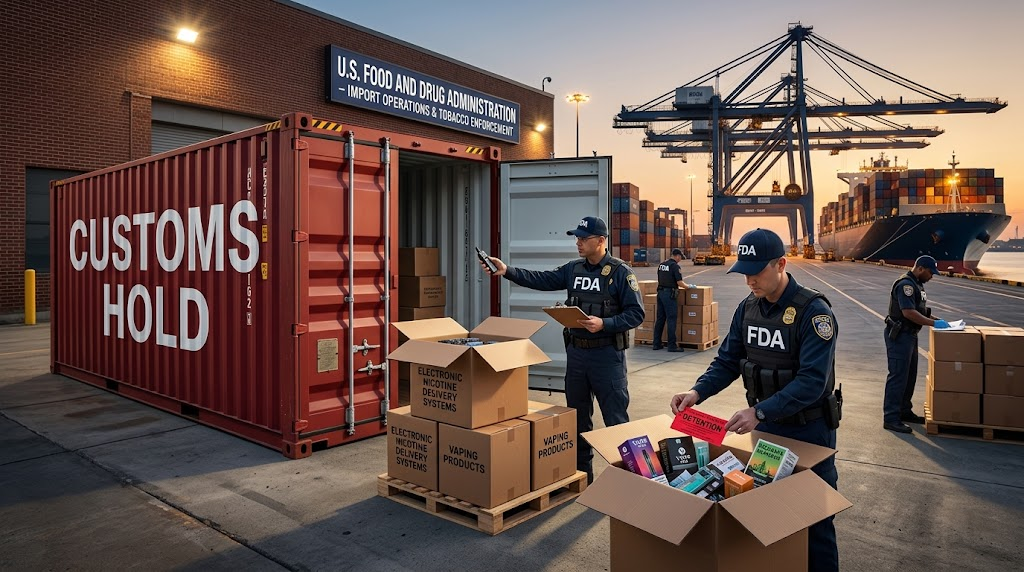
Schwartz further alleges that the FDA seized some of its products from a Chicago distributor despite claiming to exercise “enforcement discretion” toward products with pending premarket applications that were already on sale when FDA oversight began. The company contends that competing products remain on store shelves, while its own were unfairly targeted.


The complaint also accuses the FDA of favoring major tobacco firms — including Altria and Reynolds American — by conducting expedited reviews for their applications, even when those were filed long after Schwartz’s submission.


Schwartz is asking the court to compel the FDA to render a final decision within 90 days and to take into account the population-level reach of flavored products when evaluating their public health impact. The company argues that flavored e-cigarettes, while potentially less effective per user in reducing cigarette use, have far greater popularity and reach, resulting in a larger net reduction in smoking overall.


In a statement, Schwartz founder Huy Nguyen said:


“We felt that we had no choice but to initiate this lawsuit. The FDA has ignored its statutory duty for years while threatening American manufacturers with seizures over products that are still awaiting a lawful decision.”


The FDA did not immediately comment on the lawsuit.


Image source: Law360

We welcome news tips, article submissions, interview requests, or comments on this piece.

Please contact us at info@2firsts.com, or reach out to Alan Zhao, CEO of 2Firsts, on LinkedIn


Notice

1.  This article is intended solely for professional research purposes related to industry, technology, and policy. Any references to brands or products are made purely for objective description and do not constitute any form of endorsement, recommendation, or promotion by 2Firsts.

2.  The use of nicotine-containing products — including, but not limited to, cigarettes, e-cigarettes, nicotine pouchand heated tobacco products — carries significant health risks. Users are responsible for complying with all applicable laws and regulations in their respective jurisdictions.

3.  This article is not intended to serve as the basis for any investment decisions or financial advice. 2Firsts assumes no direct or indirect liability for any inaccuracies or errors in the content.

4.  Access to this article is strictly prohibited for individuals below the legal age in their jurisdiction.


Copyright


This article is either an original work created by 2Firsts or a reproduction from third-party sources with proper attribution. All copyrights and usage rights belong to 2Firsts or the original content provider. Unauthorized reproduction, distribution, or any other form of unauthorized use by any individual or organization is strictly prohibited. Violators will be held legally accountable.

For copyright-related inquiries, please contact: info@2firsts.com


AI Assistance Disclaimer


This article may have been enhanced using AI tools to improve translation and editorial efficiency. However, due to technical limitations, inaccuracies may occur. Readers are encouraged to refer to the cited sources for the most accurate information.

We welcome any corrections or feedback. Please contact us at: info@2firsts.com

Russia’s Vape Device Labeling Regime Enters Force: Registration Starts in September, Mandatory Coding in December
Russia's digital labeling regime for reusable e-cigarettes and similar personal vaping devices entered its first mandatory phase in September 2026. From September 1, manufacturers, importers and other market participants must register with the national Chestny ZNAK tracking system. From December 1, newly manufactured and imported covered devices will be required to carry digital identification codes and be reported as entering circulation. Russia has also issued new operational guidance for imports, marking the transition from a voluntary pilot to phased mandatory implementation.
Sep.15
FDA Revises Import Alert 98-07 Rules, Bringing May Enforcement Priorities Into Unauthorized ENDS Detentions
The U.S. Food and Drug Administration has revised the rules under Import Alert 98-07 to incorporate its May 2026 enforcement-priority policy for certain electronic nicotine delivery systems marketed without premarket authorization. The alert continues to allow detention without physical examination, or DWPE, for ENDS lacking required marketing authorization, while directing field divisions to apply the May risk-based framework. When necessary, detention or refusal decisions must also undergo review by the FDA's Center for Tobacco Products. Products including PACHA and Vuse Pro have already emerged as industry examples of the May policy, although enforcement discretion does not constitute FDA marketing authorization.
News
Sep.28 by 2Firsts Perspectives
Product | SMOORE's VAPORESSO Introduces VAST Refillable Vape With Three Resistances in One Pod
SMOORE-owned vaping brand VAPORESSO introduced the VAST refillable open-system vape in October 2026, featuring Tri-Core Mesh technology that integrates three resistance configurations—0.8Ω, 0.6Ω and 0.4Ω—within a single pod. The device supports different operating modes and e-liquid types. The standard version features a 10mL pod, while a TPD-labelled configuration combines a 2mL pod with an 8mL refill container. The device has a 1,600mAh battery and a maximum output of 30W. VAPORESSO claims up to six pod refills and a tested coil lifespan of up to 150,000 puffs. The UK's MHRA published a related device notification on October 12. The official MSRP is $25.90, compared with a $35.90 listing on VAPORESSO's direct store.
product
Oct.30
Malaysia's Poisons Board Backs New Vape Nicotine Exemption After Unanimously Opposing 2023 Proposal
Malaysia's Poisons Board has endorsed Health Minister Dzulkefly Ahmad's proposal to exempt liquid nicotine used in vaping products from the Poisons List, according to a November 2, 2026, report by CodeBlue. The Board unanimously opposed a similar proposal in 2023, but the government proceeded with the exemption. The Kuala Lumpur High Court invalidated the 2023 decision in May 2026, and the government withdrew its appeal in August. No new ministerial order has been published. The development raises questions about the interaction between Malaysia's two regulatory frameworks and the treatment of RM354.51 million in excise duties collected on e-cigarette and vape products between May 2023 and June 11, 2026.
Regulations
Nov.03
North Carolina Tightens Vape Product Directory Enforcement, Expands State and Local Powers as Violators Face Fines, Product Seizures and License Suspension or Revocation
North Carolina has expanded enforcement of its vapor product directory rules, authorizing more state and local law enforcement participation and establishing a task force led by the State Bureau of Investigation. The legislation requires at least one unannounced compliance inspection annually for retailers, distributors and wholesalers handling covered products. Penalties effective October 1, 2026, include civil fines of $500–$750 for a first violation and $1,000–$1,500 for repeated violations within 12 months, along with potential license suspension or revocation. Manufacturers may face penalties of $10,000 per unlisted product. The measures strengthen the product directory system established in 2024.
Regulations
Oct.28
India Steps Up Nicotine Pouch Enforcement as ZYN, White Fox Circulate and Drug Panel Urges Halt to New Nicotine Formulations
India's Ministry of Health and Family Welfare has directed states to step up enforcement against nicotine pouch sales, citing increased availability through online and offline channels and concern about nicotine exposure among children. Reuters reported that international brands including ZYN and White Fox are being sold in India. A study led by ICMR-NICPR found pouches in seven of 10 surveyed locations and identified 68 brands and 445 flavors online. Separately, India's Drugs Technical Advisory Board recommended in August that no new nicotine formulation be approved.
Regulations
Sep.28 by 2Firsts Perspectives