Russian State Duma Committee supports bill for tobacco and nicotine products market legalization

Nov.14.2025
Russian State Duma Committee supports bill for tobacco and nicotine products market legalization
A bill endorsing a licensing system for tobacco and nicotine products has been recommended in Russia's State Duma.

Key Points


  • The Russian State Duma's Economic Policy Committee has endorsed a bill for first reading, with plans to submit it for full chamber discussion on November 18. 
  • The bill proposes to implement a mandatory licensing system for the wholesale and retail trade of cigarettes, e-cigarettes (вейпы), and hookah products. 
  • The issuance of licenses is set to begin on March 1, 2026, with the selling of these products without a license becoming fully illegal starting on September 1, 2026. 
  • Wholesale licenses will be issued by the Federal Alcohol and Tobacco Regulatory Authority, while retail licenses will be issued by regional governments.


2Firsts, November 14, 2025 - According to Russian media outlet Rosbalt, the Economic Policy Committee of the Russian State Duma has recommended to the State Duma a bill for debate in the first reading aimed at "legalizing the tobacco and nicotine products market." The bill stipulates that the wholesale and retail trade of cigarettes, e-cigarettes, and waterpipe products will be subject to mandatory licensing, with licenses set to be issued starting from March 1, 2026 at the earliest.


Committee chair Maxim Topilin stated that the primary goal of this legislative initiative is to "increase market transparency and reduce the circulation of counterfeit products." He emphasized that the licensing system will bring positive economic effects to the country, including increased tax revenue.


According to the draft bill, wholesale licenses will be issued by the Federal Alcohol and Tobacco Control Agency (Rosalkogoltabakkontrol), while retail licenses will be issued by regional governments. To apply for a license, businesses must meet two criteria: be registered with the product traceability system "Honest Sign" and have a minimum operating area of at least 5 square meters. Regional governments have the authority to increase the minimum area requirement to 10 square meters.


Artem Kiryanov, Deputy Chairman of the State Duma's Economic Policy Committee, stated that he "firmly believes that a licensing system will significantly reduce violations of existing laws - including sales to minors." He added that the licensing system will effectively decrease the share of illegal products in the market: cigarettes by about 9.5% and the illegal share of so-called "e-cigarettes (вейпы)" by a conservative estimate of 67%, with industry assessments even exceeding 90%.


The bill will be implemented in stages.


Starting from March 1, 2026, licenses will be distributed; from September 1, 2026, operating without a license will be considered illegal; the transition period will continue until September 1, 2027, to allow businesses to adapt to the new regulations.


Image source: Rosbalt


We welcome news tips, article submissions, interview requests, or comments on this piece.

Please contact us at info@2firsts.com, or reach out to Alan Zhao, CEO of 2Firsts, on LinkedIn


Notice

1.  This article is intended solely for professional research purposes related to industry, technology, and policy. Any references to brands or products are made purely for objective description and do not constitute any form of endorsement, recommendation, or promotion by 2Firsts.

2.  The use of nicotine-containing products — including, but not limited to, cigarettes, e-cigarettes, nicotine pouchand heated tobacco products — carries significant health risks. Users are responsible for complying with all applicable laws and regulations in their respective jurisdictions.

3.  This article is not intended to serve as the basis for any investment decisions or financial advice. 2Firsts assumes no direct or indirect liability for any inaccuracies or errors in the content.

4.  Access to this article is strictly prohibited for individuals below the legal age in their jurisdiction.


Copyright


This article is either an original work created by 2Firsts or a reproduction from third-party sources with proper attribution. All copyrights and usage rights belong to 2Firsts or the original content provider. Unauthorized reproduction, distribution, or any other form of unauthorized use by any individual or organization is strictly prohibited. Violators will be held legally accountable.

For copyright-related inquiries, please contact: info@2firsts.com


AI Assistance Disclaimer


This article may have been enhanced using AI tools to improve translation and editorial efficiency. However, due to technical limitations, inaccuracies may occur. Readers are encouraged to refer to the cited sources for the most accurate information.

We welcome any corrections or feedback. Please contact us at: info@2firsts.com

Pennsylvania Vape Directory Law Survives Court Challenge From Nova Distro and Others Amid Similar Rulings Across States
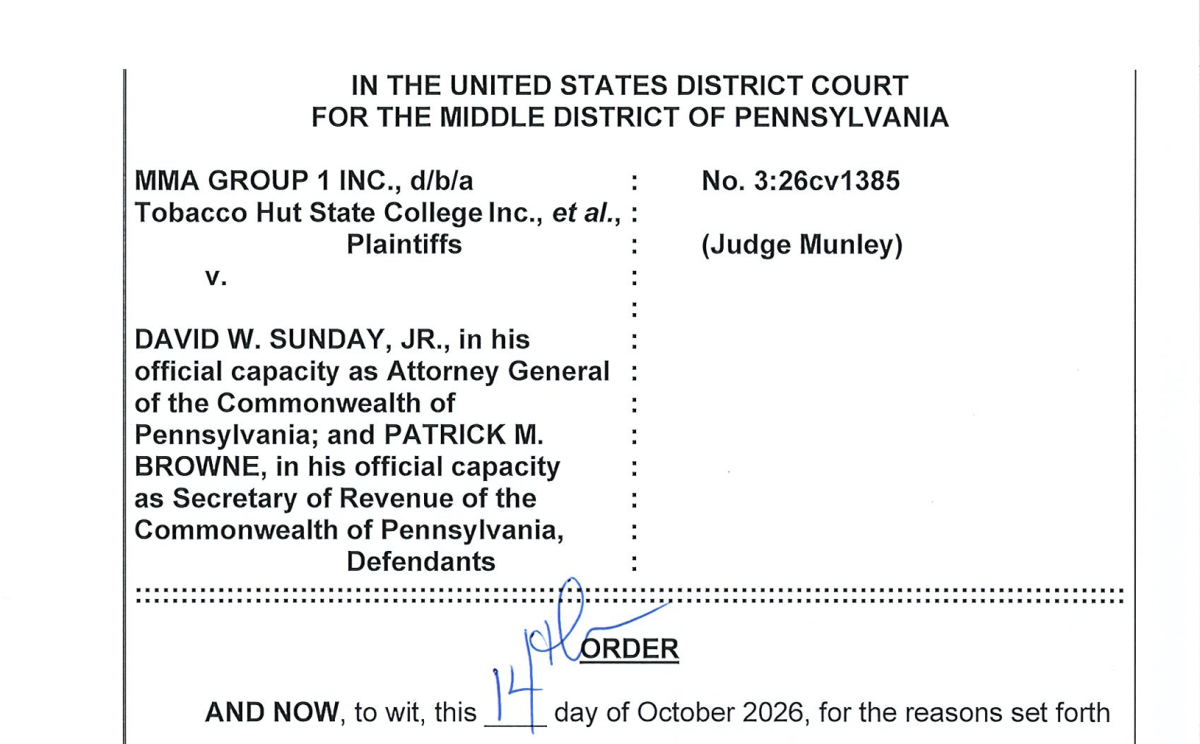
A U.S. federal court upheld Pennsylvania's vape directory law on October 14, rejecting a challenge brought by Nova Distro, 101 Distributors and companies operating Tobacco Hut retail stores. Court records show that vaping accounts for about 60% of Tobacco Hut's profits and that the chain held approximately $2 million in inventory potentially subject to seizure under the law as of June 2. Pennsylvania began enforcement on October 19. The ruling follows similar appellate decisions in other states, even as new research shows that unlisted vaping products continue to account for substantial sales in states with established directories.
Regulations
Oct.22
U.S. Ninth Circuit Upholds FDA Denial of MH Global’s Flavored Vape PMTA Applications
The U.S. Court of Appeals for the Ninth Circuit upheld the FDA’s denial of MH Global LLC’s applications to market flavored electronic nicotine delivery systems (ENDS). The court ruled that FDA’s comparative-efficacy framework, which requires applicants to show that flavored products provide greater cessation or switching benefits than tobacco-flavored alternatives, is consistent with the Tobacco Control Act’s “appropriate for the protection of the public health” standard. The court also found that FDA was not required to establish the framework through notice-and-comment rulemaking.
Aug.26
UK Extends Age-18 Rules to Zero-Nicotine Vapes and Nicotine Pouches From Oct. 29, Bans Vending Machines and Promotional Giveaways
Key provisions of the UK's Tobacco and Vapes Act 2026 will take effect on Oct. 29, extending an age-18 sales restriction to all vaping and non-medicinal nicotine products. In England, Wales and Northern Ireland, the change brings zero-nicotine vapes within statutory age-of-sale rules and also covers products including nicotine pouches, strips and pearls. The law will also prohibit proxy purchasing for under-18s, consumer-facing vending machines, promotional giveaways and substantial discounts intended to promote vaping and nicotine products.
Regulations
Oct.10
FDA Appoints Former Tobacco Enforcement Deputy Jessica Zeller as Director as Agency Weighs PMTA Framework Changes
The U.S. Food and Drug Administration (FDA) has named Jessica Zeller director of the Center for Tobacco Products' (CTP) Office of Compliance and Enforcement (OCE), effective November 1, 2026. Zeller, the office's inaugural deputy director, returns from medical device manufacturer Edwards Lifesciences with more than 20 years of regulatory and legal experience. The appointment follows CTP leadership changes and adjustments to tobacco regulation. Bret Koplow became permanent CTP director in September; the FDA revised enforcement priorities for unauthorized e-cigarettes and nicotine pouches in May and announced faster PMTA review procedures. On September 28, the agency said it would evaluate changes to the existing PMTA regulatory framework, including potential rulemaking to replace it.
FDA
Oct.20 by 2Firsts Perspectives
NATO Executive Director David Spross Sees U.S. Vape Regulation Improving, Calls for More PMTA Authorizations and Warns of 2027 State Tax Pressure
The National Association of Tobacco Outlets is calling for more FDA marketing authorizations, greater transparency in the PMTA process and continued enforcement against unauthorized e-cigarettes, even as its executive director, David Spross, points to recent regulatory developments as signs of progress. At the state level, excise taxes, flavor restrictions and vapor product directories remain major issues for tobacco retailers. By August 2026, 17 states had enacted laws establishing state-managed e-cigarette directories or similar systems.
Innovation
Sep.29 by 2Firsts Perspectives
Kantar Study Finds More Than 93% of Vape Products in Ukraine Fail Regulatory Requirements
According to Interfax-Ukraine, a study conducted by market research firm Kantar Ukraine at the request of major tobacco companies found that more than 93% of vape products in Ukraine did not fully comply with regulatory requirements. The research examined product categories, brand distribution and consumer purchasing channels, showing that pod systems and disposable vapes represent major segments of the market, while offline retail remains the dominant purchasing channel. The findings highlight ongoing compliance challenges in Ukraine’s vape market.
Aug.26