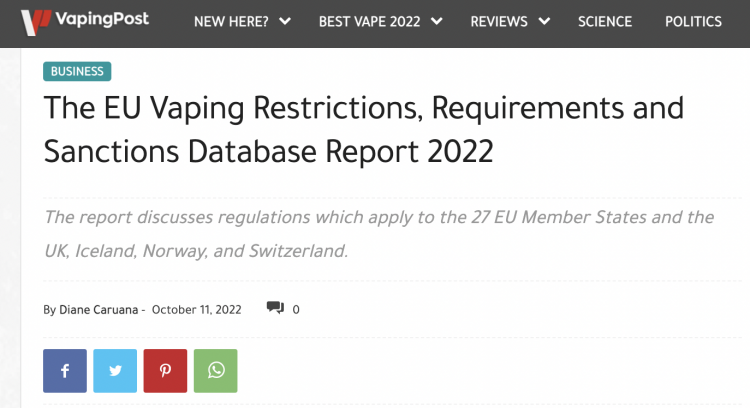
A report titled "Vaping EU Restrictions, Requirements, and Sanctions Database" has been added to the ResearchAndMarkets.com product lineup. The report provides important electronic cigarette regulations in Europe, allowing individuals to easily filter and compare relevant information. With this important tool, interested parties can find regulations applicable to various EU member states, the UK, Iceland, Norway, and Switzerland.
The report provides necessary insights into various aspects of the e-cigarette industry, through specific regulations, requirements, limitations, and expert analysis based on firsthand data collected from legislators and industry professionals of particular nations. A press release explained the report's aim to clarify this dispersed industry.
The report contains the following main sections:
New Regulations on Products and Retail: The TPD Notification, Related Proposals and Tax Penalties, Public Space Advertising and Marketing Laws. The regulations cover various areas of regulation related to products and retail, including limitations on advertising and marketing in public spaces.
Product packaging and labeling restrictions limit retail sales.
Report provided:
To effectively operate in different areas of the vaping industry, it is crucial to have an understanding of the regulations, requirements, and limitations of specific countries or regions. The most important restrictions in the proposed policy areas can be summarized and classified through color-coded tables. Comprehensive data is available to accurately interpret this fragmented industry. Each country's current regulations are compiled in one place. Links to external sources for regulations and recommendations are also provided. Experts have analyzed the information.
Key themes covered:
Product and retail restrictions:
The TPD product notification concerns proposals related to taxation and sanctions on advertising and marketing in public places, as well as packaging and labeling laws for products. The promotional material for Zhongdian Healthy Warning Leaflets is available in multiple packs and individually wrapped units, with zero nicotine. Meanwhile, the EU's Commissioner for Health and Food Safety, Stella Kyriakides, has made a statement questioning the effectiveness of e-cigarettes as a smoking cessation aid and even suggesting that they may serve as a gateway to smoking, spreading false information about e-cigarettes.
Michael Landl, director of the World Vapers' Alliance (WVA), expressed his disappointment that the European Commission continues to ignore the scientific evidence on e-cigarettes and make statements despite it. "It is shocking that the Commission is still peddling outdated and debunked theories," Landl said. "The Commission has systematically ignored vast scientific evidence pointing to the benefits of e-cigarettes, not to mention the firsthand experiences of millions of vapers. E-cigarettes are 95% less harmful than smoking and are a more effective smoking cessation method than traditional therapies such as gum and patches. The commission's approach to e-cigarettes will only cost lives.
The problematic statement is a written response to MEP Sara Skyttedal's inquiry about the future treatment of electronic and nasal snuff and their place in Europe's anti-cancer plan. "Overall, smokeless tobacco and emerging tobacco and related products contain nicotine, a toxic and highly addictive substance - known to cause significant health consequences - and they prolong nicotine addiction times. This is why these products are regulated and oral tobacco is banned in the EU," the statement concludes.
Sadly, Commissioner Kyriakides did not consider the scientific issues regarding nicotine and instead chose to ignore opinions from experts and consumers. A statement reveals that the European Commission intends to crack down on e-cigarettes, which is not a promising indication for the upcoming Tobacco Products Directive update. This strengthens the belief that consumers need to speak up and convince the representatives in the European Parliament to reduce harm, added Randall.
Statement:
This article was compiled based on third-party information and is intended solely for industry discussions and learning.
This article does not represent the views of 2FIRSTS, and 2FIRSTS cannot confirm the authenticity or accuracy of the content. The translation of this article is only intended for industry communication and research.
Due to the limitations of the translating ability, the translated article may not express the same meaning as the original. Please refer to the original article for accuracy.
2FIRSTS maintains complete alignment with the Chinese government on any domestic, Hong Kong-Macao-Taiwan-related, and foreign issues and stances.
The copyright of the compiled information belongs to the original media and author. If there is any infringement, please contact us for removal.
Disclaimer
This article is provided solely for professional research, industry discussion, and informational purposes. Any references to brands, companies, products, technologies, or policies are made for factual reporting and analytical purposes only, and do not constitute endorsement, recommendation, promotion, or advertising by 2Firsts.
Nicotine-containing products, including but not limited to cigarettes, e-cigarettes, heated tobacco products, and nicotine pouches, carry significant health risks. Readers are responsible for complying with all applicable laws and regulations in their respective jurisdictions, including age restrictions and access limitations.
The information contained in this article should not be regarded as investment, legal, medical, regulatory, or commercial advice. While 2Firsts strives to ensure the accuracy and reliability of its content, it does not assume liability for any direct or indirect loss arising from errors, omissions, inaccuracies, or reliance on the information contained herein.
This article is not intended for individuals below the legal age for accessing tobacco or nicotine-related information in their jurisdiction.
Copyright Notice
This article is either original content produced by 2Firsts or content reproduced, translated, summarized, or adapted from third-party sources with attribution where applicable. The intellectual property rights of the original content remain with 2Firsts or the respective original rights holders.
No individual or organization may copy, reproduce, distribute, republish, modify, translate, or otherwise use this content without prior authorization. Any unauthorized use may result in legal action.
For copyright-related inquiries, corrections, or removal requests, please contact: info@2firsts.com.
AI-Assisted Translation and Editing Notice
Portions of this article may have been translated, edited, or reviewed with the assistance of artificial intelligence tools to improve efficiency and readability. Due to the limitations of AI-assisted translation and editing, discrepancies, omissions, or inaccuracies may exist when compared with the original source.
Where applicable, readers are advised to refer to the original source for the most complete and accurate information. If you identify any errors or believe that any content infringes upon your rights, please contact us at info@2firsts.com, and we will review and address the matter promptly.