Key points
• Virginia filed a motion in the Fourth Circuit seeking a stay pending appeal
• A district court order partially blocked enforcement, finding preemption under the FDCA and TCA in part
• Virginia argues the statutes allow stricter state sales regulation and do not require state rules to differ from federal law
• Virginia says its law is an independent measure and can exclude products even if FDA-authorized when state registration steps are unmet
• Virginia challenges plaintiffs’ standing and claims irreparable public health harm without a stay
2Firsts, January 21, 2026
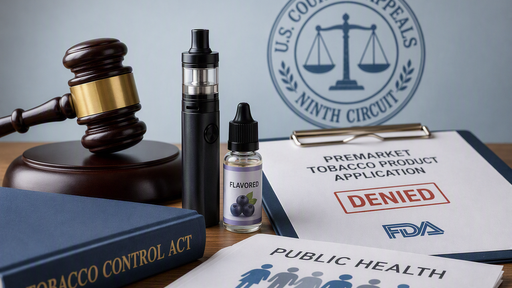
According to Law360, the Commonwealth of Virginia is asking the U.S. Court of Appeals for the Fourth Circuit to stay a district court order that blocks enforcement of certain aspects of a state law restricting the sale of unauthorized vaping products.
The report says Virginia filed a motion on Friday arguing the district court was wrong to conclude the law is preempted by the federal Food, Drug and Cosmetic Act (FDCA) and the Family Smoking Prevention and Tobacco Control Act (TCA). Virginia contends those statutes expressly allow states to impose stricter regulations on the sale of tobacco products and do not require state laws to be different from federal requirements. The state also describes the district court’s approach as an outlier compared with other jurisdictions that have rejected the same premise.
The dispute follows an order by U.S. District Judge David J. Novak that partially granted a request by Nova Distro Inc. and Tobacco Hut and Vape Fairfax Inc. to block enforcement of some provisions, finding preemption to the extent the state law was enforcing federal law.
Virginia argues that preemption requires a conflict between state and federal law, and that a state law incorporating and running parallel to federal standards does not create such a conflict. The state further argues the district court misread the TCA, and that the TCA’s savings clause covering state laws involving the sale or distribution of tobacco products contains no requirement that state rules must be different. Virginia says the district court’s view produces “anomalous” results, including allowing states to ban all e-cigarettes — even FDA-authorized ones — while preventing states from coordinating with federal oversight.
The report also notes Virginia’s position that its law is a separate measure rather than an impermissible attempt to enforce the FDCA, pointing out that even FDA-authorized products may be excluded if a manufacturer has not completed state registration steps.
Virginia additionally argues the plaintiffs lack standing because they have no legally protected interest in selling products that are already illegal under federal law, and that the plaintiffs are not challenging the validity of that federal law. The state says it will suffer irreparable harm to its ability to protect public health absent a stay, and that the balance of equities favors the state because the products at issue are illegal under federal law.
Image source: Law360
We welcome news tips, article submissions, interview requests, or comments on this piece.
Please contact us at info@2firsts.com, or reach out to Alan Zhao, CEO of 2Firsts, on LinkedIn
Notice
1. This article is intended solely for professional research purposes related to industry, technology, and policy. Any references to brands or products are made purely for objective description and do not constitute any form of endorsement, recommendation, or promotion by 2Firsts.
2. The use of nicotine-containing products — including, but not limited to, cigarettes, e-cigarettes, nicotine pouchand heated tobacco products — carries significant health risks. Users are responsible for complying with all applicable laws and regulations in their respective jurisdictions.
3. This article is not intended to serve as the basis for any investment decisions or financial advice. 2Firsts assumes no direct or indirect liability for any inaccuracies or errors in the content.
4. Access to this article is strictly prohibited for individuals below the legal age in their jurisdiction.
Copyright
This article is either an original work created by 2Firsts or a reproduction from third-party sources with proper attribution. All copyrights and usage rights belong to 2Firsts or the original content provider. Unauthorized reproduction, distribution, or any other form of unauthorized use by any individual or organization is strictly prohibited. Violators will be held legally accountable.
For copyright-related inquiries, please contact: info@2firsts.com
AI Assistance Disclaimer
This article may have been enhanced using AI tools to improve translation and editorial efficiency. However, due to technical limitations, inaccuracies may occur. Readers are encouraged to refer to the cited sources for the most accurate information.
We welcome any corrections or feedback. Please contact us at: info@2firsts.com