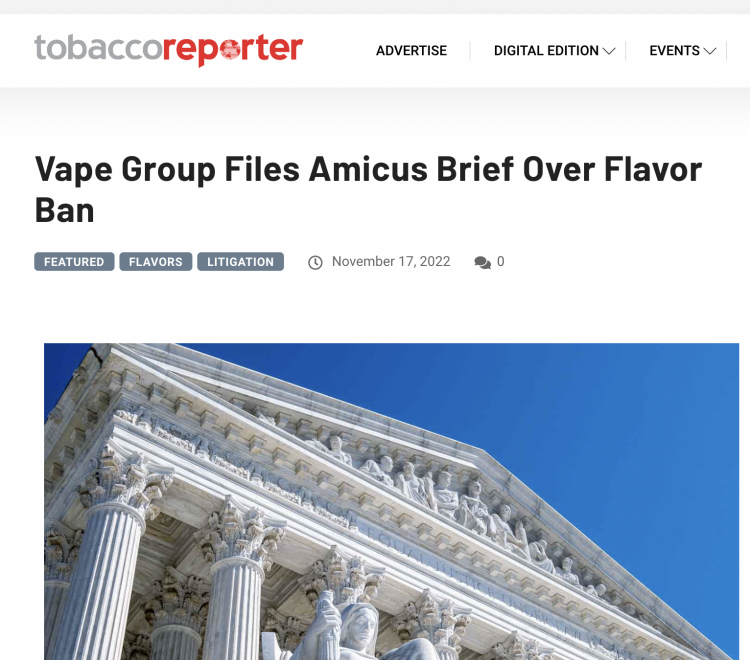
The American Vaping Association has submitted an amicus brief to the United States Supreme Court in support of seeking a subpoena in a case against the Los Angeles County ban on flavored tobacco products.
The trade organization cited the significant impact of tobacco product sales on the US economy and stated that the Supreme Court's review of the ban on flavored tobacco is crucial.
According to an economic impact report prepared by John Dunham and Associates, the electronic cigarette industry in the United States is composed of over 10,000 companies. This industry has created over 130,000 job positions and generated over $22 billion in economic activity for the American economy.
In its Friend of the Court brief, the Vaping Trade Association (VTA) argues that an unrestricted flavor ban would destroy the vaping industry, which relies heavily on selling flavored e-cigarette products to adult consumers.
The industry organization also noted that since the passage of the Los Angeles County ordinance, leading tobacco control scientists have questioned the concept of banning flavored e-cigarettes, warning that a decrease in the supply of flavored e-cigarette products could damage adult smokers' ability to quit smoking.
According to VTA in its Friends of the Court Brief, these tobacco control scientists are not advocating for a complete ban, but rather support alternative time, place, and manner restrictions on the sale of flavored e-cigarette products.
Local and state governments allowing the implementation of unscientific bans is directly interfering with the basic purpose of the Tobacco Control Act and overturning decisions made by the Food and Drug Administration regarding products deemed appropriate for protecting public health. According to the Vapor Technology Association, this not only violates the law but is also dangerous from a public health perspective. Tobacco and e-cigarette flavor bans are gaining momentum in the United States. On November 8th, Californians voted in favor of a state law that ends the sale of most flavored tobacco products.
Statement:
This article is compiled from third-party information and is intended only for learning and exchange within the industry.
This article does not represent the views of 2FIRSTS, and 2FIRSTS cannot confirm the truthfulness or accuracy of its content. The translation of this article is solely intended for industry-related discussion and research purposes.
Due to limitations in the compiler's proficiency, the translated article may not fully reflect the original text. Please refer to the original text for accuracy.
2FIRSTS maintains complete alignment with the Chinese government on any domestic, Hong Kong, Macau, Taiwan, or foreign-related matters concerning its statements and positions.
The copyright of compiled information belongs to the original media and author. If there is any infringement, please contact us for deletion.
Disclaimer
This article is provided solely for professional research, industry discussion, and informational purposes. Any references to brands, companies, products, technologies, or policies are made for factual reporting and analytical purposes only, and do not constitute endorsement, recommendation, promotion, or advertising by 2Firsts.
Nicotine-containing products, including but not limited to cigarettes, e-cigarettes, heated tobacco products, and nicotine pouches, carry significant health risks. Readers are responsible for complying with all applicable laws and regulations in their respective jurisdictions, including age restrictions and access limitations.
The information contained in this article should not be regarded as investment, legal, medical, regulatory, or commercial advice. While 2Firsts strives to ensure the accuracy and reliability of its content, it does not assume liability for any direct or indirect loss arising from errors, omissions, inaccuracies, or reliance on the information contained herein.
This article is not intended for individuals below the legal age for accessing tobacco or nicotine-related information in their jurisdiction.
Copyright Notice
This article is either original content produced by 2Firsts or content reproduced, translated, summarized, or adapted from third-party sources with attribution where applicable. The intellectual property rights of the original content remain with 2Firsts or the respective original rights holders.
No individual or organization may copy, reproduce, distribute, republish, modify, translate, or otherwise use this content without prior authorization. Any unauthorized use may result in legal action.
For copyright-related inquiries, corrections, or removal requests, please contact: info@2firsts.com.
AI-Assisted Translation and Editing Notice
Portions of this article may have been translated, edited, or reviewed with the assistance of artificial intelligence tools to improve efficiency and readability. Due to the limitations of AI-assisted translation and editing, discrepancies, omissions, or inaccuracies may exist when compared with the original source.
Where applicable, readers are advised to refer to the original source for the most complete and accurate information. If you identify any errors or believe that any content infringes upon your rights, please contact us at info@2firsts.com, and we will review and address the matter promptly.