Warning Issued by Ohio Health Department on Child E-cigarette Injuries

Oct.20.2023
Warning Issued by Ohio Health Department on Child E-cigarette Injuries
The Ohio Department of Health (ODH) has issued a warning about the increasing number of child e-cigarette-related injuries.

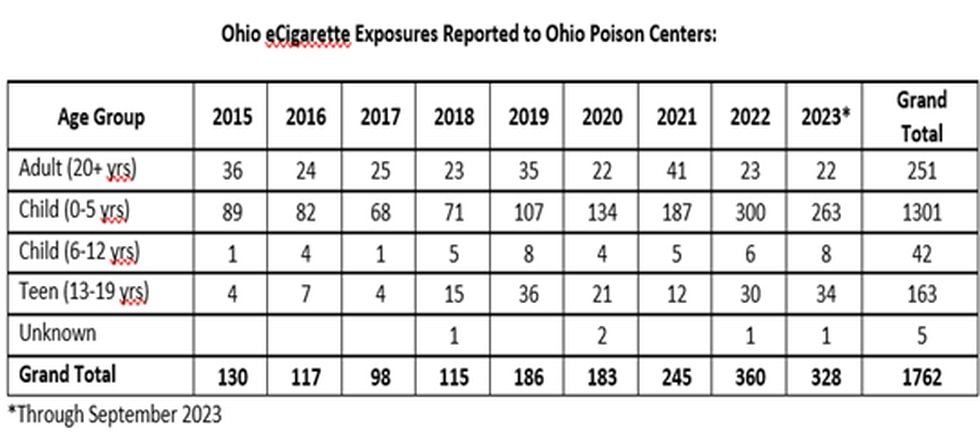
According to a report by WOIO on October 19th, the Ohio Department of Health (ODH) has issued a warning due to an increase in cases of children being harmed by e-cigarettes. Dr. Bruce Vanderhoff, Director of ODH, stated that the number of reported incidents of e-cigarette liquid exposure reported to the Ohio Poison Center has nearly doubled since 2015.
Warning Issued by Ohio Health Department on Child E-cigarette Injuries
Translate to English: Since 2015, reports of e-cigarette liquid exposure in Ohio have doubled. Image source: ODH.


He stated that most of these injuries affect children aged 5 and below, with various forms of harm including swallowing e-cigarette liquid, inhaling smoke, and absorption through the skin or eyes.


According to the Ohio Department of Health (ODH), symptoms of exposure to e-cigarette liquid may include mild nausea and vomiting. However, in cases of heavy exposure, it may have an impact on heart rate or blood pressure, and can potentially lead to seizures.


I believe many Ohioans are unaware of these very real risks, and I hope that individuals with e-cigarette items at home realize the potential dangers they pose to children.


We welcome news tips, article submissions, interview requests, or comments on this piece.

Please contact us at info@2firsts.com, or reach out to Alan Zhao, CEO of 2Firsts, on LinkedIn


Notice

1.  This article is intended solely for professional research purposes related to industry, technology, and policy. Any references to brands or products are made purely for objective description and do not constitute any form of endorsement, recommendation, or promotion by 2Firsts.

2.  The use of nicotine-containing products — including, but not limited to, cigarettes, e-cigarettes, nicotine pouchand heated tobacco products — carries significant health risks. Users are responsible for complying with all applicable laws and regulations in their respective jurisdictions.

3.  This article is not intended to serve as the basis for any investment decisions or financial advice. 2Firsts assumes no direct or indirect liability for any inaccuracies or errors in the content.

4.  Access to this article is strictly prohibited for individuals below the legal age in their jurisdiction.


Copyright


This article is either an original work created by 2Firsts or a reproduction from third-party sources with proper attribution. All copyrights and usage rights belong to 2Firsts or the original content provider. Unauthorized reproduction, distribution, or any other form of unauthorized use by any individual or organization is strictly prohibited. Violators will be held legally accountable.

For copyright-related inquiries, please contact: info@2firsts.com


AI Assistance Disclaimer


This article may have been enhanced using AI tools to improve translation and editorial efficiency. However, due to technical limitations, inaccuracies may occur. Readers are encouraged to refer to the cited sources for the most accurate information.

We welcome any corrections or feedback. Please contact us at: info@2firsts.com

Special Report | Altria's NACS Booth Raises Questions Over U.S. Tobacco Advertising Warnings
During its coverage of Altria's booth at NACS Show 2026, 2Firsts documented product displays that prompted questions about U.S. tobacco advertising warning requirements. Following public comments from a former FDA official, 2Firsts sought responses from Altria and independently consulted U.S. regulatory lawyer Azim Chowdhury. Altria maintained that its B2B communications complied with applicable laws, while Chowdhury explained that federal warning rules provide no general trade-show exemption for e-cigarettes and nicotine pouches. The special report examines the broader regulatory implications.
Nov.04
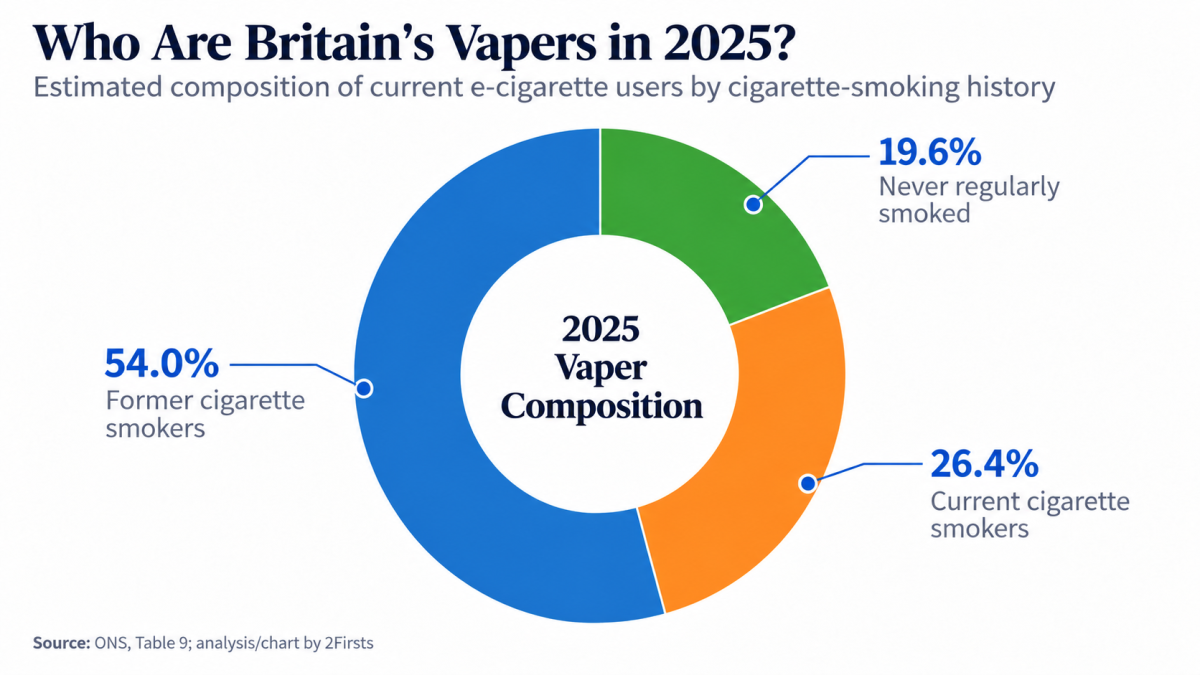
Latest UK ONS Data: 54% of Vapers Are Former Cigarette Smokers, 26% Also Smoke and 20% Never Smoked Regularly
Former cigarette smokers accounted for an estimated 54% of current e-cigarette users in Great Britain in 2025, while 26% also smoked cigarettes and 20% had never regularly smoked, according to a 2Firsts analysis of Office for National Statistics (ONS) data. Among former cigarette smokers who currently vape, approximately 81% used e-cigarettes daily, compared with about 50% of dual users. The ONS found that 33.8% of current cigarette smokers also vaped in 2025, up from 10.6% in 2014. Approximately 1.1 million adults who had never regularly smoked cigarettes used e-cigarettes, representing 2.9% of that population, compared with 0.2% in 2014. The figures highlight differences in the composition, frequency of use and long-term trends across Britain's vaping population.
DATA
Oct.14
Product | JT Launches Three Autumn-Limited Ploom Tobacco Sticks in Japan Across EVO, MEVIUS and CAMEL Brands
Japan Tobacco Inc. (JT) launched three limited-edition autumn tobacco sticks for its Ploom heated tobacco devices in Japan on October 16, 2026, under the EVO, MEVIUS and CAMEL brands. All three are regular tobacco variants with seasonal packaging. Each pack contains 20 sticks, priced at ¥620, ¥590 and ¥570, respectively, including tax. The products are compatible with all Ploom devices and are sold in limited quantities exclusively through the CLUB JT online store while supplies last.
product
Oct.20
FDA Revises Import Alert 98-07 Rules, Bringing May Enforcement Priorities Into Unauthorized ENDS Detentions
The U.S. Food and Drug Administration has revised the rules under Import Alert 98-07 to incorporate its May 2026 enforcement-priority policy for certain electronic nicotine delivery systems marketed without premarket authorization. The alert continues to allow detention without physical examination, or DWPE, for ENDS lacking required marketing authorization, while directing field divisions to apply the May risk-based framework. When necessary, detention or refusal decisions must also undergo review by the FDA's Center for Tobacco Products. Products including PACHA and Vuse Pro have already emerged as industry examples of the May policy, although enforcement discretion does not constitute FDA marketing authorization.
News
Sep.28 by 2Firsts Perspectives
Malaysia's Poisons Board Backs New Vape Nicotine Exemption After Unanimously Opposing 2023 Proposal
Malaysia's Poisons Board has endorsed Health Minister Dzulkefly Ahmad's proposal to exempt liquid nicotine used in vaping products from the Poisons List, according to a November 2, 2026, report by CodeBlue. The Board unanimously opposed a similar proposal in 2023, but the government proceeded with the exemption. The Kuala Lumpur High Court invalidated the 2023 decision in May 2026, and the government withdrew its appeal in August. No new ministerial order has been published. The development raises questions about the interaction between Malaysia's two regulatory frameworks and the treatment of RM354.51 million in excise duties collected on e-cigarette and vape products between May 2023 and June 11, 2026.
Regulations
Nov.03
Special Report | Vape bans and tougher rules: the South Caucasus takes different paths
Azerbaijan's sweeping e-cigarette ban has raised concerns over enforcement errors and the emergence of illicit sales, while neighboring Armenia is tightening technical rules and preparing higher excise taxes. Georgia, meanwhile, has resisted calls for broader vape restrictions and introduced preferential taxes for some domestically produced cigarettes. The divergent approaches across the South Caucasus highlight a regional policy dilemma: how to curb nicotine use and protect public health without encouraging black markets or creating unintended economic consequences for businesses and consumers.
Nov.03