WHO: Global Smoking Rate Down By One-Third Since Tobacco Control Treaty Took Effect 20 Years Ago

May.20.2025
WHO: Global Smoking Rate Down By One-Third Since Tobacco Control Treaty Took Effect 20 Years Ago
WHO chief Tedros said at the 78th World Health Assembly that global smoking rates have fallen by one-third since the tobacco control treaty took effect 20 years ago, preventing up to 300 million new smokers. He called for stronger regulation of e-cigarettes and new tobacco products.

Key Points:


1.World Health Organization (WHO) Director-General Tedros Adhanom Ghebreyesus pointed out that on the 20th anniversary of the implementation of the WHO Framework Convention on Tobacco Control, global smoking rates have decreased by one third.


2.Smoking causes over 8 million deaths annually, making tobacco the leading threat to public health.


3.Cigarettes remain the most common form of tobacco consumption globally, but other forms include hookah, cigars, mini cigars, hand-rolled cigarettes, pipe tobacco, bidis, and clove cigarettes.


4.The World Health Organization is facing financial constraints, but it is necessary to continue strengthening tobacco control policies and measures.


On May 19th, World Health Organization (WHO) Director-General Tedros Adhanom Ghebreyesus stated at the opening ceremony of the 78th World Health Assembly that global smoking rates have decreased by one-third since the official implementation of the WHO Framework Convention on Tobacco Control 20 years ago. If smoking rates do not decrease, the number of smokers today will increase by 300 million.


During his speech, he praised countries such as Ivory Coast, Oman, and Vietnam for implementing stricter regulations last year, including plain packaging and restrictions on e-cigarettes. He pointed out the World Health Organization's new guidelines on waste and the expansion of the Africa Tobacco-Free Farm Initiative, which has supported thousands of farmers in transitioning to growing food crops.


According to data provided by the World Health Organization, tobacco use continues to be a significant threat to public health. Tobacco is responsible for over 8 million deaths each year, with more than 7 million of those deaths attributed to current or former smokers, and over 1.2 million deaths resulting from exposure to secondhand smoke among non-smokers.


The World Health Organization has stated that all forms of tobacco use are harmful to health and there is no safe level of consumption. While cigarettes remain the most common form of tobacco consumption globally, other forms include hookah, cigars, cigarillos, hand-rolled cigarettes, pipe tobacco, bidis, and kreteks.


Despite the effectiveness of tobacco control measures over the past 20 years, tobacco continues to pose a significant threat to public health. It is necessary to continue strengthening tobacco control policies and measures in order to further reduce smoking rates and lessen the harm to health.


In addition, Tedros also expressed concerns about the tight funding of the World Health Organization, contrasting its budget with global expenditures:


"21 billion dollars is equivalent to global military spending every eight hours; 21 billion dollars is equivalent to the cost of a stealth bomber – used for killing people; 21 billion dollars is equivalent to a quarter of the tobacco industry's annual advertising and promotion expenses. And yet, this is another product for killing."


We welcome news tips, article submissions, interview requests, or comments on this piece.

Please contact us at info@2firsts.com, or reach out to Alan Zhao, CEO of 2Firsts, on LinkedIn


Notice

1.  This article is intended solely for professional research purposes related to industry, technology, and policy. Any references to brands or products are made purely for objective description and do not constitute any form of endorsement, recommendation, or promotion by 2Firsts.

2.  The use of nicotine-containing products — including, but not limited to, cigarettes, e-cigarettes, nicotine pouchand heated tobacco products — carries significant health risks. Users are responsible for complying with all applicable laws and regulations in their respective jurisdictions.

3.  This article is not intended to serve as the basis for any investment decisions or financial advice. 2Firsts assumes no direct or indirect liability for any inaccuracies or errors in the content.

4.  Access to this article is strictly prohibited for individuals below the legal age in their jurisdiction.


Copyright


This article is either an original work created by 2Firsts or a reproduction from third-party sources with proper attribution. All copyrights and usage rights belong to 2Firsts or the original content provider. Unauthorized reproduction, distribution, or any other form of unauthorized use by any individual or organization is strictly prohibited. Violators will be held legally accountable.

For copyright-related inquiries, please contact: info@2firsts.com


AI Assistance Disclaimer


This article may have been enhanced using AI tools to improve translation and editorial efficiency. However, due to technical limitations, inaccuracies may occur. Readers are encouraged to refer to the cited sources for the most accurate information.

We welcome any corrections or feedback. Please contact us at: info@2firsts.com

Special Report|Virginia Vape Directory Shows Contrast Between Vuse and JUUL Pod Systems and CrossBar 20K, Loon Flavored Disposables
A 2Firsts analysis of Virginia's liquid nicotine and vapor product certification directory identified 213 product records from 15 manufacturers. Companies associated with BAT, Altria, Imperial Brands, JTI and JUUL account for 127 entries. The directory also includes independent brands CrossBar 20K, Loon and Breeze. CrossBar advertises a 13mL disposable capable of up to 20,000 puffs, while Loon has 16 disposable entries featuring fruit, cooling and beverage-related flavors. Of all records, 120 are labeled as under FDA PMTA review. Virginia introduced revised penalties on October 1, 2026, including a minimum first-violation civil penalty of $5,000 per unlisted product, alongside new retail tobacco permitting requirements.
Regulations
Oct.30
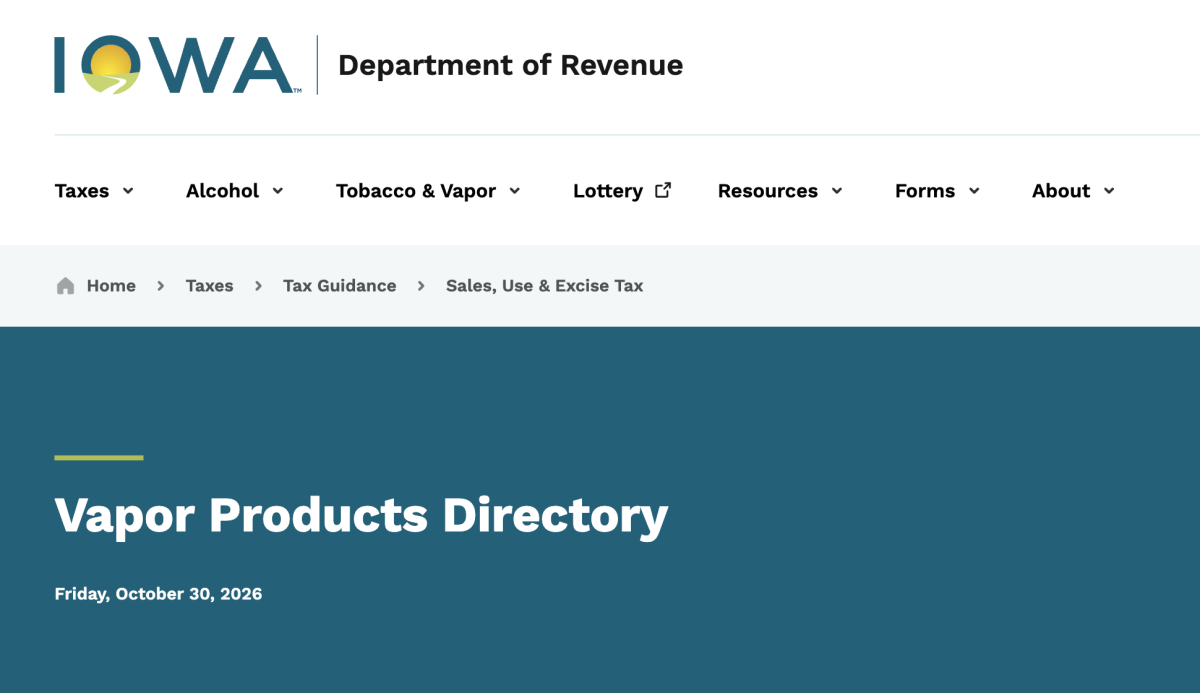
Iowa Sets November 16 Vape Directory Launch: Unlisted Products Face Sales Ban, Manufacturers $1,000 Daily Fines per Product
Iowa plans to publish its first vapor products directory on November 16, 2026, after which products not listed will be prohibited from sale or offer for sale in the state. The Department of Revenue expects to begin penalty enforcement on December 17, following an initial 21-business-day period focused on compliance education. Under House File 2677, retailers, distributors and wholesalers selling unlisted products face civil penalties of $300 per product per day, while manufacturers face $1,000 per product per day. Eligibility extends to FDA-authorized products and certain products meeting historical marketing and pending PMTA requirements. The directory program resumed after a federal appeals court vacated a preliminary injunction in July 2026.
Regulations
Nov.05
Special Report | From New York to Washington: How FDA’s Tobacco Center Is Reworking Product Review
FDA’s Center for Tobacco Products is reshaping how it approaches tobacco product review. Based on 2Firsts’ on-site reporting in New York and Washington, this report traces CTP’s emerging direction: stronger links between PMTA and tobacco harm reduction, more category-specific review, greater emphasis on decision-relevant science, more predictable timelines and expanded use of sPMTA for product modifications. CTP also acknowledged major constraints, including just nine PMTA review teams, persistent backlogs and limits on hiring capacity.
Regulations
Oct.08
German Tobacco Tax Revenue Falls 10.8% Through August as Tax-Paid Cigarette Volume Drops 12.6%
Germany collected €9.789 billion in total tobacco tax revenue from January through August 2026, down 10.8% from a year earlier, according to the Federal Ministry of Finance. Germany's tobacco tax base covers not only cigarettes and fine-cut tobacco but also heated tobacco and vaping liquids taxed as tobacco substitutes. The German Association of the Tobacco Industry and Novel Products, or BVTE, citing federal statistical data, said tax-paid cigarette volume fell 12.6% to 40.6 billion sticks. BVTE is using the latest figures to argue against further tax increases planned from 2027 through 2030, while Germany's parliament is scheduled to hold a first reading of the bill on September 24.
Sep.23
FRE and ALP Push Modern Oral to 48% of Q2 Sales as Turning Point Brands Changes CEO and Lowers Profit-Guidance Ceiling
Turning Point Brands said Executive Chairman David E. Glazek will become CEO on October 1, replacing Graham Purdy, who is stepping down for personal reasons. The company narrowed its 2026 adjusted EBITDA outlook to $70 million-$80 million from $70 million-$90 million while maintaining Modern Oral gross sales guidance of $330 million-$350 million and net sales guidance of $260 million-$270 million. In the second quarter, Modern Oral net sales rose 128% to $68.4 million and accounted for 48% of company-wide net sales. Adjusted EBITDA fell 50% year over year. TPB shares closed about 10% lower on September 21.
Market
Sep.22 by 2Firsts Perspectives
Why AIRSCREAM Built its European Production Hub for Regulated Market Growth
AIRSCREAM’s production hub in the Czech Republic brings nicotine pouch manufacturing, e-liquid bottling, product documentation, warehousing and international logistics into one operation, giving brands and commercial partners a practical platform from which to launch, expand and enter new markets.
Market
Sep.16 by 2Firsts Perspectives