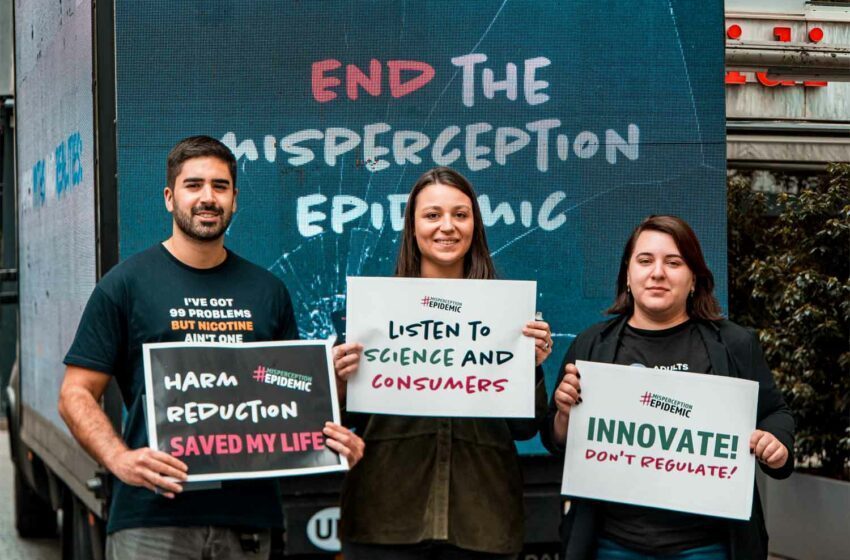
World Vapers' Alliance Protests Outside World Health Organization

Regulations by 2FIRSTS.ai
May.31.2024
World Vapers' Alliance Protests Outside World Health Organization
World Vapers Alliance protests outside WHO in Geneva, demanding recognition of e-cigarettes as harm reduction tools.

According to a recent report by the World Vapers Alliance, the World Vapers' Alliance (WVA) held a protest in front of the World Health Organization in Geneva on World Vape Day.


Participants in the event urged the global health organization to listen to consumers' voices and acknowledge that scientific evidence supports e-cigarettes, nicotine pouches, and similar products as effective harm reduction tools.


The organization expressed concerns about the prevalence of a "misinformation epidemic" surrounding tobacco harm reduction, stating that this misunderstanding is fueled by misleading information and prevents millions of people from switching to scientifically proven less harmful alternatives.


WVA director Michael Landl stated in a statement that...


The World Health Organization has turned World No Tobacco Day into a propaganda day. Sweden is on the verge of achieving a smoke-free status through alternative nicotine products. The World Health Organization needs to stop suppressing alternative nicotine products and start supporting them as key to achieving a smoke-free future. The WHO's erroneous statements are fueling a deadly epidemic of misunderstanding. Smokers should understand the truth: the health risks of e-cigarettes are far less than smoking. Accurate knowledge can save millions of lives.


We welcome news tips, article submissions, interview requests, or comments on this piece.

Please contact us at info@2firsts.com, or reach out to Alan Zhao, CEO of 2Firsts, on LinkedIn


Notice

1.  This article is intended solely for professional research purposes related to industry, technology, and policy. Any references to brands or products are made purely for objective description and do not constitute any form of endorsement, recommendation, or promotion by 2Firsts.

2.  The use of nicotine-containing products — including, but not limited to, cigarettes, e-cigarettes, nicotine pouchand heated tobacco products — carries significant health risks. Users are responsible for complying with all applicable laws and regulations in their respective jurisdictions.

3.  This article is not intended to serve as the basis for any investment decisions or financial advice. 2Firsts assumes no direct or indirect liability for any inaccuracies or errors in the content.

4.  Access to this article is strictly prohibited for individuals below the legal age in their jurisdiction.


Copyright


This article is either an original work created by 2Firsts or a reproduction from third-party sources with proper attribution. All copyrights and usage rights belong to 2Firsts or the original content provider. Unauthorized reproduction, distribution, or any other form of unauthorized use by any individual or organization is strictly prohibited. Violators will be held legally accountable.

For copyright-related inquiries, please contact: info@2firsts.com


AI Assistance Disclaimer


This article may have been enhanced using AI tools to improve translation and editorial efficiency. However, due to technical limitations, inaccuracies may occur. Readers are encouraged to refer to the cited sources for the most accurate information.

We welcome any corrections or feedback. Please contact us at: info@2firsts.com

UAE Sets Dh1-Per-ml Minimum Excise Price for Vape Liquids From Sept. 1 While Keeping 100% Tax Rate
The UAE Ministry of Finance will introduce a minimum excise price for e-liquids used in vaping and electronic smoking devices from September 1, 2026. The minimum excise price will be set at AED 1 per millilitre. The existing 100% excise tax rate will continue to apply to tobacco and electronic smoking products. The measure changes the minimum taxable base rather than the tax rate, with the UAE government saying it aims to establish unified tax standards, improve market compliance and prevent pricing loopholes.
Regulations
Aug.07 by 2Firsts Perspectives
PMI Expands Colorado Investment to $1.2 Billion to Boost ZYN Nicotine Pouch Production
Philip Morris International (PMI) is expanding its investment in its Golden, Colorado campus, bringing total investment to approximately $1.2 billion to support its smoke-free products business. The investment will strengthen PMI’s research, production and innovation capabilities in smoke-free products. As one of the world’s largest tobacco companies, PMI has continued advancing its “Smoke-Free Future” strategy through heated tobacco, oral nicotine and other reduced-risk product categories.
PMI
Jul.28
WIRED Investigation: Chinese-Made Vapes Turn to 6-Methyl-Nicotine and Other Analogs, Challenging U.S. Regulation
U.S. technology and investigative publication WIRED has examined how nicotine analogs are emerging as a new challenge for the country’s vape regulatory framework. The article argues that after the U.S. expanded federal oversight of nicotine products in 2022, some manufacturers began using nicotine-like compounds such as 6-methyl-nicotine that may fall outside existing definitions. Researchers cited by WIRED said some nicotine analogs could be more potent than traditional nicotine, although human health impacts remain unclear. U.S. policymakers are considering broader definitions of nicotine to bring these compounds under federal oversight.
Jul.27
KT&G’s Lil Strengthens Market Lead in Korea as Heated Tobacco Share Reaches 47.4%
According to South Korea’s UpKorea, KT&G’s heated tobacco brand Lil reached a 47.4% share of Korea’s heated tobacco stick market in the first quarter of 2026. The company is expanding its next-generation products (NGP) business through product development, technology investment and overseas growth. KT&G reported NGP sales of 890.1 billion won (approximately US$650 million) in 2025, up significantly from 279.3 billion won in 2020. Lil products are now available in 34 markets, while KT&G continues building its technology portfolio through patents and multiple product platforms.
Jul.23
China’s Zhengzhou Tobacco Research Institute develops end-to-end heated tobacco analysis to trace aerosol compound origins
The Zhengzhou Tobacco Research Institute of China National Tobacco Corporation has filed a patent application for an end-to-end method to analyze the migration and transformation of chemical compounds in heated tobacco products. Using GC-Orbitrap/MS non-targeted analysis, the method compares tobacco substrate and aerosol samples to distinguish compounds transferred directly from the substrate from those newly formed during heating, while also calculating transfer rates. In an example involving nine heated tobacco products, the patent identified 17 newly formed thermal decomposition compounds and 38 transferred compounds.
Aug.13
China’s HTP Exports Fell 14.3% in H1 2026 as Russia and Belarus Accounted for 76% Lead
In H1 2026, China’s HS 24041100 exports stood at $1.32 million, down 14.3% YoY, with volume falling 17.2% to 55.33 tons. Market distribution shifted drastically amid overall export drops. Exports to Russia and Belarus totaled $1 million, taking 76.0% of all shipments versus 29.5% in H1 2025. Belarus became the top destination with export value jumping 177.5%, while the Philippines, Singapore and Indonesia’s combined share slumped from 49.3% to 11.2%.Domestically, Yunnan led exporter registrations; Jiangsu and Shanghai were key suppliers, yet Anhui and Sichuan had no exports. Heavy concentration means order or declaration changes for Russia/Belarus greatly affect national aggregate data. The data shows customs entry points (not end markets), covering tobacco consumables only, excluding heating equipment and the complete HTP supply chain.
Aug.11