Yinghe Technology Q3 profit falls 25.9% to $21.7 million

Oct.28.2024
Yinghe Technology Q3 profit falls 25.9% to $21.7 million
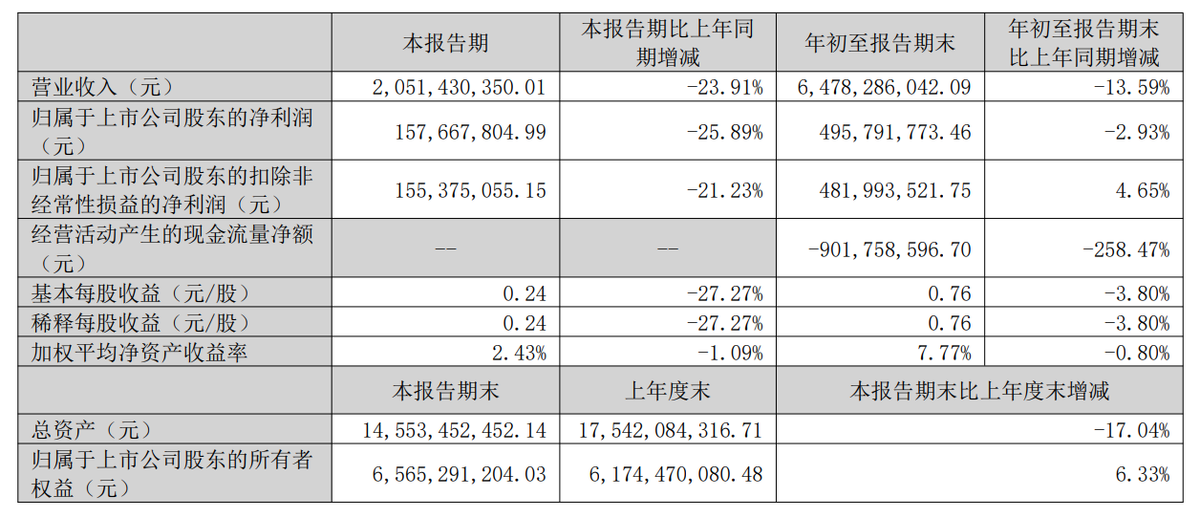
Yinghe Technology recently released its financial report for the third quarter of 2024, showing revenues of approximately $287.14 million, down 23.91% year over year and down approximately 20% quarter over quarter.

Shenzhen Yinghe Technology (stock code: 300457) recently released its third quarter financial report. The data shows that Yinghe's quarterly revenue was approximately $2.87 billion, down 23.91% year-on-year and down approximately 20% sequentially. Net profit attributable to shareholders was $221.2 million, down 25.89% year-on-year and 12.22% sequentially.


For the first three quarters of 2024, Yinghe reported total revenue of approximately US$9.07 billion, a decrease of 13.59% year on year, and net profit attributable to shareholders of US$694.4 million, a decrease of 2.93% year on year.
Yinghe Technology Q3 profit falls 25.9% to $21.7 million
Q3 financial report | Image source: Yinghe Technology


A comparison of Yinghe Technology's quarterly results in 2024 shows that net profit attributable to shareholders remained stable at $221.2 million in both Q1 and Q3. However, revenue increased slightly from $2.61 billion in Q1 to $2.87 billion in Q3.


We welcome news tips, article submissions, interview requests, or comments on this piece.

Please contact us at info@2firsts.com, or reach out to Alan Zhao, CEO of 2Firsts, on LinkedIn


Notice

1.  This article is intended solely for professional research purposes related to industry, technology, and policy. Any references to brands or products are made purely for objective description and do not constitute any form of endorsement, recommendation, or promotion by 2Firsts.

2.  The use of nicotine-containing products — including, but not limited to, cigarettes, e-cigarettes, nicotine pouchand heated tobacco products — carries significant health risks. Users are responsible for complying with all applicable laws and regulations in their respective jurisdictions.

3.  This article is not intended to serve as the basis for any investment decisions or financial advice. 2Firsts assumes no direct or indirect liability for any inaccuracies or errors in the content.

4.  Access to this article is strictly prohibited for individuals below the legal age in their jurisdiction.


Copyright


This article is either an original work created by 2Firsts or a reproduction from third-party sources with proper attribution. All copyrights and usage rights belong to 2Firsts or the original content provider. Unauthorized reproduction, distribution, or any other form of unauthorized use by any individual or organization is strictly prohibited. Violators will be held legally accountable.

For copyright-related inquiries, please contact: info@2firsts.com


AI Assistance Disclaimer


This article may have been enhanced using AI tools to improve translation and editorial efficiency. However, due to technical limitations, inaccuracies may occur. Readers are encouraged to refer to the cited sources for the most accurate information.

We welcome any corrections or feedback. Please contact us at: info@2firsts.com

PMI Q2 Revenue Rises 10.4% as IQOS and VEEV Expand, U.S. ZYN Growth Slows
Philip Morris International’s second-quarter net revenues rose 10.4% to a record $11.19 billion, as heated tobacco and e-vapor expanded across international markets. IQOS remained the main smoke-free growth engine, while VEEV shipments jumped 55.1%. In the United States, however, ZYN shipments increased just 1.8% and consumer offtake was broadly flat to slightly higher. Cigarette volumes also rose, showing that PMI’s transformation is advancing, but growth is becoming increasingly uneven across categories and markets.
PMI
Jul.22
WIRED Investigation: Chinese-Made Vapes Turn to 6-Methyl-Nicotine and Other Analogs, Challenging U.S. Regulation
U.S. technology and investigative publication WIRED has examined how nicotine analogs are emerging as a new challenge for the country’s vape regulatory framework. The article argues that after the U.S. expanded federal oversight of nicotine products in 2022, some manufacturers began using nicotine-like compounds such as 6-methyl-nicotine that may fall outside existing definitions. Researchers cited by WIRED said some nicotine analogs could be more potent than traditional nicotine, although human health impacts remain unclear. U.S. policymakers are considering broader definitions of nicotine to bring these compounds under federal oversight.
Jul.27
Nearly Half of Seoul Vape Vending Machines Bypassed by Fake IDs, Raising Youth Access Concerns
Seoul city authorities inspected 339 tobacco vending machines at e-cigarette retailers and found that 168, or 49.5%, allowed purchases using fake IDs, showing that unmanned retail terminals and adult-verification systems remain a major enforcement gap after e-cigarettes were brought under tobacco regulation.
Market
Jul.03 by 2Firsts Perspectives
Canadian Court Allows Juul and Altria Vape Class Action to Move Forward Over Youth Marketing Claims
A Quebec Superior Court has allowed a class action lawsuit against Juul Labs and Altria Group related to vaping products to proceed, involving allegations concerning marketing practices, youth exposure and corporate responsibility. The ruling only allows the case to move forward and does not represent a finding that Juul or Altria are legally liable. The case highlights continued legal risks facing vape companies regarding product marketing, youth protection and corporate accountability.
Jul.28
South Korea Vape Strategies Diverge as BAT Reconsiders Exit and PMI Takes VEEV to About 14,000 Stores
BAT Rothmans says it previously considered exiting South Korea's vaping market because of competitive pressure from unregulated products, but is now reassessing conditions following changes to the country's nicotine regulatory framework. Vuse and other BAT vaping products remain available through existing distribution channels. The statement followed a South Korean media report that interpreted BAT's broader withdrawal from selected Vapour markets as a full exit from South Korea. Meanwhile, Philip Morris International launched VEEV inPRIME in the country in June and began expanding distribution to around 14,000 convenience stores and other retail channels in July. The contrasting moves highlight differing investment strategies as South Korea's regulated vaping market evolves.
Aug.14
PMI Q2 Call: ZYN Growth, IQOS Pricing and a Diverging Global Tobacco Market
Philip Morris International’s second-quarter earnings call offered new detail on its smoke-free strategy. Management said it would increase U.S. investment behind nicotine pouch brand ZYN, keep IQOS focused on volume before stronger pricing, and use SENTIA, DELIA, LEVIA, VEEV and ZYN to manage tax and regulatory pressure across Japan and Europe. Analysts from Goldman Sachs, Morgan Stanley, UBS and other firms also pressed PMI on profitability, market share, cigarette resilience and the durability of its global transformation over coming quarters.
Jul.24