Disclaimer:
1、This article is an expert opinion submission, and 2FIRSTS has obtained the author’s authorization to publish it.
2、The views and opinions expressed herein are solely those of the expert and do not represent the position of 2FIRSTS.
3、2FIRSTS shares this article to disseminate information and present diverse perspectives. Readers should exercise independent judgment and caution when interpreting or citing the information and opinions contained herein.
Key Points
1. China Customs Seized Over 265,000 ZYN-Labeled Nicotine Pouches
Recent enforcement actions exposed the legal gray area surrounding nicotine pouches, which are not clearly defined under Chinese law.
2. ZYN Trademark Faces Risk of Revocation for Non-Use in China
Due to regulatory restrictions, ZYN products cannot be lawfully sold or manufactured in China—making it difficult for the rights holder to prove actual trademark use.
3. Trademark Revocation Could Undermine Legal Enforcement
If the ZYN trademark is revoked, it may weaken the legal basis for customs seizures, civil lawsuits, and even criminal prosecutions.
4. Post-Revocation, the Trademark May Be Vulnerable to Hijacking
Once revoked, the ZYN mark could be registered by others unless the brand proves it is well-known in China—an extremely difficult threshold under current law.
5. Foreign Tobacco Brands Must Align IP Strategy with Supply Chain Use in China
Holding a valid trademark is not enough—foreign brands must establish genuine “use” ties within China to protect their rights.
The English translation is for reference only. Please refer to the Chinese version as the authoritative text.
Author:Liu Peiling, an intellectual property attorney at Tian Yuan Law Firm in Beijing.
On October 3, 2025, China Customs’ official Weibo account “Customs Release” reported that Ningbo Customs (Beilun Branch) and Huangpu Customs had successively seized 265,140 boxes of suspected trademark-infringing and undeclared oral tobacco products during export inspections. Among these, Ningbo Customs intercepted 255,740 boxes (including 212,960 labeled “ZYN” and 42,780 unbranded), while Huangpu Customs seized 9,400 boxes (all labeled “ZYN”).
(Related Reading:China Customs Seizes Over 265K Oral Nicotine Pouches; ‘ZYN’ and Unbranded Products Flagged for IP Violations)
The seized products are, in essence, “nicotine pouches,” not “oral tobacco” (snus or snuff) as defined by China’s national standard GB/T 18771.2. That standard defines “oral tobacco” specifically as “a finished product in the form of loose or small pouch-packed fine tobacco particles or shredded tobacco.” In contrast, nicotine pouches are made from nicotine (also known as “nicotiana” or “alkaloid”) and are not yet clearly defined under any Chinese law or regulation.
This regulatory vacuum directly impacts how Customs enforces the law regarding ZYN products: How should the product be categorized? Who has the authority to make this determination? On what legal basis? Should the conduct be treated as trademark counterfeiting, illegal business operation, or production of substandard products?
These unresolved questions highlight the broader trademark dilemma facing the ZYN brand in China.
Trademark Registration Status of ZYN Nicotine Pouches in China
(1) Trademark Record with the General Administration of Customs
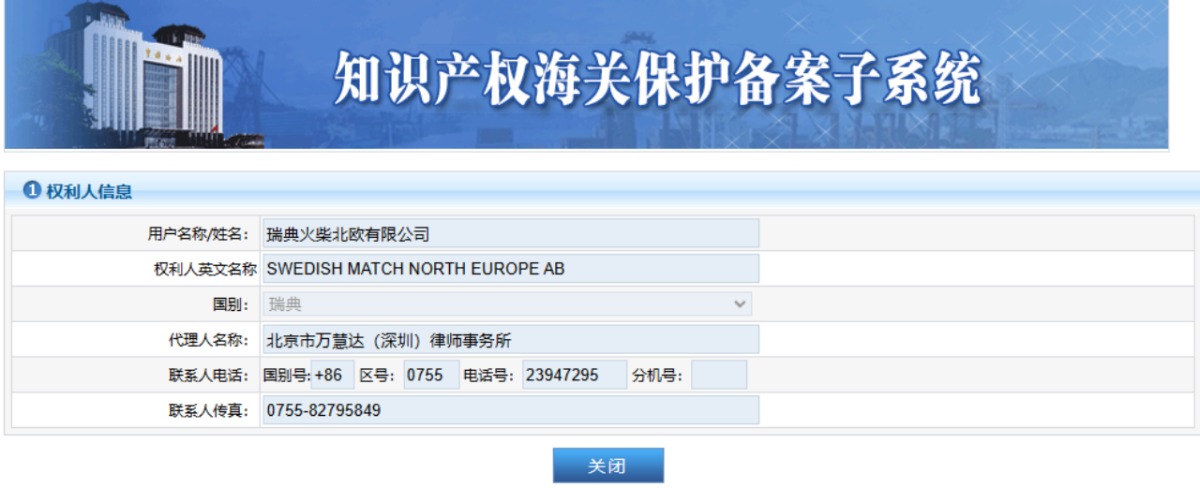
According to a search of the Intellectual Property Customs Protection Filing Subsystem, the trademark rights holder of “ZYN” filed with China’s General Administration of Customs is Swedish Match North Europe AB. The registered trademark number is G1421212. This trademark was submitted via the Madrid System for international registration, and its validity period in China began on November 10, 2022. Detailed filing information is as follows:
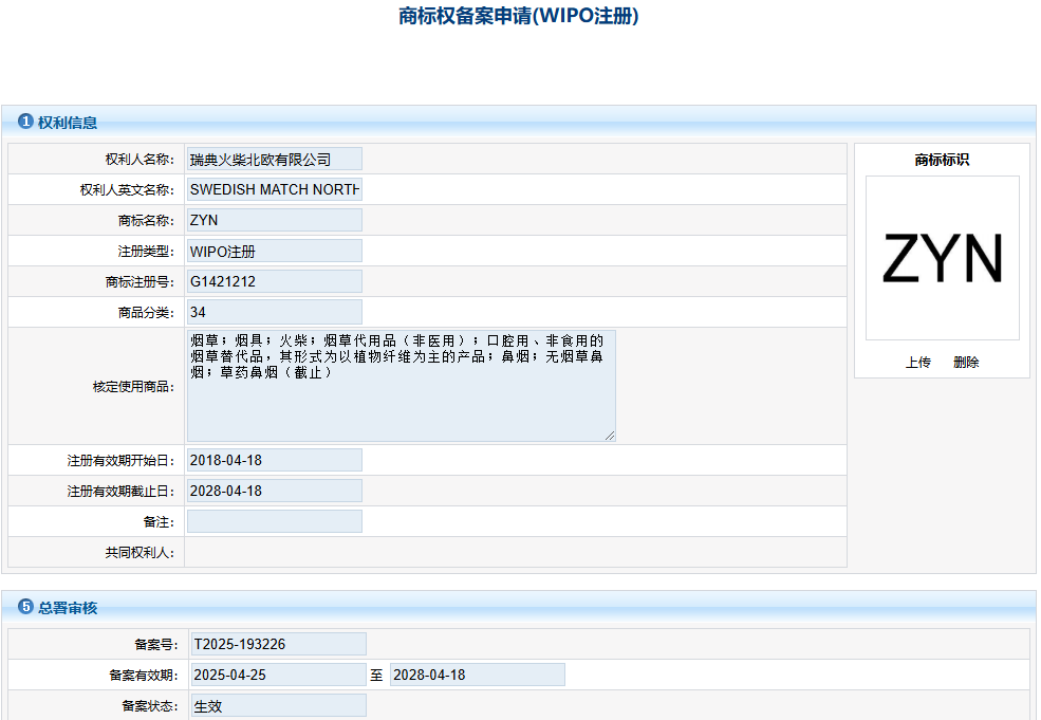
Although the nicotine pouch products involved attempt to correspond to the approved goods category of “oral, non-edible tobacco substitutes (primarily plant fiber-based),” this description more closely resembles the definition of “oral tobacco” under GB/T 18771.2, and therefore differs in nature from pure nicotine-based products.
(2) Domestic Trademark Registration Status
A search shows that Swedish Match North Europe AB has filed trademark applications for “ZYN” under multiple categories in China, including Classes 3, 5, 6, 9, 16, 18, 25, 28, 30, 32, 33, 34, and 41. At present, only the trademark G1421212 under Class 34 has been granted approval. This class covers: snuff; herbal snuff; tobacco substitutes (non-medical); tobacco; oral, non-edible tobacco substitutes in the form of plant fiber-based products; tobacco-free snuff; smoking articles; and matches. Applications under other classes are still pending approval.
It is also noteworthy that the G1421212 trademark is currently undergoing “cancellation/invalidation review proceedings.”
In addition to Swedish Match North Europe AB, certain domestic Chinese companies have also applied for trademarks related to “ZYN” under tobacco-related categories such as Classes 5 and 34. As of now, only Rongshi Integrated Circuit Research (Shenzhen) Co., Ltd. has three trademarks under Class 5 (registration numbers 84023619, 74044680, 74042368) that are either in the “preliminary publication” phase or undergoing “post-approval cancellation/invalidation review.” Other related applications have not yet been approved.
Trademark Revocation Risks and Legal Barriers for ZYN in China
(1) Risk of Trademark Revocation
At present, the regulation of nicotine pouches (including those marketed as ZYN oral nicotine products) in China has not been defined through legislation, administrative regulations, or official standards. However, from the perspective of legal theory and global tobacco regulatory practice—along with documents issued by the State Tobacco Monopoly Administration—there is a strong rationale for including nicotine pouches within the scope of tobacco monopoly management. This, in turn, determines whether ZYN products can be legally “used” in China.
Article 49 of China’s Trademark Law establishes the “three-year non-use cancellation” rule. It stipulates: “If a registered trademark has not been used for three consecutive years without a justified reason, any entity or individual may apply to the Trademark Office for cancellation of the registration.” This rule is designed to prevent hoarding of trademarks and to promote genuine commercial use.
Due to the absence of legal authorization, all nicotine pouch products—including ZYN—face legal uncertainty regarding sales in China. Even contract manufacturing within China carries legal risks, especially when nicotine (particularly tobacco-derived nicotine) is involved. Against this backdrop, the registered “ZYN” trademark in China is highly susceptible to cancellation due to non-use.
In the ongoing revocation proceedings concerning the G1421212 trademark, the primary challenge for the rights holder is how to prove actual use of the ZYN trademark within China.
The “Trademark Examination and Adjudication Guidelines” in China explicitly state that use of the disputed trademark solely for export—without entering the domestic market—can still be deemed valid use. However, the trademark owner must provide solid evidence of such domestic use, including customs export declarations, sales invoices, agreements, and payment vouchers.
Reference Case: In the revocation review of the No. 15119363 “BOSSA NOSSA” trademark, a foreign company submitted evidence including agreements, invoices, customs declarations, and payment receipts for commissioning a Chinese enterprise to manufacture “BOSSA NOSSA” branded clothing (tops, pants, swimsuits, etc.). The China National Intellectual Property Administration (CNIPA) held that since the manufacturing took place within China and followed the “Made in China, sold abroad” model, the activity constituted “real, active, and public use,” and upheld the trademark registration.
In contrast, the ZYN trademark faces regulatory hurdles under China’s tobacco monopoly and electronic cigarette management policies. ZYN nicotine pouches are not only barred from legal sales but may not even qualify for lawful contract manufacturing in China.
Dilemma: For Swedish Match North Europe AB (or Philip Morris International), it is extremely difficult to provide evidence that meets the criteria in the Trademark Guidelines—such as whether ZYN nicotine pouches can be lawfully manufactured in China; whether Chinese manufacturers are willing to provide supporting documents like production or export records to help sustain the trademark; and whether the submitted evidence meets the legal standards of authenticity, legality, and relevance. All of these uncertainties greatly increase the risk of trademark revocation.
(2) Enforcement Challenges Related to ZYN’s Trademark in China
1. Obstacles in Criminal Proceedings
According to Article 55 of the Trademark Law, once a trademark is revoked for “non-use for three consecutive years,” the exclusive rights to that trademark are terminated as of the date of the revocation announcement. Importantly, this does not retroactively affect effective judgments or decisions that were made prior to the revocation—such as criminal verdicts, administrative penalties, or customs seizures based on the now-revoked trademark. These remain valid.
However, if the revocation occurs before a verdict is rendered in a criminal case—for example, one involving “counterfeiting of a registered trademark”—then the basis for conviction may no longer hold, due to the application of the principle of leniency under earlier or lighter laws (“从旧兼从轻” principle in Chinese criminal law).
Moreover, during investigations into trademark counterfeiting crimes, prosecutors and courts often rely on critical evidence such as:
- actual use of the trademark in China by the rights holder;
- brand recognition and reputation in the Chinese market;
- the commercial value (price) of the allegedly infringed product.
In our assessment, it will be extremely difficult for Swedish Match North Europe AB (or Philip Morris International) to provide such evidence demonstrating lawful use or manufacturing of ZYN nicotine pouches within China. As such, from the perspective of criminal defendants, initiating revocation proceedings may serve as a strategic move to undermine the legal foundation of trademark enforcement—effectively “pulling the rug out from under” the prosecution.
2. Challenges in Customs and Administrative Enforcement
Article 2 of the “Regulations of the People’s Republic of China on Customs Protection of Intellectual Property Rights” defines customs IP protection as enforcement by customs authorities of rights related to trademarks, copyrights and related rights, and patents that are protected under Chinese laws and administrative regulations.
In addition, the implementation measures for the same regulation stipulate that trademark rights holders must submit a copy of their trademark registration certificate issued by the State Administration for Industry and Commerce (now the China National Intellectual Property Administration) when filing an application for customs protection with the General Administration of Customs.
This means that customs protection of trademarks in China hinges on a critical prerequisite: the trademark must be legally registered and protected under Chinese law.
If the “ZYN” trademark (G1421212) is ultimately revoked, then the legal basis for its record with China Customs will be invalidated. This would result in the loss of customs protection for ZYN nicotine pouches in cross-border trade, and authorities would no longer be able to seize infringing goods at the border. Moreover, civil lawsuits, administrative actions, and even criminal penalties involving the “ZYN” trademark would lack legal grounds once the exclusive rights are terminated—effectively stalling all enforcement or rights-protection actions.
(3) Risk of Trademark Hijacking After Revocation
Article 50 of the Trademark Law stipulates:
“If a registered trademark is canceled, the Trademark Office shall not approve any application for the same or a similar trademark within one year from the date of revocation.”
This so-called “one-year grace period” is intended to give the original rights holder time to reorganize evidence and refile for trademark registration. It also serves to prevent the trademark from being immediately and chaotically re-registered by unrelated parties.
However, once this grace period ends, other market participants are free to apply for the same or similar “ZYN” trademark. Although Article 32 of the Trademark Law provides some protection by stating:
“Applications for trademark registration shall not infringe upon the existing prior rights of others, nor may they be filed in bad faith by preempting the registration of a trademark that has already been used and has a certain degree of influence,”this clause, while intended to protect unregistered trademarks with some market influence, sets a high bar for proof—especially when the trademark was only used outside of China.
For example, Article 11.5 of the “Guidelines of the Beijing High People’s Court for Adjudicating Trademark Authorization and Confirmation Cases” provides further clarification:
“If a prior trademark enjoys a high level of recognition in other countries or regions, but there is insufficient evidence of actual use or recognition among the relevant public in China prior to the application date of the contested trademark, it shall not be deemed well-known within China.”
As a result, for internationally recognized brands like ZYN, to block others from registering the “ZYN” trademark in China, the original rights holder must usually prove that the trademark has already attained the status of a “well-known mark” in the Chinese market.
It is important to note that brand awareness formed overseas does not automatically extend to China. The burden of proof falls entirely on the trademark owner (Swedish Match North Europe AB or Philip Morris International), who must demonstrate:
- actual use of the “ZYN” trademark within China,
- a certain degree of market recognition,
- or that “ZYN” constitutes the distinctive name of a well-known product.
Given that ZYN nicotine pouches cannot currently be legally used or marketed in China, meeting these evidentiary requirements is exceptionally difficult. This significantly increases the risk of trademark hijacking after revocation.
Conclusion
As new tobacco products rise globally, China has emerged as a hub for innovation and supply chains in the sector. However, for foreign tobacco companies, navigating China’s regulatory and intellectual property landscape remains a formidable challenge.
From technology innovation to patent strategy, trademark deployment, and ultimately brand development, international tobacco and e-cigarette companies cannot afford to overlook the dual risks posed by Chinese regulatory uncertainty and intellectual property enforcement.
In this context, the ability to hold a valid trademark—and more importantly, to establish a meaningful and legally recognized “use” relationship with Chinese supply chains—has become a strategic imperative. It is no longer enough to register a trademark in China; foreign rights holders must also ensure that their trademarks are actively used and defensible under Chinese law.
Only by doing so can they avoid cancellation risks, preserve enforcement capabilities, and protect their brands against infringement or unauthorized registration in the Chinese market.
About the Author
Liu Peiling, an intellectual property attorney at Tian Yuan Law Firm in Beijing, with extensive experience in the tobacco and new tobacco products sectors.
Cover image source: ChatGPT