Analysis of 2024 February E-cigarette Exports from China to Hungary

Industry Insight by 2FIRSTS
Apr.17.2024
Analysis of 2024 February E-cigarette Exports from China to Hungary
China's e-cigarette exports to Hungary in February 2024 totaled $890,000, dropping 61.28% month-on-month but growing 12.9% year-on-year.

According to updated trade data from the General Administration of Customs of the People's Republic of China, 2FIRSTS has compiled e-cigarette export data from China to Hungary for February 2024. Specifically, the data is as follows:

Analysis of 2024 February E-cigarette Exports from China to Hungary
Image source: 2FIRSTS (map drawn by Mincy)


The export value is approximately $890,000, which is a 61.28% decrease compared to the previous period, but a 12.9% increase compared to the same period last year.

Analysis of 2024 February E-cigarette Exports from China to Hungary
Image source: 2FIRSTS (Mincy Chart)


The export volume was approximately 14 tons, representing a decrease of 66.39% compared to the previous period and an increase of 176.74% year-on-year.

Analysis of 2024 February E-cigarette Exports from China to Hungary
Image source: 2FIRSTS (Created by Mincy)


The export unit price is $62.11 per kilogram, representing a 15.2% increase month-on-month but a 59.2% decrease year-on-year. The average price for "e-cigarettes and similar personal electronic vaporizers" is $7.16 per unit.

Analysis of 2024 February E-cigarette Exports from China to Hungary
Image source: 2FIRSTS (created by Mincy)


"E-cigarettes and similar personal electronic vapor devices" account for 7.29% of the export product category, while "products that do not contain tobacco or reconstituted tobacco, but contain nicotine for non-combustible use" account for 92.71%.

Analysis of 2024 February E-cigarette Exports from China to Hungary
Image source: 2FIRSTS (created by Mincy)


We welcome news tips, article submissions, interview requests, or comments on this piece.

Please contact us at info@2firsts.com, or reach out to Alan Zhao, CEO of 2Firsts, on LinkedIn


Notice

1.  This article is intended solely for professional research purposes related to industry, technology, and policy. Any references to brands or products are made purely for objective description and do not constitute any form of endorsement, recommendation, or promotion by 2Firsts.

2.  The use of nicotine-containing products — including, but not limited to, cigarettes, e-cigarettes, nicotine pouchand heated tobacco products — carries significant health risks. Users are responsible for complying with all applicable laws and regulations in their respective jurisdictions.

3.  This article is not intended to serve as the basis for any investment decisions or financial advice. 2Firsts assumes no direct or indirect liability for any inaccuracies or errors in the content.

4.  Access to this article is strictly prohibited for individuals below the legal age in their jurisdiction.


Copyright


This article is either an original work created by 2Firsts or a reproduction from third-party sources with proper attribution. All copyrights and usage rights belong to 2Firsts or the original content provider. Unauthorized reproduction, distribution, or any other form of unauthorized use by any individual or organization is strictly prohibited. Violators will be held legally accountable.

For copyright-related inquiries, please contact: info@2firsts.com


AI Assistance Disclaimer


This article may have been enhanced using AI tools to improve translation and editorial efficiency. However, due to technical limitations, inaccuracies may occur. Readers are encouraged to refer to the cited sources for the most accurate information.

We welcome any corrections or feedback. Please contact us at: info@2firsts.com

JAMA Study: U.S. Vape Directories Fail to Sustainably Curb Unlisted Sales as Product Shifts May Redistribute Brand Share 2Firsts Recommended
A study by CDC Foundation researchers found no sustained decline in e-cigarette sales across Alabama, Oklahoma and Louisiana, the first three U.S. states to implement e-cigarette directory laws. Louisiana initially saw a significant sales decline, followed by a rebound and a persistent reduction in product availability. Sales also shifted from nontobacco-flavored disposables toward prefilled cartridges, with Vuse Alto driving much of the increase in menthol cartridges. By April 2025, unlisted products still accounted for more than half of e-cigarette nicotine sales in all three states.
Sep.18
Wisconsin Vape Directory One Year On: Retailer Reports Four Store Closures and 70% Staff Cuts
Wisconsin's electronic vaping device directory has been fully enforced for more than a year, and local vape retailers say the reduced range of eligible products has contributed to declining sales, store closures and layoffs. Johnny Vapes owner Ben Hall said he has closed four of seven locations and cut about 70% of his staff. State law bars the sale of vaping devices not listed on the Wisconsin Department of Revenue directory and allows penalties of $1,000 per day for each unlisted device sold or offered for sale. In April 2026, the U.S. Court of Appeals for the Seventh Circuit allowed enforcement of the law to continue.
Regulations
Oct.10
PMI Expands U.S. ZYN Portfolio With New 1.5 mg and 8 mg Strengths, Moves Toward a Unified 20-Pouch-Per-Can Format
Philip Morris International is expanding its U.S. ZYN nicotine pouch portfolio with new 1.5 mg and 8 mg strengths and plans to move its core 3 mg and 6 mg dry-pouch products from 15 to 20 pouches per can in the fourth quarter of 2026. ZYN ULTRA is also commercially available, with FDA authorization covering 10 products at 9 mg and one 11 mg Smooth product. PMI U.S. lists the new 1.5 mg and 8 mg strengths as commercially available, but as of September 10 they do not appear on the FDA’s public authorization list. Public materials do not identify which PMTA submissions cover the two new strengths or their current review status.
Sep.11
JUUL Purchasers Ask Ninth Circuit to Preserve Antitrust Classes in Case Over Altria’s $12.8 Billion Investment
Private antitrust litigation stemming from Altria's 2018 $12.8 billion investment for a 35% economic interest in JUUL is advancing before the U.S. Court of Appeals for the Ninth Circuit. Direct purchasers, indirect purchasers and indirect resellers of JUUL products filed answering briefs this week seeking to preserve class certifications granted by a California federal court in February. Altria and JUUL argue that individual consumers and large distributors differ too much in purchasing terms to remain in a single direct-purchaser class, while a separate dispute concerns whether California antitrust law can apply to indirect purchasers across 27 jurisdictions. A September trial has been put on hold during the appeal.
Sep.23
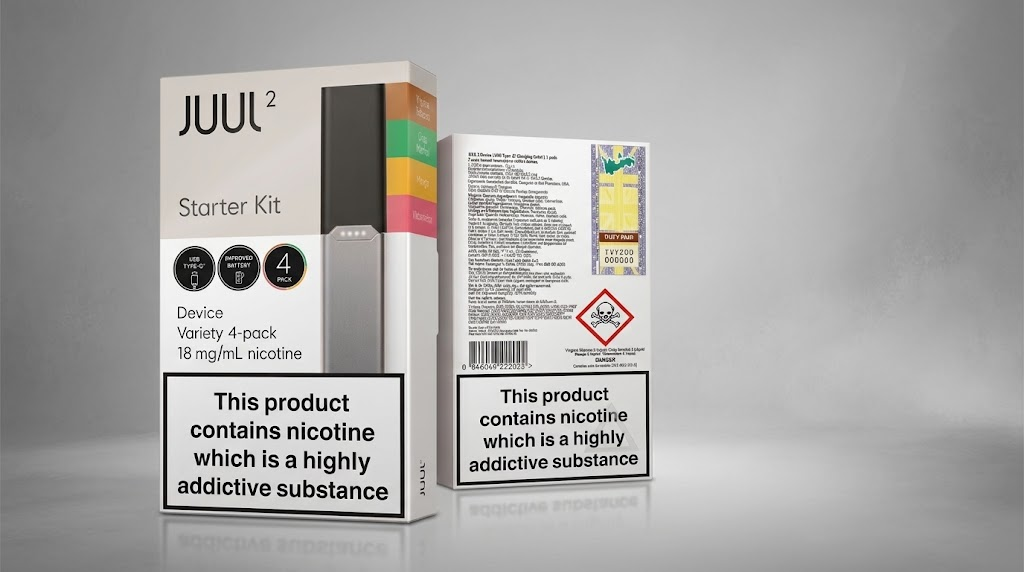
Product | Juul Labs Launches Upgraded JUUL2 Kit in UK With Four Pods at £9.99 and USB-C Charging
Juul Labs UK has introduced an upgraded JUUL2 Starter Kit for the UK market in October 2026, retaining a recommended retail price of £9.99 while doubling the number of included pods from two to four. The kit contains Crisp Menthol, Virginia Tobacco, Mango and Watermelon pods. The updated device replaces the previous proprietary charging dock with a USB-C port and offers longer battery life. The kit also features reduced packaging and retains a two-year limited warranty. Distribution is scheduled through major UK retailers, wholesalers, convenience stores and the JUUL UK website.
product
Oct.15
As JUUL2 Wins FDA Authorization, Harm Reduction Journal Highlights the Role of Real-World Evidence in Nicotine Product Regulation
A commentary published in the international open-access, peer-reviewed Harm Reduction Journal argues that randomized controlled trials remain central to evaluating smoking cessation efficacy but cannot alone capture real-world uptake, complete switching, longer-term use and population impact of non-combustible nicotine products such as e-cigarettes, heated tobacco and nicotine pouches. The authors frame impact as “reach × efficacy” and call for real-world evidence to complement RCTs. Three days after publication, the FDA authorized three JUUL2 products and highlighted complete switching among adult smokers in explaining its decision, providing a timely regulatory backdrop to the debate.
Sep.08