Key Points
- First Things First is seeking an excise tax equal to 50% of the retail price of vaping products and estimates it could generate about $100 million annually.
- The agency received approximately $102 million in fiscal 2026 revenue, including about $89 million from tobacco taxes. It says tobacco-tax revenue has fallen 47% since 2008.
- Arizona's 2025 HB 2778 proposed a 50% wholesale-price tax on nicotine and vapor products. The 2026 HB 4032 shifted to a 50% retail-price tax on alternative nicotine and vapor products. Neither bill was enacted.
- Arizona enacted HB 4001 in 2026, establishing manufacturer and distributor licensing and other sales regulations for alternative nicotine products, with licensing requirements scheduled to take effect in January 2028.
2Firsts
September 21, 2026
According to KJZZ on September 15, Arizona early-childhood agency First Things First is asking state lawmakers to impose a new excise tax on vaping products equal to 50% of their retail price.
First Things First CEO Melinda Morrison Gulick said the agency estimates the tax could generate about $100 million annually to support early-childhood programs in Arizona.
The proposal remains a policy initiative and has not been enacted. New taxes in Arizona generally require approval from two-thirds of both chambers of the state Legislature as well as the governor's signature.
Tobacco-Tax Revenue Falls to About $89 Million
First Things First was created by Arizona voters in 2006 and relies primarily on dedicated tobacco-tax revenue, including an 80-cent tax on each pack of cigarettes.
KJZZ reported that the levy generated about $169 million in its first full year, while current tobacco-tax collections are projected at around $89 million.
First Things First's fiscal 2026 annual report, released September 15, showed approximately $102 million in total revenue, including about $89 million from tobacco taxes, $4.2 million in investment earnings and $9.1 million in grants.
The agency said tobacco-tax revenue has declined 47% since 2008, reducing annual revenue by more than $76 million compared with that year.
First Things First attributes part of the decline to fewer people smoking and to consumers shifting toward vaping and other nicotine products that are not covered by its existing dedicated tobacco tax.
Its current proposal would impose a tax equal to 50% of the retail price of vaping products, paid by consumers at the retail level. Under that rate, an applicable product priced at $10 before tax would carry an additional $5 tax.
The structure differs from Arizona's existing per-unit cigarette taxes. The latest vaping proposal would instead use an ad valorem tax calculated as a percentage of the product's retail value.
Tax Proposal Shifts From 50% of Wholesale Price to 50% of Retail Price
Arizona lawmakers have considered measures to broaden the nicotine-product tax base in each of the past two years, with changes in both the point of taxation and product definitions.
In 2025, Rep. Consuelo Hernandez and other lawmakers introduced HB 2778, which proposed a tax equal to 50% of the wholesale price of nicotine products and vapor products.
The bill would have allocated 40% of the revenue to the state general fund and 60% to the Early Childhood Development and Health Fund. Part of the latter allocation was designated for programs intended to improve the quality and accessibility of early-childhood education.
HB 2778 did not complete the legislative process.
In 2026, lawmakers introduced HB 4032 with a different tax structure. The bill proposed an excise tax equal to 50% of the retail price of alternative nicotine products and vapor products sold to consumers.
Its definition of an “alternative nicotine product” covered noncombustible products containing nicotine from any source and intended for human consumption through chewing, absorption, dissolution, ingestion or other means, while vapor products were defined separately.
Under that definition, some nicotine pouches and other noncombustible oral nicotine products could fall within the alternative-nicotine category.
HB 4032 also proposed a more detailed revenue allocation: 49% to the Early Childhood Development and Health Fund, 21% to the state general fund, 19% to out-of-school programs, 5% to a ninth-grade on-track program, 5% to early-intervention services and 1% to the Smoke-Free Arizona Fund.
The bill did not advance during the 2026 legislative session.
The latest proposal reported by KJZZ shares HB 4032's 50% retail-price rate, but the current reporting specifically identifies vaping products. No new legislative text has yet been cited that confirms whether alternative nicotine products would again be included.
Alternative-Nicotine Regulation Has Advanced Ahead of Tax Legislation
While HB 4032 did not pass, Arizona enacted a separate alternative-nicotine regulatory measure this year, HB 4001, which became Chapter 124.
The law establishes licensing requirements for manufacturers and distributors of alternative nicotine products and sets additional sales and marketing requirements.
It defines an alternative nicotine product as a noncombustible product containing nicotine and intended for human consumption through chewing, absorption, dissolution, ingestion, inhalation or other means. The definition excludes statutory tobacco products and products regulated by the U.S. Food and Drug Administration as drugs or medical devices.
Beginning in January 2028, manufacturers and distributors of alternative nicotine products are generally required to hold state licenses, and retailers are prohibited from purchasing such products from unlicensed manufacturers or distributors.
The result is a split in Arizona's policy development for newer nicotine categories: a licensing and sales framework for alternative nicotine products has been enacted, while proposals to create a new tax on vaping and other nicotine products have yet to become law.
Industry Group Raises Cross-Border and Black-Market Concerns
John Paul Willett, chairman of industry coalition Arizona Innovates, told KJZZ that the organization was open to a model that provides additional funding for state programs, but said any policy would need to be examined for how revenue is used and how it affects the consumer market.
Willett also raised concerns that high taxation could encourage consumers to move toward black-market channels.
For products subject to a high ad valorem tax, industry concerns also include purchases from outside the state. Such shifts could affect regulated Arizona retailers while reducing the amount of revenue the tax ultimately generates.
Gulick said the proposed 50% rate itself remains open to negotiation with lawmakers.
From the 50% wholesale-price proposal in 2025 to the 50% retail-price structure in 2026 and the enactment of HB 4001's alternative-nicotine licensing regime, Arizona has increasingly brought vaping and other newer nicotine categories into separate regulatory and tax discussions. Whether the latest initiative produces another formal tax bill, and which product categories it would cover, will depend on the next legislative text.
Follow 2Firsts for timely updates on global tobacco and nicotine regulations, market developments and industry trends.
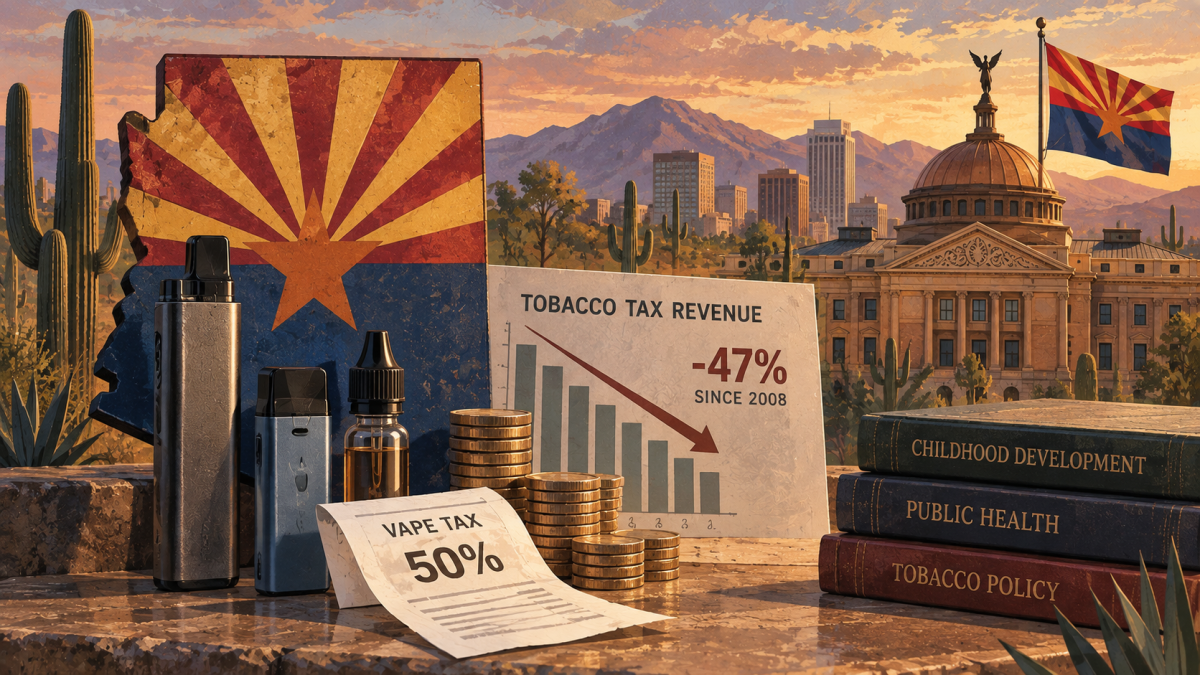
Cover Image generated by AI
Disclaimer
This article is provided solely for professional research, industry discussion, and informational purposes. Any references to brands, companies, products, technologies, or policies are made for factual reporting and analytical purposes only, and do not constitute endorsement, recommendation, promotion, or advertising by 2Firsts.
Nicotine-containing products, including but not limited to cigarettes, e-cigarettes, heated tobacco products, and nicotine pouches, carry significant health risks. Readers are responsible for complying with all applicable laws and regulations in their respective jurisdictions, including age restrictions and access limitations.
The information contained in this article should not be regarded as investment, legal, medical, regulatory, or commercial advice. While 2Firsts strives to ensure the accuracy and reliability of its content, it does not assume liability for any direct or indirect loss arising from errors, omissions, inaccuracies, or reliance on the information contained herein.
This article is not intended for individuals below the legal age for accessing tobacco or nicotine-related information in their jurisdiction.
Copyright Notice
This article is either original content produced by 2Firsts or content reproduced, translated, summarized, or adapted from third-party sources with attribution where applicable. The intellectual property rights of the original content remain with 2Firsts or the respective original rights holders.
No individual or organization may copy, reproduce, distribute, republish, modify, translate, or otherwise use this content without prior authorization. Any unauthorized use may result in legal action.
For copyright-related inquiries, corrections, or removal requests, please contact: info@2firsts.com.
AI-Assisted Translation and Editing Notice
Portions of this article may have been translated, edited, or reviewed with the assistance of artificial intelligence tools to improve efficiency and readability. Due to the limitations of AI-assisted translation and editing, discrepancies, omissions, or inaccuracies may exist when compared with the original source.
Where applicable, readers are advised to refer to the original source for the most complete and accurate information. If you identify any errors or believe that any content infringes upon your rights, please contact us at info@2firsts.com, and we will review and address the matter promptly.