The Canadian government has provided $7 million in funding to Ontario to tackle the opioid crisis and address the harms related to substance use and the illicit supply of toxic drugs. The funding covers a total of eight projects led by innovative groups, including one that involves researching the toxicity of e-cigarettes.
Funding for a range of evidence-based and innovative interventions for both legal and illegal substances is provided through the Substance Use and Addiction Program (SUAP) of Health Canada. This program supports a broad scope of intervention measures including prevention, harm reduction, and treatment.
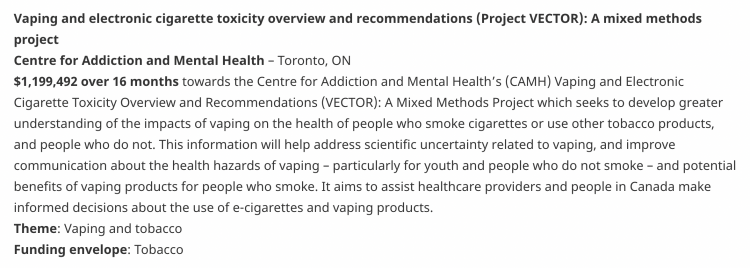
The details of the research project on the toxicity of electronic cigarettes are as follows:
Research Institution: Centre for Addiction and Mental Health (CAMH) in Toronto, Canada.
Research Project: Summary of Toxicity and Recommendations for E-cigarettes (VECTOR Project)
Research funding: CAD 1,199,492 (equivalent to CNY 6,030,000 under the current exchange rate).
Research Duration: 16 months long.
The purpose of this research is to thoroughly investigate the effects of electronic cigarettes on the health of smokers, users of other tobacco products, and non-smokers, and to develop relevant recommendations. By conducting surveys, analyzing data, and evaluating the components and impacts of e-cigarettes, this project aims to deepen our understanding of this controversial product. In addition, the research team will collaborate with healthcare providers and public health organizations to develop policies and guidelines to raise public awareness and risk awareness of e-cigarettes.
Reference:
The Government of Canada has recently declared that they will provide more than $7 million in funds to tackle the negative effects stemming from substance use issues in Ontario.
Disclaimer
This article is provided solely for professional research, industry discussion, and informational purposes. Any references to brands, companies, products, technologies, or policies are made for factual reporting and analytical purposes only, and do not constitute endorsement, recommendation, promotion, or advertising by 2Firsts.
Nicotine-containing products, including but not limited to cigarettes, e-cigarettes, heated tobacco products, and nicotine pouches, carry significant health risks. Readers are responsible for complying with all applicable laws and regulations in their respective jurisdictions, including age restrictions and access limitations.
The information contained in this article should not be regarded as investment, legal, medical, regulatory, or commercial advice. While 2Firsts strives to ensure the accuracy and reliability of its content, it does not assume liability for any direct or indirect loss arising from errors, omissions, inaccuracies, or reliance on the information contained herein.
This article is not intended for individuals below the legal age for accessing tobacco or nicotine-related information in their jurisdiction.
Copyright Notice
This article is either original content produced by 2Firsts or content reproduced, translated, summarized, or adapted from third-party sources with attribution where applicable. The intellectual property rights of the original content remain with 2Firsts or the respective original rights holders.
No individual or organization may copy, reproduce, distribute, republish, modify, translate, or otherwise use this content without prior authorization. Any unauthorized use may result in legal action.
For copyright-related inquiries, corrections, or removal requests, please contact: info@2firsts.com.
AI-Assisted Translation and Editing Notice
Portions of this article may have been translated, edited, or reviewed with the assistance of artificial intelligence tools to improve efficiency and readability. Due to the limitations of AI-assisted translation and editing, discrepancies, omissions, or inaccuracies may exist when compared with the original source.
Where applicable, readers are advised to refer to the original source for the most complete and accurate information. If you identify any errors or believe that any content infringes upon your rights, please contact us at info@2firsts.com, and we will review and address the matter promptly.