Cannabis Addiction Study Reveals Genetic Predisposition and Cancer Risk

Industry Insight by 2FIRSTS.ai
Nov.21.2023
Cannabis Addiction Study Reveals Genetic Predisposition and Cancer Risk
Yale University-led study finds genetic predisposition to cannabis addiction and increased risk of lung cancer. Over one million patients worldwide included in research.

According to the latest report by Proyectopuente, a study led by Yale University has found a genetic predisposition to cannabis addiction, with individuals suffering from cannabis addiction being at a higher risk of developing lung cancer. The research, which analyzed data from over one million patients across four continents, has been published in the journal Nature Genetics.


Genetics professor Joel Gelernter stated, "The idea behind this study is that as marijuana use becomes increasingly lenient, it is important to understand the risks associated with addiction-related dysfunctions in order to develop drug therapies to address this issue. Known negative health impacts of marijuana addiction include: over one-third of marijuana addicts are more susceptible to becoming dependent compared to non-addicts. Over one-third of marijuana users experience addiction and negative health effects. These consequences include impaired cognitive function, diminished productivity, and increased risk of accidents while under the influence. The genetic analysis included data from 154,365 individuals, with 886,256 from Europe, 123,208 from Africa, 38,289 biracial individuals from the United States, and 6,843 from Asia.


We welcome news tips, article submissions, interview requests, or comments on this piece.

Please contact us at info@2firsts.com, or reach out to Alan Zhao, CEO of 2Firsts, on LinkedIn


Notice

1.  This article is intended solely for professional research purposes related to industry, technology, and policy. Any references to brands or products are made purely for objective description and do not constitute any form of endorsement, recommendation, or promotion by 2Firsts.

2.  The use of nicotine-containing products — including, but not limited to, cigarettes, e-cigarettes, nicotine pouchand heated tobacco products — carries significant health risks. Users are responsible for complying with all applicable laws and regulations in their respective jurisdictions.

3.  This article is not intended to serve as the basis for any investment decisions or financial advice. 2Firsts assumes no direct or indirect liability for any inaccuracies or errors in the content.

4.  Access to this article is strictly prohibited for individuals below the legal age in their jurisdiction.


Copyright


This article is either an original work created by 2Firsts or a reproduction from third-party sources with proper attribution. All copyrights and usage rights belong to 2Firsts or the original content provider. Unauthorized reproduction, distribution, or any other form of unauthorized use by any individual or organization is strictly prohibited. Violators will be held legally accountable.

For copyright-related inquiries, please contact: info@2firsts.com


AI Assistance Disclaimer


This article may have been enhanced using AI tools to improve translation and editorial efficiency. However, due to technical limitations, inaccuracies may occur. Readers are encouraged to refer to the cited sources for the most accurate information.

We welcome any corrections or feedback. Please contact us at: info@2firsts.com

2Firsts On-Site | CTIHK Showcases Nicotine Pouches, Heated Tobacco and Chinese Cigars at InterTabac 2026
At InterTabac 2026 in Dortmund, China Tobacco International (HK) Company Limited (CTIHK) is exhibiting across two separate booths in Hall 5 and Hall 4. Products observed by 2Firsts include heated tobacco products, nicotine pouches, Chinese cigars and tobacco leaf. Nicotine pouch products on display include TOOP, Shuangxi and Ashima.
Market
Sep.16
Cochrane 2026 Update Adds Nine Trials, Keeps High-Certainty Finding That Nicotine E-Cigarettes Improve Quit Rates Over NRT
Cochrane’s 2026 update of its living review on electronic cigarettes for smoking cessation included 80 randomized controlled trials involving 29,861 adult smokers, with nine trials added in this update. The review retained its high-certainty conclusion that nicotine e-cigarettes increase smoking cessation rates compared with nicotine replacement therapy. In absolute terms, about 10 in 100 people using nicotine e-cigarettes may quit smoking for at least six months, compared with about 6 in 100 using NRT. The review found no clear difference in serious adverse event rates between the two groups, while longer-term safety and the relative effectiveness of newer device types remain less certain.
Sep.07
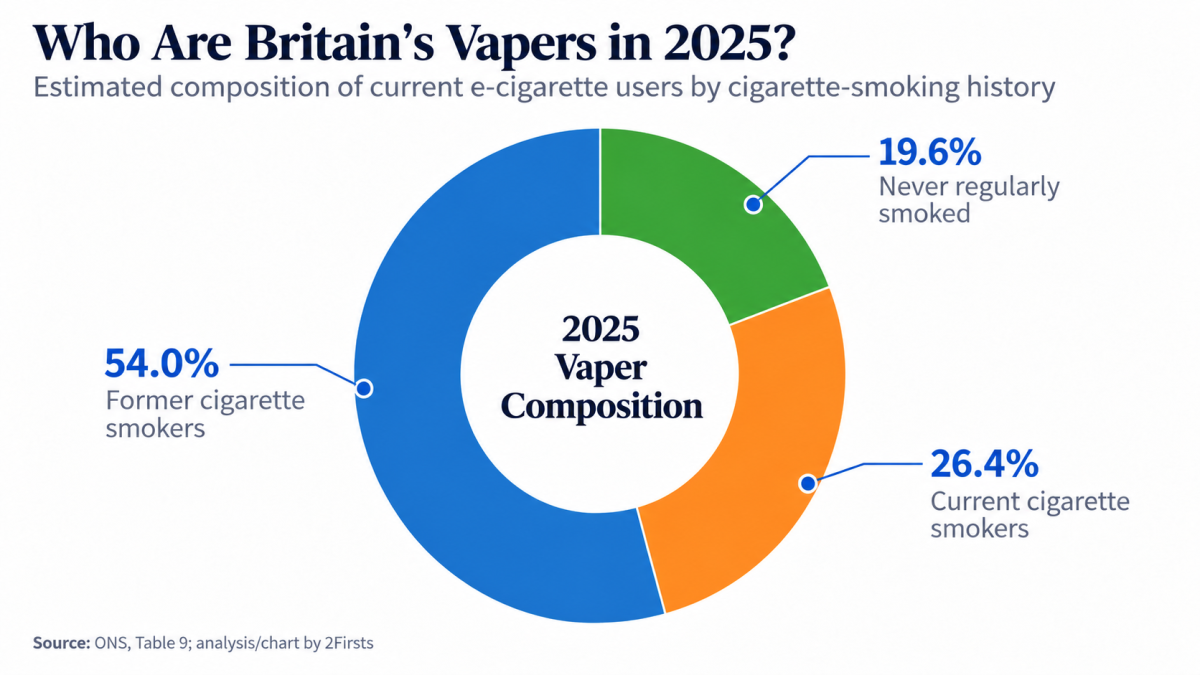
Latest UK ONS Data: 54% of Vapers Are Former Cigarette Smokers, 26% Also Smoke and 20% Never Smoked Regularly
Former cigarette smokers accounted for an estimated 54% of current e-cigarette users in Great Britain in 2025, while 26% also smoked cigarettes and 20% had never regularly smoked, according to a 2Firsts analysis of Office for National Statistics (ONS) data. Among former cigarette smokers who currently vape, approximately 81% used e-cigarettes daily, compared with about 50% of dual users. The ONS found that 33.8% of current cigarette smokers also vaped in 2025, up from 10.6% in 2014. Approximately 1.1 million adults who had never regularly smoked cigarettes used e-cigarettes, representing 2.9% of that population, compared with 0.2% in 2014. The figures highlight differences in the composition, frequency of use and long-term trends across Britain's vaping population.
DATA
Oct.14
Malaysia Liquid Nicotine Returns to Poisons List, Leaving Vape Retail and RM354 Million Tax Collection in Legal Uncertainty
Malaysia’s withdrawal of its appeal in a landmark liquid-nicotine case has left a High Court ruling that struck down the 2023 nicotine exemption in force, bringing liquid and gel nicotine used in vaping products back under the Poisons Act 1952. At the same time, the Control of Smoking Products for Public Health Act 2024 continues to provide a regulatory framework for vaping products, creating uncertainty over retail sales, taxation and existing inventory. MPs are calling for nicotine vape sales and excise collection to stop, including refunds of more than RM354 million collected since 2023, while industry and consumer groups are asking the government to clarify the current legal position.
Sep.04
Imperial Brands Sees Double-Digit NGP Growth as Sixth Year of Tobacco Revenue Gains Backs £1.5 Billion Buyback
Imperial Brands reaffirmed its FY26 guidance in its October 8 pre-close trading update, forecasting double-digit net revenue growth in next-generation products and share gains across heated tobacco, vape and modern oral. Tobacco net revenue is expected to grow at a low-single-digit rate, marking a sixth consecutive year of growth. The company has completed its £1.45 billion FY26 share repurchase and announced a £1.5 billion buyback for FY27. Group adjusted operating profit is expected to increase 3% to 5%, while free cash flow is forecast to exceed £2.2 billion.
Oct.09
UK-Listed Consumer Goods Group Supreme Sees Vape Duty as Potential Consolidation Opportunity, Holds FY27 Outlook
UK-listed consumer goods group Supreme plc says it continues to expect FY27 trading to meet market expectations as the Vaping Products Duty takes effect on October 1, while maintaining a comparatively positive view of the new tax and compliance regime. Supreme has said the framework could increase compliance complexity for smaller operators and contribute to market consolidation, while its manufacturing, compliance and distribution scale may allow it to gain share. Its 88Vape brand will retain its value positioning.
Sep.18