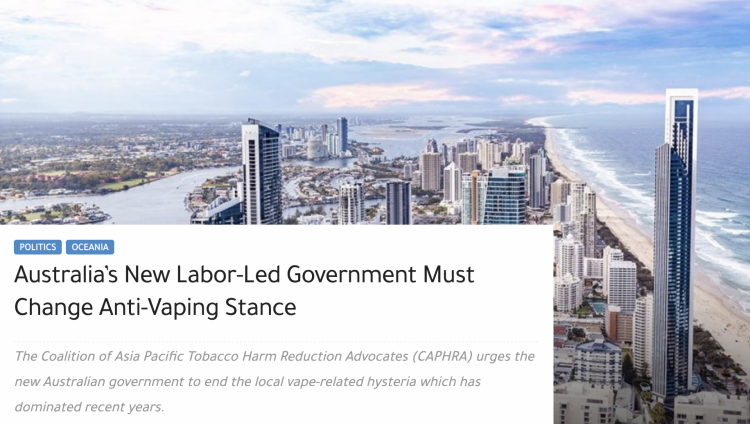
The Asia Pacific Advocates for Tobacco Harm Reduction Alliance (CAPHRA) has urged the new Australian government to reconsider its stance against electronic cigarettes.
As of October 1st, electronic cigarette users in Australia can only purchase e-cigarette products from a pharmacy with a prescription. This is in contrast to neighboring New Zealand and most other countries, where retailers can sell nicotine products over the counter. However, anyone who violates Australian regulations will face hefty fines and, in severe cases, imprisonment.
At the same time, the latest report from the National Household Survey on Drug Strategy states that although over 2.5 million Australians still smoke, the number of people using e-cigarettes was 240,000 in 2016 and 520,000 in 2019. If this trend continues, there could be up to 600,000 Australians using e-cigarettes currently.
CAPHRA has emphasized that the local, hard-line approach to electronic cigarettes is increasingly out of sync with other Asia-Pacific countries. The new government and the next Health Minister must support tobacco harm reduction (THR) methods, including providing safer alternatives to smokers. CAPHRA Coordinator, Nancy Loucas, said, "We hope the Liberal Party will end the public war on nicotine products that has been going on for nearly a decade.
Former Health Minister Greg Hunt and his cabinet colleagues oversaw a failed "quit or die" approach to tobacco control. As a result, Australia's overall smoking rates have hardly budged, while other countries have achieved significant success. "To save thousands of Australian lives every year, the new government must urgently adopt a completely different strategy," Loucas said.
According to a recent press release by CAPHRA, Australian tobacco harm reduction (THR) expert Dr. Colin Mendelsohn has recently described Australia's past decade of anti-smoking strategies as "embarrassing failures," and the numbers confirm it. In 2018, a target was set for adults to reduce smoking by 10% per day, but only 13.8% was achieved, with smoking rates now at a stable level.
Dr. Alexander David Wodak, a renowned advocate for reducing drug harm in Australia, has long argued that the same approach needed for smoking. In a recent interview with ABC, Dr. Wodak explained how Australia has taken the wrong approach to safer nicotine alternatives, causing it to fall behind other countries in smoking rates instead of making progress.
He suggested that "the majority of smokers have low income", therefore, safer nicotine substitutes should not be priced too high in order to encourage smokers to switch to alternatives such as e-cigarettes.
Disclaimer
This article is provided solely for professional research, industry discussion, and informational purposes. Any references to brands, companies, products, technologies, or policies are made for factual reporting and analytical purposes only, and do not constitute endorsement, recommendation, promotion, or advertising by 2Firsts.
Nicotine-containing products, including but not limited to cigarettes, e-cigarettes, heated tobacco products, and nicotine pouches, carry significant health risks. Readers are responsible for complying with all applicable laws and regulations in their respective jurisdictions, including age restrictions and access limitations.
The information contained in this article should not be regarded as investment, legal, medical, regulatory, or commercial advice. While 2Firsts strives to ensure the accuracy and reliability of its content, it does not assume liability for any direct or indirect loss arising from errors, omissions, inaccuracies, or reliance on the information contained herein.
This article is not intended for individuals below the legal age for accessing tobacco or nicotine-related information in their jurisdiction.
Copyright Notice
This article is either original content produced by 2Firsts or content reproduced, translated, summarized, or adapted from third-party sources with attribution where applicable. The intellectual property rights of the original content remain with 2Firsts or the respective original rights holders.
No individual or organization may copy, reproduce, distribute, republish, modify, translate, or otherwise use this content without prior authorization. Any unauthorized use may result in legal action.
For copyright-related inquiries, corrections, or removal requests, please contact: info@2firsts.com.
AI-Assisted Translation and Editing Notice
Portions of this article may have been translated, edited, or reviewed with the assistance of artificial intelligence tools to improve efficiency and readability. Due to the limitations of AI-assisted translation and editing, discrepancies, omissions, or inaccuracies may exist when compared with the original source.
Where applicable, readers are advised to refer to the original source for the most complete and accurate information. If you identify any errors or believe that any content infringes upon your rights, please contact us at info@2firsts.com, and we will review and address the matter promptly.