Hong Kong Customs Seizes 6 Million Cigarettes and Heated Tobacco Products Worth Over $3.8 Million

Mar.10.2025
Hong Kong Customs Seizes 6 Million Cigarettes and Heated Tobacco Products Worth Over $3.8 Million
China's Hong Kong customs seized over 6 million illegal cigarettes worth $380,000 in multiple actions against cross-border smuggling.

Key points:


1. Hong Kong Customs recently seized over 6 million illegal cigarettes and heated tobacco products in two separate operations, with a total value exceeding $3.8 million.


2. Multiple suspects have been arrested for participating in cross-border cigarette smuggling, with the smuggled products involving other countries.


The Customs of Hong Kong, China seized over 6 million illegal cigarettes and heated tobacco products in two operations, with a total value exceeding 29 million Hong Kong dollars (approximately 3.8 million US dollars), according to Tobaccoreporter.


In a recent operation, two male suspects were arrested for storing 6 million cigarettes in a truck and warehouse. 


Chan Sing-lung, Senior Investigator at the Hong Kong Customs and Excise Department's Tax Crime Investigation Bureau, said: "We believe these products were intended for export to other countries, but we cannot rule out the possibility that some of them may end up being sold in the local black market for tobacco."


In a separate operation, Hong Kong Customs arrested a mainland Chinese man for possessing 90,000 illegal cigarettes and 110,000 illegal heated tobacco products. 


Authorities also found 140,000 untaxed Japanese cigarettes and alternative smoking products in his room. Officials said the smuggled items were part of an illegal operation involving Japan.


Wong Wing-yuen, Customs and Excise Department Senior Investigator, said: "Our investigation shows that this syndicate uses airline passengers to smuggle illegal tobacco products into Hong Kong, storing them in hotel rooms, and then distributing them to customers.


In the past two weeks, a total of 13 men and eight women have been arrested, mostly Mainland tourists from Japan. They are involved in 20 cases, in which a total of 600,000 untaxed cigarettes and 240,000 alternative tobacco products were seized, with a market value of 4 million Hong Kong dollars (approximately 520,000 US dollars).


We welcome news tips, article submissions, interview requests, or comments on this piece.

Please contact us at info@2firsts.com, or reach out to Alan Zhao, CEO of 2Firsts, on LinkedIn


Notice

1.  This article is intended solely for professional research purposes related to industry, technology, and policy. Any references to brands or products are made purely for objective description and do not constitute any form of endorsement, recommendation, or promotion by 2Firsts.

2.  The use of nicotine-containing products — including, but not limited to, cigarettes, e-cigarettes, nicotine pouchand heated tobacco products — carries significant health risks. Users are responsible for complying with all applicable laws and regulations in their respective jurisdictions.

3.  This article is not intended to serve as the basis for any investment decisions or financial advice. 2Firsts assumes no direct or indirect liability for any inaccuracies or errors in the content.

4.  Access to this article is strictly prohibited for individuals below the legal age in their jurisdiction.


Copyright


This article is either an original work created by 2Firsts or a reproduction from third-party sources with proper attribution. All copyrights and usage rights belong to 2Firsts or the original content provider. Unauthorized reproduction, distribution, or any other form of unauthorized use by any individual or organization is strictly prohibited. Violators will be held legally accountable.

For copyright-related inquiries, please contact: info@2firsts.com


AI Assistance Disclaimer


This article may have been enhanced using AI tools to improve translation and editorial efficiency. However, due to technical limitations, inaccuracies may occur. Readers are encouraged to refer to the cited sources for the most accurate information.

We welcome any corrections or feedback. Please contact us at: info@2firsts.com

Product | Four CrossBar 20K 13mL High-Puff Vapes Listed on Pennsylvania's ENDS Directory, Rated for Up to 20,000 Puffs
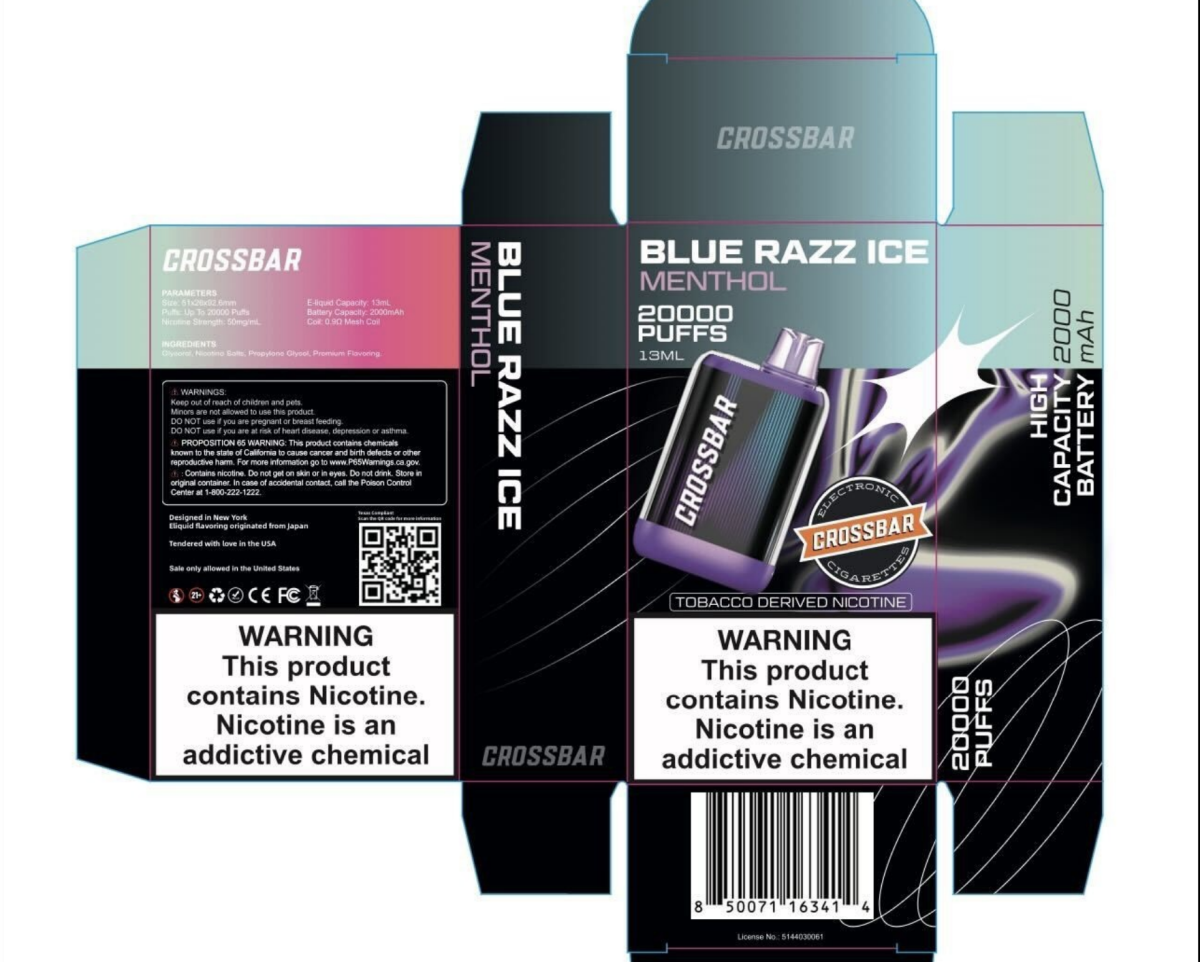
Four CrossBar 20K disposable e-cigarettes appeared on Pennsylvania's 163-entry ENDS directory ahead of enforcement beginning October 19, 2026. The devices feature 13mL e-liquid reservoirs, 50mg/mL nicotine, 2,000mAh batteries and 0.9Ω mesh coils, with advertised puff counts of up to 20,000. CrossBar was the only modern high-puff disposable series among the directory's 15 disposable entries. Its packaging emphasizes New York design and Japanese-origin flavoring, while historical CrossBar records identify a registered U.S. tobacco manufacturing-related establishment. The link between the newer 13mL devices and earlier 1.3mL PMTA filings remains unconfirmed.
product
Oct.26
Indonesia's Influential Islamic Body MUI Urges Vape Permit Freeze, Raising Uncertainty for 200 Manufacturers
Indonesia's Ulema Council (MUI) published Fatwa No. 131/2026 on November 9, declaring electronic cigarette use, production and trade haram under Islamic religious rules. The council urged the Industry Ministry to prohibit the issuance of vape industry permits and review licensing policies, while calling on the president and parliament to enact a comprehensive ban. On November 10, the Constitutional Court heard a challenge to provisions of the 2023 Health Law seeking a prohibition on vape production, importation, distribution and use. The Health Ministry said on November 11 it was studying stronger restrictions, including a possible ban on circulation, while industry association APVI called for tighter oversight rather than a total ban. Indonesia's Industry Ministry previously estimated the sector comprises about 200 companies, Rp31 trillion ($1.7 billion) in cumulative investment and approximately 100,000 supply-chain jobs. No nationwide statutory ban has been enacted.
Regulations
Nov.12
China’s Vape-Related Exports Rose 4.5% in Q3 2026 as 21.6% Growth in Shipments to the UK Offset a Decline in Shipments to the US
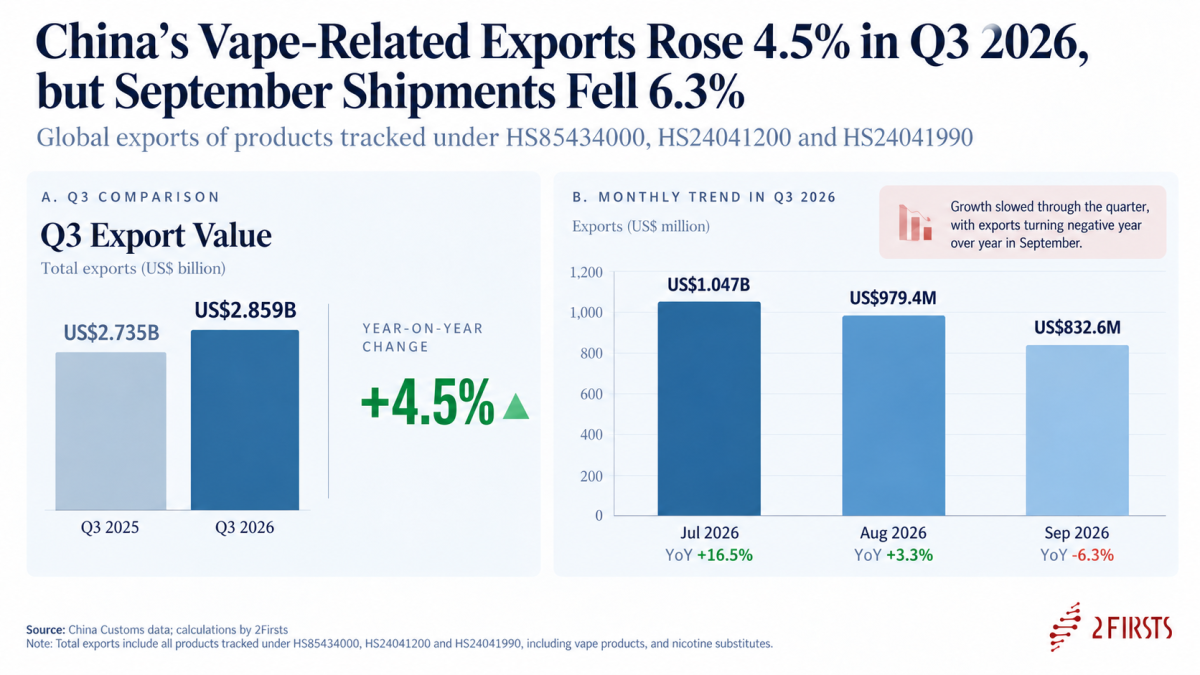
China's vape-related exports rose 4.5% year over year to $2.86 billion in the third quarter of 2026, led by stronger shipments to the United Kingdom as exports to the United States declined. UK-bound shipments increased 21.6%, adding $81.9 million, while US exports fell 5.2%, or $53.6 million. Growth weakened through the quarter, with September exports down 6.3% globally and 37.8% to the US. Nicotine-containing vape products accounted for more than 82% of the quarterly net increase, while device exports were nearly flat. Nine-month exports totaled $7.82 billion, up 4.0%.
DATA
Oct.26
FDA Appoints Former Tobacco Enforcement Deputy Jessica Zeller as Director as Agency Weighs PMTA Framework Changes
The U.S. Food and Drug Administration (FDA) has named Jessica Zeller director of the Center for Tobacco Products' (CTP) Office of Compliance and Enforcement (OCE), effective November 1, 2026. Zeller, the office's inaugural deputy director, returns from medical device manufacturer Edwards Lifesciences with more than 20 years of regulatory and legal experience. The appointment follows CTP leadership changes and adjustments to tobacco regulation. Bret Koplow became permanent CTP director in September; the FDA revised enforcement priorities for unauthorized e-cigarettes and nicotine pouches in May and announced faster PMTA review procedures. On September 28, the agency said it would evaluate changes to the existing PMTA regulatory framework, including potential rulemaking to replace it.
FDA
Oct.20 by 2Firsts Perspectives
U.S. Expands Illicit Vape Enforcement as ATF Brings PACT Act Powers Into Trade Fraud Task Force
The U.S. Bureau of Alcohol, Tobacco, Firearms and Explosives said on September 23 that it has joined the interagency Trade Fraud Task Force to strengthen enforcement against illegal, misdeclared and smuggled vape and tobacco products. ATF will bring its authority under the Prevent All Cigarette Trafficking Act into the task force, including registration, reporting, shipping and record-inspection requirements covering interstate sales of electronic nicotine delivery systems. ATF said the move will strengthen its ability to trace illicit products from U.S. points of entry through domestic trafficking and distribution networks.
News
Sep.28 by 2Firsts Perspectives
Russia's Vape Ban Decisions Reach 17 Regions With 39 More Considering Laws, Putting Over 3,000 St. Petersburg Retail Outlets in Focus
Russia's regional vape retail restrictions are expanding. State Duma Speaker Vyacheslav Volodin said on November 7 that 17 regions had adopted decisions to ban vape sales, while another 39 were preparing or considering similar legislation. On November 12, lawmakers in Leningrad Oblast and the Republic of Karelia adopted bans scheduled to begin on March 1, 2027. A day earlier, St. Petersburg unanimously approved a five-year ban proposal in its first reading. The city has 615 specialist vape shops and more than 2,400 other retail outlets selling vaping products alongside other goods. Under Federal Law No. 186-FZ, enacted in June 2026, Russian regions may prohibit retail sales of electronic nicotine delivery systems and related liquids between March 2027 and March 2032. The legislation also restricts licensed suppliers from delivering covered products to retail premises in regions where bans apply.
Regulations
Nov.13