Hong Kong Health Authority Warns E-Cigarettes Becoming New Tool for Drug Abuse

Nov.28.2024
Hong Kong Health Authority Warns E-Cigarettes Becoming New Tool for Drug Abuse
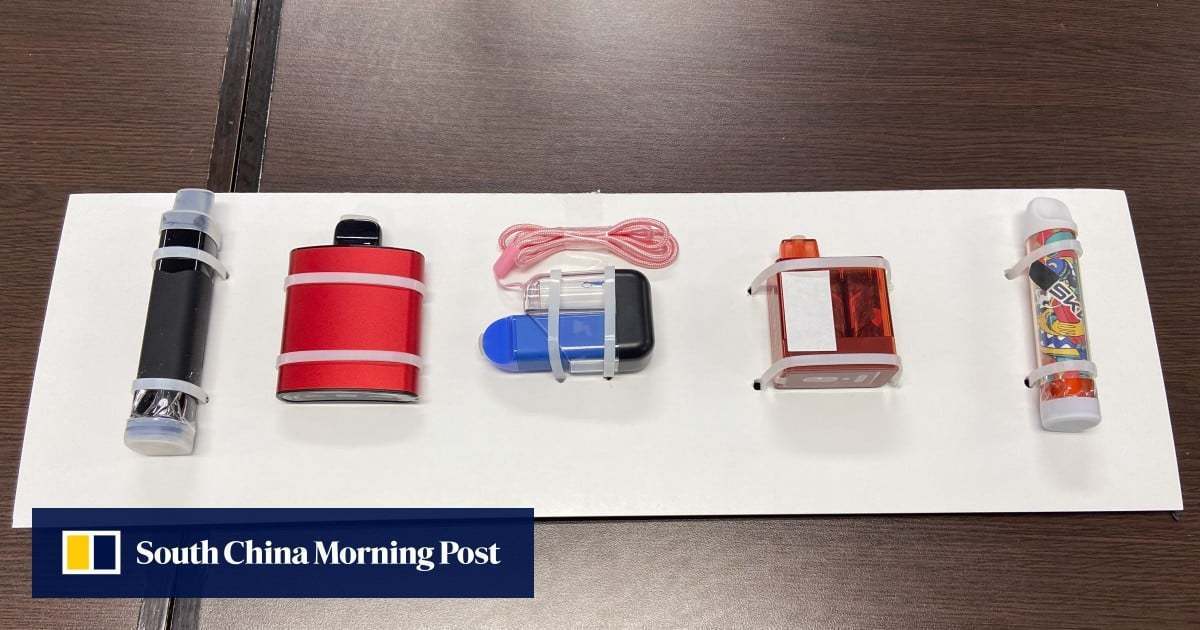
The Hong Kong Department of Health has issued a warning that e-cigarettes are becoming a new tool for drug abuse. The cartridges containing illegal drugs resemble regular e-liquid, highlighting the need for legislative restrictions.

According to a report by SCMP on November 27th, the Hong Kong Health Department has warned that e-cigarettes are increasingly being used as a tool for drug abuse, as these devices can easily be filled with drugs and are difficult to detect.


The Hong Kong Department of Health's subordinate agency, the Tobacco and Alcohol Control Office, said on Wednesday (27th) that they have recently dealt with cases where the "space oil" in e-cigarette pods appeared to be identical to the e-liquid contained in other products.


The head of the office, Dr. Fung Ying, pointed out that: "Those cartridges containing illegal drugs look no different from those with ordinary e-liquid."


Space oil" is one of the highly demanded drugs in the city, often found in e-cigarette pods. It contains etomidate, a prescription anesthetic categorized as a Schedule I controlled substance.


The Hong Kong government announced a series of proposed measures on June 10, including amending laws to ban the possession of alternative tobacco products. The Department of Health stated that they are currently drafting the details of the legislative proposal and have contacted lawmakers to seek their input. It is expected that these legislative amendments will be submitted to the Legislative Council by the end of 2024 or early 2025.


We welcome news tips, article submissions, interview requests, or comments on this piece.

Please contact us at info@2firsts.com, or reach out to Alan Zhao, CEO of 2Firsts, on LinkedIn


Notice

1.  This article is intended solely for professional research purposes related to industry, technology, and policy. Any references to brands or products are made purely for objective description and do not constitute any form of endorsement, recommendation, or promotion by 2Firsts.

2.  The use of nicotine-containing products — including, but not limited to, cigarettes, e-cigarettes, nicotine pouchand heated tobacco products — carries significant health risks. Users are responsible for complying with all applicable laws and regulations in their respective jurisdictions.

3.  This article is not intended to serve as the basis for any investment decisions or financial advice. 2Firsts assumes no direct or indirect liability for any inaccuracies or errors in the content.

4.  Access to this article is strictly prohibited for individuals below the legal age in their jurisdiction.


Copyright


This article is either an original work created by 2Firsts or a reproduction from third-party sources with proper attribution. All copyrights and usage rights belong to 2Firsts or the original content provider. Unauthorized reproduction, distribution, or any other form of unauthorized use by any individual or organization is strictly prohibited. Violators will be held legally accountable.

For copyright-related inquiries, please contact: info@2firsts.com


AI Assistance Disclaimer


This article may have been enhanced using AI tools to improve translation and editorial efficiency. However, due to technical limitations, inaccuracies may occur. Readers are encouraged to refer to the cited sources for the most accurate information.

We welcome any corrections or feedback. Please contact us at: info@2firsts.com

Rethinking Nicotine Harm Reduction: A Neuroscientist’s Perspective on Scientific Gaps and Future Directions — By Dr. Xin-an Liu
After France’s ANSES report on nicotine products and harm reduction, Dr. Xin-an Liu wrote to 2Firsts reassessing the field’s foundations. She argues the debate reveals gaps in evidence on long-term behavioral substitution, addiction pathways and neurobiological impacts, and calls for longitudinal research, integrated behavioral science and neuroimaging, clearer risk assessment and stronger transparency to ensure policy and next-generation product development rest on solid evidence.
Industry Insight
Feb.24
Croatian decree raises excise duties on tobacco products effective January 1, 2026
Croatian government decree provides that higher excise duties on tobacco manufactures and tobacco products take effect from January 1, 2026. Excise on e-liquid is set at €0.25 per millilitre, on heated tobacco products at €211.30 per kilogram, and on a new tobacco product at €126.90 per kilogram. The decree’s explanation says 2026 budget revenue from these excises is expected to increase by €129.1 million.
Jan.07 by 2FIRSTS.ai
Mexico to impose an absolute ban on the commercialization, import and sale of vapes from Jan. 16, 2026
Mexico will enforce an absolute ban on the commercialization, import and sale of vapes and e-cigarettes from January 16, 2026, under a reform published in the Official Journal of the Federation (DOF) amending the General Health Law.
Jan.16 by 2FIRSTS.ai
Editorial says West Virginia’s HB 5437 “Vape Safety Act” goes too far, targeting residency and citizenship provisions
A News and Sentinel editorial argues that West Virginia’s HB 5437, the “Vape Safety Act,” goes beyond reasonable regulation by adding provisions barring any part of a vape or smoke shop from being used as a residence and requiring owners to be U.S. citizens.
Feb.27 by 2FIRSTS.ai
Morocco rolls out compulsory rules for e-cigarettes, muassel and nicotine pouches
Starting February 2026, Morocco will apply its first mandatory standard governing “smoke-free” products—covering e-cigarettes, muassel and nicotine pouches. Drafted by IMANOR, the standard introduces detailed requirements on composition, labelling, traceability and safety, and will apply to imported products. Consumer advocates say clear labelling and traceability are essential, while urging stronger public-awareness efforts and resources.
Feb.03 by 2FIRSTS.ai
Netherlands plans to raise nicotine purchase age to 21, including vapes
The Netherlands is planning to raise the legal age for buying nicotine-containing products from 18 to 21, a change that would also cover vapes. The move, embedded in the governing coalition’s latest agreement, aligns with a wider European trend toward tighter youth nicotine controls, though industry groups have criticised the proposal and warned it could fuel illicit trade.
Feb.09 by 2FIRSTS.ai