China's E-Cigarette Exports to Russia Soar in December 2023

Industry Insight by 2FIRSTS Mincy
Jan.26.2024
China's E-Cigarette Exports to Russia Soar in December 2023
China's e-cigarette exports to Russia in December 2023 reached 77.27 million USD, with a YoY growth of 23.62%.

According to the latest trade data released by the General Administration of Customs of the People's Republic of China, 2FIRSTS has reviewed the e-cigarette export numbers from China to Russia in December 2023. The specifics are as follows:

China's E-Cigarette Exports to Russia Soar in December 2023
Source of the image: 2FIRSTS (Mincy graphics)


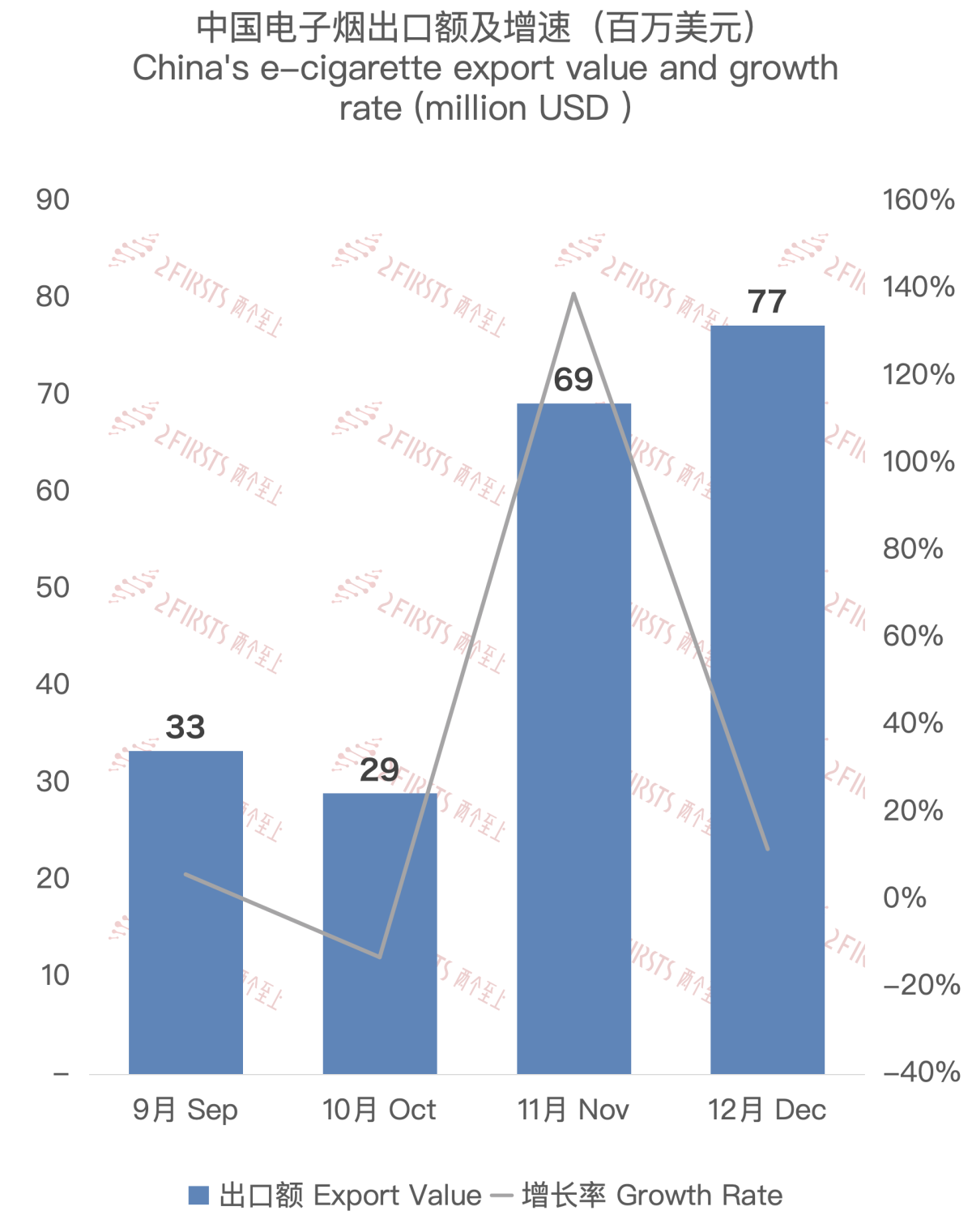
The export volume reached approximately $77.27 million, registering a month-on-month growth of 11.61% and a year-on-year growth of 23.62%.
China's E-Cigarette Exports to Russia Soar in December 2023
Source of image: 2FIRSTS (Mincy design)


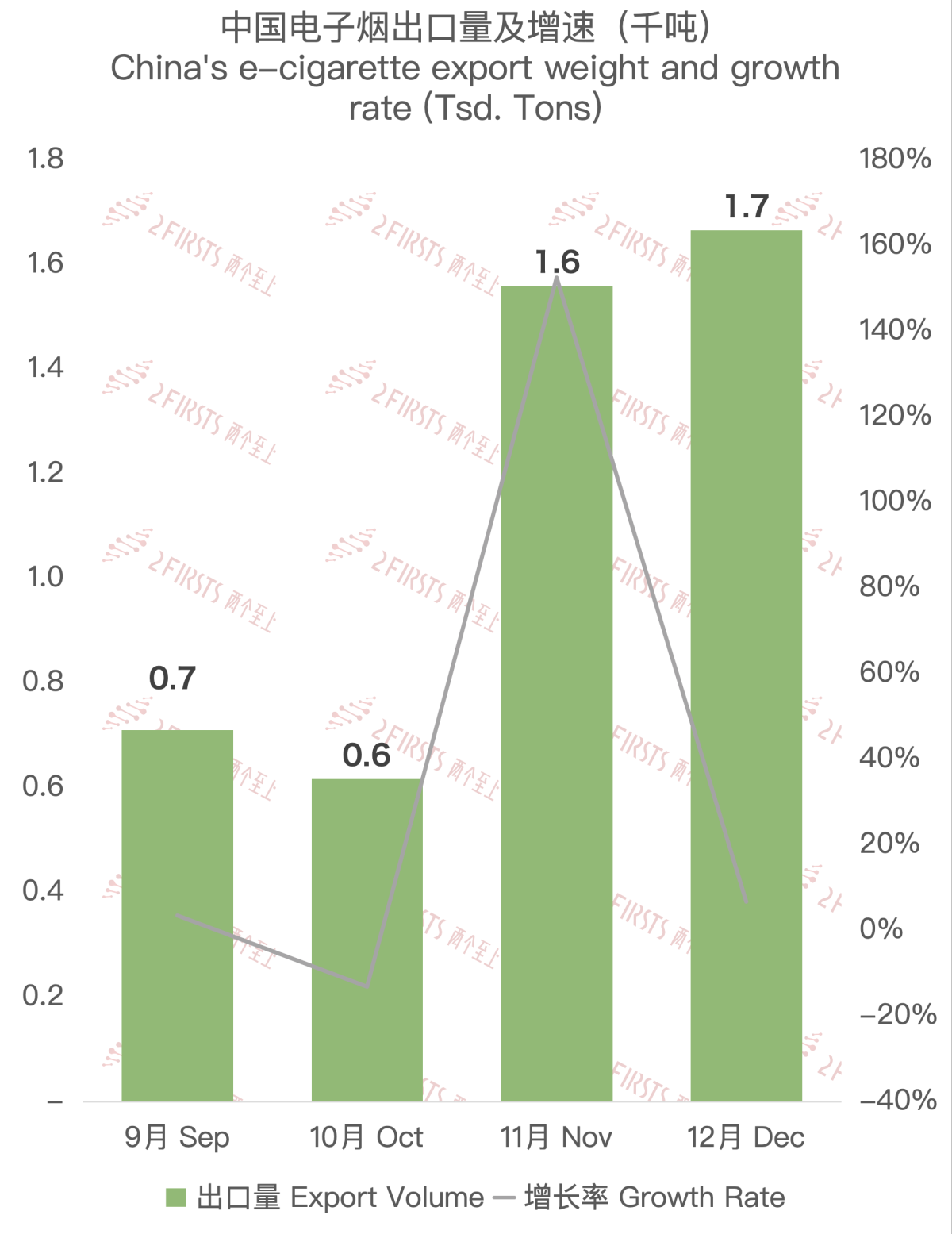
The export volume amounted to approximately 1667 tons, with a month-on-month increase of 6.78% and a year-on-year increase of 51.17%.
China's E-Cigarette Exports to Russia Soar in December 2023
Image source: 2FIRSTS (Mincy graphics).


The export unit price for e-cigarettes and similar personal electronic vaporizers was $46.37 per kilogram, with a 4.52% month-on-month increase but an 18.22% year-on-year decline. The average price for these devices was $9.07 per unit.

China's E-Cigarette Exports to Russia Soar in December 2023
Image source: 2FIRSTS (Graphic by Mincy)


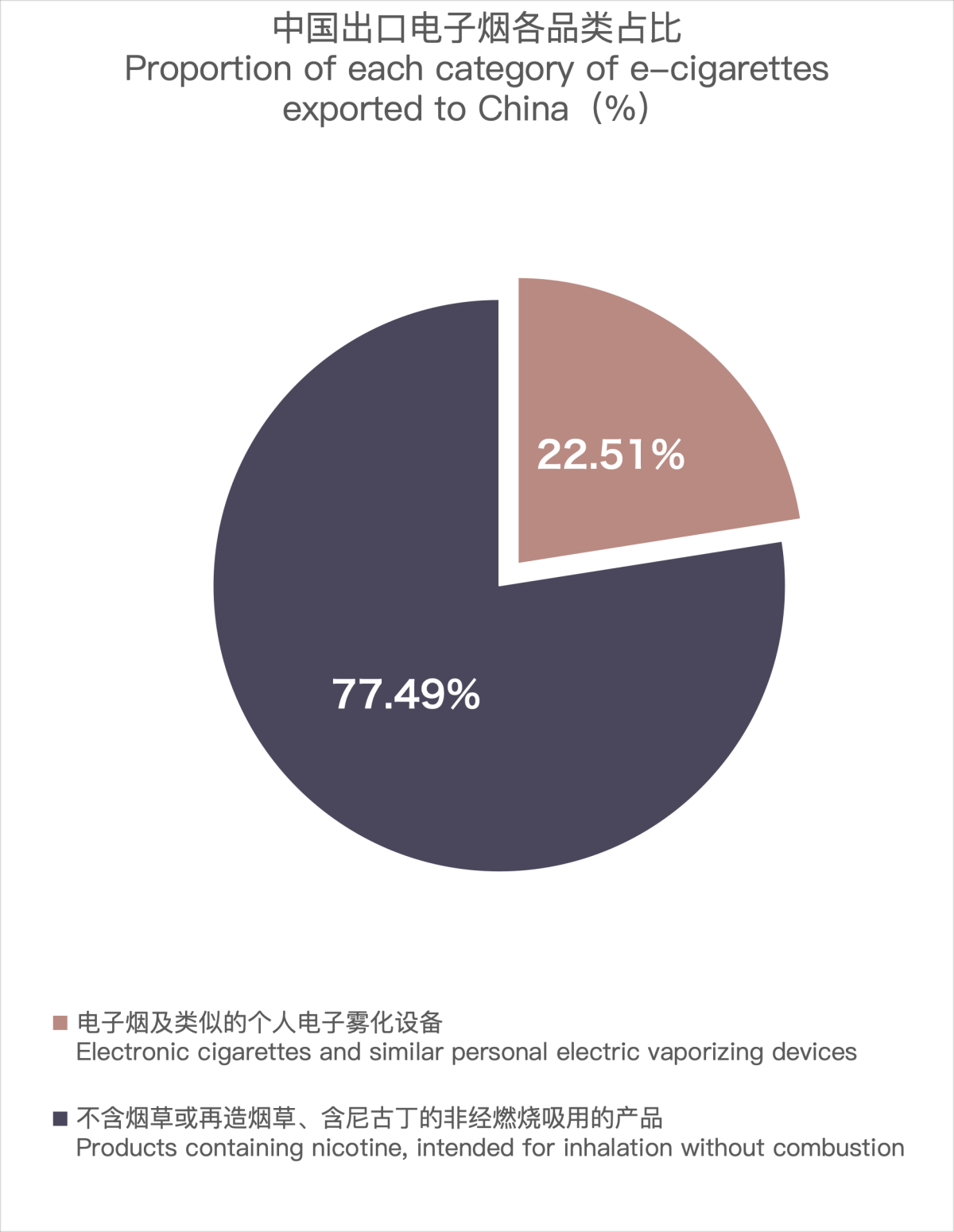
Among them, "e-cigarettes and similar personal electronic vaporizers" accounted for 22.51% of the export categories, while "nicotine-containing non-combustible products that do not contain tobacco or reconstructed tobacco" accounted for 77.49%.
China's E-Cigarette Exports to Russia Soar in December 2023
Source of the image: 2FIRSTS (Mincy's chart)


We welcome news tips, article submissions, interview requests, or comments on this piece.

Please contact us at info@2firsts.com, or reach out to Alan Zhao, CEO of 2Firsts, on LinkedIn


Notice

1.  This article is intended solely for professional research purposes related to industry, technology, and policy. Any references to brands or products are made purely for objective description and do not constitute any form of endorsement, recommendation, or promotion by 2Firsts.

2.  The use of nicotine-containing products — including, but not limited to, cigarettes, e-cigarettes, nicotine pouchand heated tobacco products — carries significant health risks. Users are responsible for complying with all applicable laws and regulations in their respective jurisdictions.

3.  This article is not intended to serve as the basis for any investment decisions or financial advice. 2Firsts assumes no direct or indirect liability for any inaccuracies or errors in the content.

4.  Access to this article is strictly prohibited for individuals below the legal age in their jurisdiction.


Copyright


This article is either an original work created by 2Firsts or a reproduction from third-party sources with proper attribution. All copyrights and usage rights belong to 2Firsts or the original content provider. Unauthorized reproduction, distribution, or any other form of unauthorized use by any individual or organization is strictly prohibited. Violators will be held legally accountable.

For copyright-related inquiries, please contact: info@2firsts.com


AI Assistance Disclaimer


This article may have been enhanced using AI tools to improve translation and editorial efficiency. However, due to technical limitations, inaccuracies may occur. Readers are encouraged to refer to the cited sources for the most accurate information.

We welcome any corrections or feedback. Please contact us at: info@2firsts.com

UAE Sets Dh1-Per-ml Minimum Excise Price for Vape Liquids From Sept. 1 While Keeping 100% Tax Rate
The UAE Ministry of Finance will introduce a minimum excise price for e-liquids used in vaping and electronic smoking devices from September 1, 2026. The minimum excise price will be set at AED 1 per millilitre. The existing 100% excise tax rate will continue to apply to tobacco and electronic smoking products. The measure changes the minimum taxable base rather than the tax rate, with the UAE government saying it aims to establish unified tax standards, improve market compliance and prevent pricing loopholes.
Regulations
Aug.07 by 2Firsts Perspectives
PMI Q2 Call: ZYN Growth, IQOS Pricing and a Diverging Global Tobacco Market
Philip Morris International’s second-quarter earnings call offered new detail on its smoke-free strategy. Management said it would increase U.S. investment behind nicotine pouch brand ZYN, keep IQOS focused on volume before stronger pricing, and use SENTIA, DELIA, LEVIA, VEEV and ZYN to manage tax and regulatory pressure across Japan and Europe. Analysts from Goldman Sachs, Morgan Stanley, UBS and other firms also pressed PMI on profitability, market share, cigarette resilience and the durability of its global transformation over coming quarters.
Jul.24
After Apple Business Decline, South Korea’s ITM Semiconductor Expands KT&G Vape Supply Chain as Vape Revenue Rises 24.8%
South Korean electronics component supplier ITM Semiconductor is reshaping its business portfolio after a decline in Apple-related protection circuit business, expanding its supply of vape devices and cartridges to KT&G. According to News1 on August 18, 2026, ITM’s vape-related revenue rose 24.8% year on year to 75.5 billion won in the first half of 2026. The company began mass production of vape devices at its Cikarang, Indonesia facility in January 2026, strengthening export manufacturing capacity. Meanwhile, Samsung-related protection circuit sales continued to grow, providing support during the transition.
Aug.20
Kantar Study Finds More Than 93% of Vape Products in Ukraine Fail Regulatory Requirements
According to Interfax-Ukraine, a study conducted by market research firm Kantar Ukraine at the request of major tobacco companies found that more than 93% of vape products in Ukraine did not fully comply with regulatory requirements. The research examined product categories, brand distribution and consumer purchasing channels, showing that pod systems and disposable vapes represent major segments of the market, while offline retail remains the dominant purchasing channel. The findings highlight ongoing compliance challenges in Ukraine’s vape market.
Aug.26
Russian Strikes Destroy JTI and Imperial Brands Ukraine Warehouses, With Losses Reaching Tens of Millions of Hryvnias
According to Ukrainska Pravda, Russian strikes on the Kyiv region during the night of Aug. 4-5, 2026, damaged warehouses storing products of Japan Tobacco International (JTI) and Imperial Brands Ukraine. JTI said a finished goods warehouse in Kyiv Oblast was destroyed, with no employees injured, and that it did not expect disruptions to retail supplies. Imperial Brands Ukraine said products stored at warehouses of distributors and retail partners were affected and estimated losses from the strikes at “tens of millions of Ukrainian hryvnias” (roughly hundreds of thousands of U.S. dollars).
JTI
Aug.07
U.S. Fifth Circuit Vacates NicQuid Vape MDO, Says FDA Comparative-Efficacy Standard Violated APA Procedures
According to VitalLaw on August 27, 2026, the U.S. Court of Appeals for the Fifth Circuit vacated an FDA marketing denial order (MDO) against NicQuid LLC, ruling that the agency’s comparative-efficacy standard for electronic nicotine delivery system (ENDS) applications had become a substantive rule requiring notice-and-comment rulemaking under the Administrative Procedure Act (APA). The court did not reject FDA’s authority to compare the public health benefits and risks of flavored vapes, but held that the agency could not establish a broadly binding standard through informal adjudications. The case was remanded to FDA for further proceedings.
Aug.28