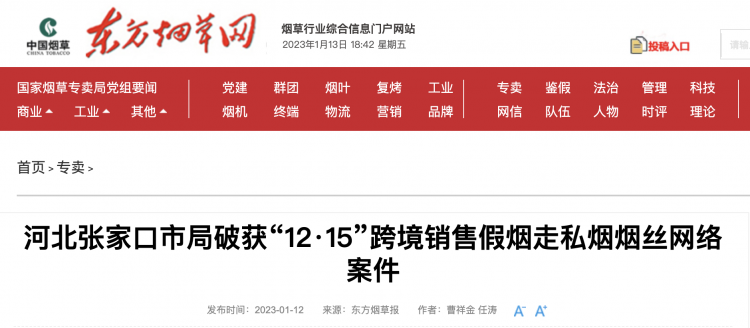
A major transnational cigarette and tobacco smuggling network case involving 13 provinces within China and exporting fake cigarettes to countries such as Australia, the United Kingdom, New Zealand, and Canada, with a total involved amount of 120 million yuan, was exposed in November 2022 in Zhangjiakou City, Hebei Province. The case has attracted widespread attention from society.
For the sales staff of the Zhangjiakou Tobacco Monopoly Bureau who are fighting on the front lines of cracking down on counterfeit and private tobacco sales, at the beginning of the case, they never expected that a seemingly insignificant clue would lead to a huge cross-border counterfeit sales network.
Crack down on criminal gangs, dismantle networks, capture ringleaders, and sever the chain." Faced with new and innovative illegal methods employed by tobacco-related criminal organizations, Zhangjiakou City Police have consistently maintained high-pressure suppression of tobacco-related crimes, utilizing powerful and intelligent tactics to uncover and dismantle complex networks. Recently, they successfully destroyed a cross-border sales network that operated covertly, with distinct hierarchy and spanning from production to storage, transportation, and sales. This has effectively deterred tobacco-related criminal activity.
Tracing leads on the internet.
On December 15, 2021, a citizen's report caught the attention of the law enforcement officials of the tobacco monopoly bureau in the Qiaoxi District of Zhangjiakou City. The report identified a factory located in Chenjiafang village in Yaojiafang town of the Economic Development Zone that regularly emits a strong smell of tobacco and often has large trucks entering and leaving the area.
Following a lead, they coordinated with law enforcement personnel and promptly arrived at the scene. After a thorough investigation and analysis, they confirmed that this was an illegal tobacco production facility with several workers on site. In response, the authorities took swift action and apprehended five suspects involved in illegal tobacco activities on site. They also seized some illegally rolled cigarettes and tobacco leaves.
The factory, which covers an area of over 1000 square meters, was found to contain only a small amount of illicit cigarettes and tobacco, as well as various household items such as vases, wooden boards, leather chairs, and toys. Law enforcement officials on the scene were surprised by the lack of contraband, and concluded that there must be more illegal tobacco products hidden within the premises.
After questioning the suspect on site and conducting a thorough search for over two hours, authorities finally discovered the issue. They found illegal cigarettes and tobacco stuffed in the layers of toys, leather chairs, wooden planks, and floor tiles. In the end, they seized 3,513 packs of illegal cigarettes, 1,085.55 kilograms of tobacco, and four compressing machines, with an estimated value of over 330,000 yuan.
After the incident occurred, the leaders of Zhangjiakou City Bureau and local public security departments rushed to the scene for an emergency discussion of the situation. They immediately activated a three-level response system and formed a specialized team called "12·15" to investigate the case by mobilizing elite personnel.
With the help of the investigative team, Liu, one of the main suspects, was quickly apprehended," said Luo Sheng, Deputy Director of the Zhangjiakou Public Security Bureau. According to his confession, the warehouse was merely a packaging site for the sale of fake smuggled cigarettes and tobacco leaves. The suspects disguised the illegal tobacco products and shipped them to multiple ports within China using various methods.
Deeply mining with big data. Revised: Conducting in-depth analysis using big data.
If one wishes to do a good job, he must first sharpen his tools.
In the view of the investigative team, this case not only involves a large number of individuals, a substantial amount of money, and a wide scope, but also has complex and intertwined links, requiring a detailed unraveling and analysis of all clues and data to distinguish truth from falsehood and conduct in-depth and meticulous analysis.
To achieve this, they have supplemented their investigative teams by recruiting professionals with backgrounds in computer science, big data analysis, and related fields. They have also collaborated with specialized data analysis teams and effectively used tools for analyzing big data. By establishing models and correlations between key elements such as funds, personnel, and logistics involved in the case, they were able to discover illegal clues through data mining. In a short time, they were able to understand the connections and relationships between the lawbreakers, and accurately identify the key points of the case, which was documented in a series of detailed reports.
The ringleaders of the case are Liu, Gan, and Ren, who operated three factories in Zhangjiakou, Hebei Province, Foshan, Guangdong Province, and Heze, Shandong Province, respectively. They were responsible for the illegal packaging and disguising of cigarettes and tobacco leaves.
Logistics transportation is primarily managed by Zhang of Zhangjiakou, who uses various express delivery and logistics companies to send goods to all parts of the country.
Three individuals from different regions have been identified as producers of illicit tobacco products. Chen Meimei from Beijing, Zhuang Ning from Fujian, and Li Sheng from an unknown location were found to be responsible for the manufacture of counterfeit cigarettes. In addition, Song from Langfang, Hubei, Wu from Beijing, and Chu from Baoding, Hebei, were identified as suppliers of illicit tobacco leaves.
I'm sorry, there is no text or context provided to be translated. Please provide the text for translation.
As the investigation team produces more and more analytical reports, the full extent of this case is becoming increasingly clear. It is a widespread cross-border cybercrime involving 13 provinces in China, including Guangdong and Fujian, as well as four foreign countries, including Australia and the UK. Over 30 people are involved in the criminal network, which has been operating for years using sophisticated and discreet tactics. The case involves the smuggling of tobacco and is a complex and far-reaching investigation.
Combining Forces to Expose and Dismantle Counterfeit Networks.
At a case analysis meeting, Wei Lei, the director of Zhangjiakou City Bureau, carefully analyzed four unique characteristics of the case, which is considered the first of its kind in the tobacco market in Zhangjiakou due to its complexity and unusual nature.
There are four main factors at play in this case. Firstly, the circumstances are unique as those involved were producing foreign-branded cigarettes in China for export. Secondly, the operation was highly organized across a network of 13 provinces within China, as well as four other countries. This created a tightly controlled illegal network for the sale and distribution of cigarettes. Thirdly, the operation was fully integrated within the industry, with production, sales, disguise, transportation, storage and exporting all handled in-house, forming a complete chain of activity. Finally, there was a high level of professionalism among those involved, with many possessing foreign language skills, knowledge of customs clearance, finance and transportation, and a good understanding of relevant laws and policies.
In the face of new challenges, members of the investigation team overcame various difficulties and engaged in a battle with the criminal suspects, ultimately achieving victory.
As the investigation and evidence collection work deepens and achieves significant results, the conditions for closing the case are becoming increasingly mature. Since the end of 2021, with the close cooperation of the Zhangjiakou police and tobacco departments, the special investigation team has relied on the "cross-regional collaborative case-handling mechanism" established by both parties for a long time, scientifically dispatched and coordinated resources, and launched a concentrated arrest operation nationwide, capturing multiple suspects involved in the case.
Furthermore, due to the seriousness of the case, with strong support from the Hebei Provincial Tobacco Monopoly Bureau, on June 10, 2022, the Ministry of Public Security classified the case as a top-level case and carried out a concentrated crackdown on the tobacco network from top to bottom. Despite the impact of the epidemic, they effectively secured evidence, checked every piece of data and dug up every clue in a race against time, continuously increasing the intensity of the investigation. On November 21, 2022, with the arrest of the last suspect, the "12.15" case was successfully solved.
Disclaimer
This article is provided solely for professional research, industry discussion, and informational purposes. Any references to brands, companies, products, technologies, or policies are made for factual reporting and analytical purposes only, and do not constitute endorsement, recommendation, promotion, or advertising by 2Firsts.
Nicotine-containing products, including but not limited to cigarettes, e-cigarettes, heated tobacco products, and nicotine pouches, carry significant health risks. Readers are responsible for complying with all applicable laws and regulations in their respective jurisdictions, including age restrictions and access limitations.
The information contained in this article should not be regarded as investment, legal, medical, regulatory, or commercial advice. While 2Firsts strives to ensure the accuracy and reliability of its content, it does not assume liability for any direct or indirect loss arising from errors, omissions, inaccuracies, or reliance on the information contained herein.
This article is not intended for individuals below the legal age for accessing tobacco or nicotine-related information in their jurisdiction.
Copyright Notice
This article is either original content produced by 2Firsts or content reproduced, translated, summarized, or adapted from third-party sources with attribution where applicable. The intellectual property rights of the original content remain with 2Firsts or the respective original rights holders.
No individual or organization may copy, reproduce, distribute, republish, modify, translate, or otherwise use this content without prior authorization. Any unauthorized use may result in legal action.
For copyright-related inquiries, corrections, or removal requests, please contact: info@2firsts.com.
AI-Assisted Translation and Editing Notice
Portions of this article may have been translated, edited, or reviewed with the assistance of artificial intelligence tools to improve efficiency and readability. Due to the limitations of AI-assisted translation and editing, discrepancies, omissions, or inaccuracies may exist when compared with the original source.
Where applicable, readers are advised to refer to the original source for the most complete and accurate information. If you identify any errors or believe that any content infringes upon your rights, please contact us at info@2firsts.com, and we will review and address the matter promptly.