Declining Tobacco Use among US Teenagers in 2022

Nov.15.2022
Declining Tobacco Use among US Teenagers in 2022
Tobacco use among US middle and high school students has decreased while e-cigarette use remains prominent, according to CDC data.

The numbers are increasing, but the use of tobacco among teenagers is decreasing. According to government data released last week, an estimated 3.08 million American middle and high school students reported using tobacco products in the last 30 days of 2022. This number is lower than the 4.47 million reported in 2020 and the 6.2 million reported in 2019.


According to a new study published in the Morbidity and Mortality Weekly Report by the Centers for Disease Control and Prevention (CDC), electronic cigarettes have remained the most commonly used tobacco product among adolescents for the ninth consecutive year.


A survey has found that cigars are the second most popular choice, with 500,000 people reporting their use, following closely behind 440,000 smokers.


According to a report from Reuters, nearly 31% of surveyed students have reported using multiple products, which the Centers for Disease Control and Prevention have deemed "particularly concerning" due to its association with adolescent nicotine dependence and long-term use.


Over the past two decades, the smoking rate among American teenagers has steadily declined. However, due to changes in data collection methods related to the COVID-19 pandemic, the CDC warns against comparing the results to previous years.


According to a nationwide annual survey conducted from January to May of this year, the study revealed that nearly 11.3% of students had used tobacco products within the past 30 days.


Statement:


This article is compiled from third-party information and is only intended for industry exchange and learning.


This article does not reflect the opinions of 2FIRSTS, and 2FIRSTS cannot confirm the authenticity and accuracy of the contents. The translation of this article is only for industry exchange and research purposes.


Due to limitations in the compiling ability, the translated article may not accurately convey the same meaning as the original. Please refer to the original article for accuracy.


2FIRSTS maintains complete alignment with the Chinese government's stance and statements on all domestic, Hong Kong, Macau, Taiwan, and foreign matters.


The copyright of the compiled information belongs to the original media and author. If there is any infringement, please contact us for removal.


Disclaimer

This article is provided solely for professional research, industry discussion, and informational purposes. Any references to brands, companies, products, technologies, or policies are made for factual reporting and analytical purposes only, and do not constitute endorsement, recommendation, promotion, or advertising by 2Firsts.

Nicotine-containing products, including but not limited to cigarettes, e-cigarettes, heated tobacco products, and nicotine pouches, carry significant health risks. Readers are responsible for complying with all applicable laws and regulations in their respective jurisdictions, including age restrictions and access limitations.

The information contained in this article should not be regarded as investment, legal, medical, regulatory, or commercial advice. While 2Firsts strives to ensure the accuracy and reliability of its content, it does not assume liability for any direct or indirect loss arising from errors, omissions, inaccuracies, or reliance on the information contained herein.

This article is not intended for individuals below the legal age for accessing tobacco or nicotine-related information in their jurisdiction.


Copyright Notice

This article is either original content produced by 2Firsts or content reproduced, translated, summarized, or adapted from third-party sources with attribution where applicable. The intellectual property rights of the original content remain with 2Firsts or the respective original rights holders.

No individual or organization may copy, reproduce, distribute, republish, modify, translate, or otherwise use this content without prior authorization. Any unauthorized use may result in legal action.

For copyright-related inquiries, corrections, or removal requests, please contact: info@2firsts.com.


AI-Assisted Translation and Editing Notice

Portions of this article may have been translated, edited, or reviewed with the assistance of artificial intelligence tools to improve efficiency and readability. Due to the limitations of AI-assisted translation and editing, discrepancies, omissions, or inaccuracies may exist when compared with the original source.

Where applicable, readers are advised to refer to the original source for the most complete and accurate information. If you identify any errors or believe that any content infringes upon your rights, please contact us at info@2firsts.com, and we will review and address the matter promptly.

U.S. Ninth Circuit Upholds FDA Denial of MH Global’s Flavored Vape PMTA Applications
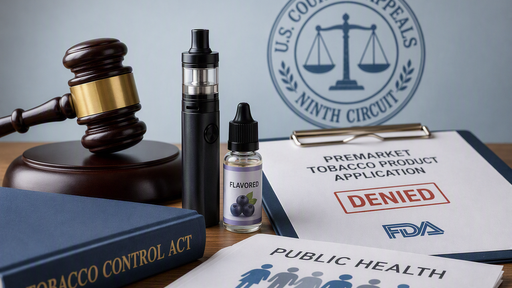
The U.S. Court of Appeals for the Ninth Circuit upheld the FDA’s denial of MH Global LLC’s applications to market flavored electronic nicotine delivery systems (ENDS). The court ruled that FDA’s comparative-efficacy framework, which requires applicants to show that flavored products provide greater cessation or switching benefits than tobacco-flavored alternatives, is consistent with the Tobacco Control Act’s “appropriate for the protection of the public health” standard. The court also found that FDA was not required to establish the framework through notice-and-comment rulemaking.
Aug.26
China Tobacco Yunnan files patent for cellulose-free nicotine pouch scaffold to replace microcrystalline cellulose
China Tobacco Yunnan Industrial Co., Ltd. has filed a patent application for a cellulose-free scaffold material for nicotine pouches, proposing a combination of bioceramic material, polydextrose and sugar alcohols to replace conventional microcrystalline cellulose and cellulose derivatives. The filing aims to address issues including powdery mouthfeel, residue and limited release control, while also reducing reliance on existing cellulose-based patent portfolios. In patent examples, one fast-release formulation reached a nicotine release rate of 50% at 10 minutes and more than 90% at 20 minutes.
Sep.02
GAO Audit Finds Nearly 132,000 FDA Tobacco Applications Waiting an Average 1,266 Days as Nicotine Pouch Pilot Practices Move Into Vape PMTA Reviews
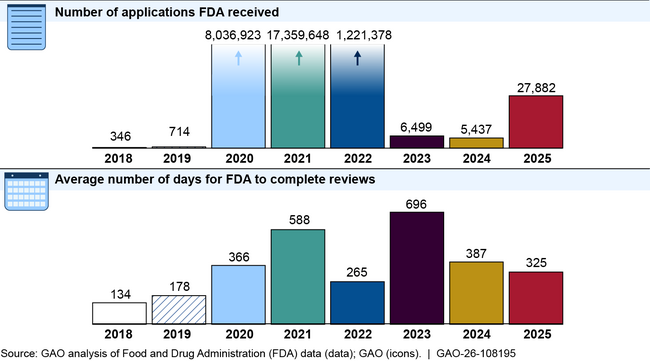
A U.S. Government Accountability Office audit found that 131,915 tobacco product applications submitted to the FDA since 2018 remained without a final review as of December 31, 2025, with pending applications waiting an average of 1,266 days. GAO also found FDA lacks the data needed to systematically determine whether scientific reviews meet applicable timelines. HHS agreed to upgrade the agency's tracking systems. At the same time, FDA has begun applying lessons from its nicotine pouch PMTA pilot to e-cigarette reviews, while changes to enforcement policy and electronic submissions are making the specific stage of a PMTA increasingly relevant to market access.
FDA
Oct.03
South Korea Imports 12,126 Kg of Nicotine Analogues From April to August After Bringing Synthetic Nicotine Under Tobacco Law
South Korea's liquid-vape market is showing changes across raw-material imports, product types and sales channels after synthetic nicotine came under the Tobacco Business Act on April 24. Customs data show nicotine-analogue imports totaled 12,126 kilograms from April through August, while synthetic-nicotine imports over the same five months totaled 231,663 kilograms, just 39.3% of the amount imported in March alone. Physical liquid-vape stores tracked in Seoul and Gyeonggi Province fell 9.9%, unmanned outlets edged higher and online sales listings increased from 27,774 to 42,437. Government testing of 105 liquid inhalation products promoted as nicotine-free separately found nicotine in 13 and 6-methylnicotine in 12.
Sep.22
U.S. Customs Plan to Require Foreign Export Declarations Could Deal ‘Devastating’ Blow to China’s Vape Exports, Logistics gl Expert Says
A U.S. Customs and Border Protection proposal to collect foreign export declarations and other overseas customs documents could expose discrepancies in the value, classification and description of China-made vape shipments entering the United States. A veteran Chinese logistics professional told 2Firsts that the measure, if implemented, could undermine the all-inclusive shipping model used by some unauthorized vape exporters and push parts of the trade toward costlier underground channels. The risk extends beyond higher duties: accurately declared products may also be more readily identified as unauthorized e-cigarettes subject to FDA enforcement.
Special Report
Sep.07
U.S. Health Groups Seek to Overturn FDA Enforcement Discretion for Pending PMTAs as Altria's Helix, NJOY and AVM Move to Intervene
American Vapor Manufacturers (AVM) and Altria subsidiaries Helix Innovations and NJOY filed separate motions on October 7, 2026, seeking to intervene on the FDA's side in a lawsuit challenging its enforcement guidance for certain e-cigarette and nicotine pouch products with pending premarket tobacco product applications (PMTAs). Seven public health and tobacco-control organizations, including the Campaign for Tobacco-Free Kids, sued the agency in July to overturn the policy. AVM argues that vacating the guidance could disrupt orders, inventory, retail distribution and investments in regulatory submissions.
Regulations
Oct.09