DTI Reiterates SHFT Product Distribution Ban; Social Media Giveaways Face Penalty as Violations

Apr.22.2025
DTI Reiterates SHFT Product Distribution Ban; Social Media Giveaways Face Penalty as Violations
DTI reiterates ban on SHFT products following free giveaway announcement on social media, citing violation of preventive measures.

Key points:

Reiteration of Ban Background: On April 16, 2025, SHFT posted on social media announcing "free product giveaway until supplies last." The DTI promptly responded, emphasizing that even free giveaways violate existing Preventive Measures Order (PMO).


Administrative Measures Are In Place: Administrative measures have been taken by the Department of Trade and Industry (DTI) on September 6, 2024 and January 31, 2025 against SHFT and its manufacturers and importers, issuing Preventive Measures Orders (PMOs) for violating sections 4(d) and 18 of the Republic Act 11900 on the regulation of nicotine and non-nicotine vapor products, as well as related national administrative orders (DAO 02-2007) and Philippine National Standards (PNS) requirements under Republic Act 4109.


Conditional Customs Release (CCR) restrictions still in effect: While SHFT goods have been issued conditional customs release certificates, CCR explicitly prohibits any form of transfer, use, sale, or distribution, whether it be for all or part of the goods.


Enforcement stance clear: DTI OSMV warns the public against engaging in any activities involving SHFT products, violators will face corresponding penalties.


On April 21, the Special Authority Office for the Regulation of Vape Nicotine and Non-Nicotine Products, Devices and Novel Tobacco under the Department of Trade and Industry (DTI) of the Philippines reiterated that the sale and distribution (including giveaways) of SHFT brand products is strictly prohibited until the cases are resolved.


This statement is in response to a post made by SHFT on social media on April 16, 2025, stating their intention to "give away products for free before they sell out." In response, the DTI clarified that regardless of whether the products are being charged for, such giveaways still violate the preventive measures order (PMO) regulations previously issued.


As of now, the DTI OSMV has issued Product Registration Certificates (PMOs) on September 6, 2024 and January 31, 2025 respectively, citing violations by SHFT of section 4(d) and 18 of the RA 11900 or the Act Regulating Nicotine and Non-Nicotine Vapor Products, as well as related provisions of Department Administrative Order No. 02-2007 concerning national standards. These regulations are in accordance with the Philippine National Standards Act (RA 4109) and RA 11900.


Apart from the PMO, the DTI also pointed out that the Certificate of Conditional Release (CCR) issued for SHFT products remains valid, explicitly prohibiting any form of product transfer, use, sale, or distribution, regardless of whether the batch has fully circulated.


The Department of Trade and Industry's Office for the Special Monitoring of Vulnerable Products is urging the public to avoid engaging in any activities related to SHFT products. They have issued a warning that any violation of the Product Management Order or Consumer Code Regulations will be punished according to the law.


We welcome news tips, article submissions, interview requests, or comments on this piece.

Please contact us at info@2firsts.com, or reach out to Alan Zhao, CEO of 2Firsts, on LinkedIn


Notice

1.  This article is intended solely for professional research purposes related to industry, technology, and policy. Any references to brands or products are made purely for objective description and do not constitute any form of endorsement, recommendation, or promotion by 2Firsts.

2.  The use of nicotine-containing products — including, but not limited to, cigarettes, e-cigarettes, nicotine pouchand heated tobacco products — carries significant health risks. Users are responsible for complying with all applicable laws and regulations in their respective jurisdictions.

3.  This article is not intended to serve as the basis for any investment decisions or financial advice. 2Firsts assumes no direct or indirect liability for any inaccuracies or errors in the content.

4.  Access to this article is strictly prohibited for individuals below the legal age in their jurisdiction.


Copyright


This article is either an original work created by 2Firsts or a reproduction from third-party sources with proper attribution. All copyrights and usage rights belong to 2Firsts or the original content provider. Unauthorized reproduction, distribution, or any other form of unauthorized use by any individual or organization is strictly prohibited. Violators will be held legally accountable.

For copyright-related inquiries, please contact: info@2firsts.com


AI Assistance Disclaimer


This article may have been enhanced using AI tools to improve translation and editorial efficiency. However, due to technical limitations, inaccuracies may occur. Readers are encouraged to refer to the cited sources for the most accurate information.

We welcome any corrections or feedback. Please contact us at: info@2firsts.com

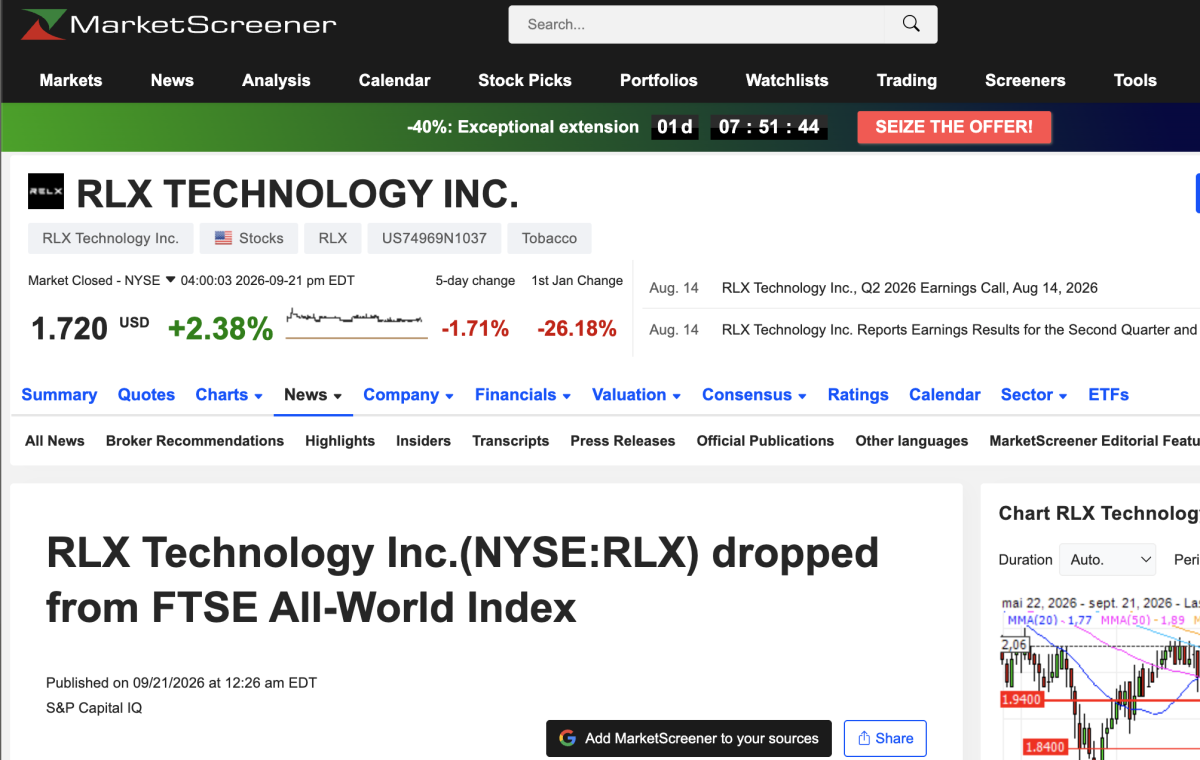
RLX Technology Dropped From FTSE All-World as International Business Reaches 68.5% of Q2 Revenue
RLX Technology (NYSE: RLX) has been removed from the FTSE All-World Index, effective September 21. FTSE Russell records show RLX was already part of its global equity index universe by 2022, when its American depositary receipts were classified as China Large Cap securities. Trading volume rose to about 44.77 million shares on September 18, roughly 23 times the previous session's volume. RLX reported RMB1.0105 billion in second-quarter revenue, up 14.8% year over year, with international operations contributing 68.5%. The company also acquired a 51% stake in one of Western Europe's largest distributors of next-generation smoke-free and FMCG products in July.
Sep.22
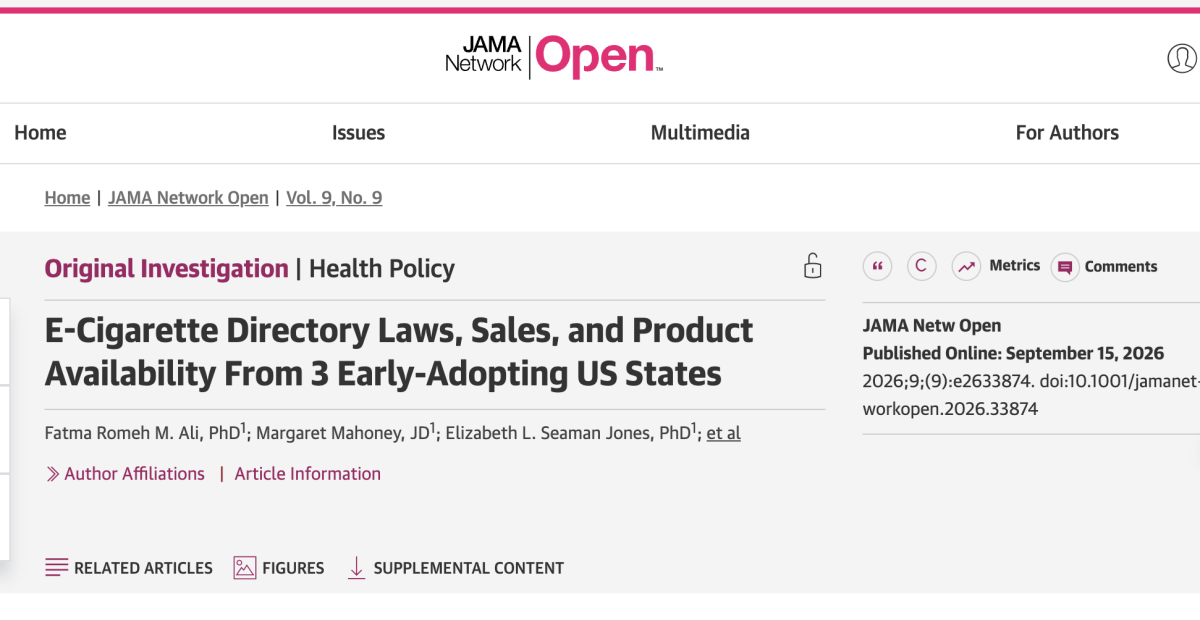
JAMA Study: U.S. Vape Directories Fail to Sustainably Curb Unlisted Sales as Product Shifts May Redistribute Brand Share 2Firsts Recommended
A study by CDC Foundation researchers found no sustained decline in e-cigarette sales across Alabama, Oklahoma and Louisiana, the first three U.S. states to implement e-cigarette directory laws. Louisiana initially saw a significant sales decline, followed by a rebound and a persistent reduction in product availability. Sales also shifted from nontobacco-flavored disposables toward prefilled cartridges, with Vuse Alto driving much of the increase in menthol cartridges. By April 2025, unlisted products still accounted for more than half of e-cigarette nicotine sales in all three states.
Sep.18
U.S. Customs Plan to Require Foreign Export Declarations Could Deal ‘Devastating’ Blow to China’s Vape Exports, Logistics gl Expert Says
A U.S. Customs and Border Protection proposal to collect foreign export declarations and other overseas customs documents could expose discrepancies in the value, classification and description of China-made vape shipments entering the United States. A veteran Chinese logistics professional told 2Firsts that the measure, if implemented, could undermine the all-inclusive shipping model used by some unauthorized vape exporters and push parts of the trade toward costlier underground channels. The risk extends beyond higher duties: accurately declared products may also be more readily identified as unauthorized e-cigarettes subject to FDA enforcement.
Special Report
Sep.07
China STMA Deputy Administrator Meets KT&G COO as Heated Cigarette Rules Advance
Wang Gongcheng, deputy administrator of China’s State Tobacco Monopoly Administration, met KT&G Chief Operating Officer Lee Sang-hak in Shanghai on September 1, according to Oriental Tobacco News. The meeting comes as China seeks public comment on a draft mandatory national standard for heated cigarettes. The report did not disclose the subjects discussed or indicate whether heated tobacco products or market access were addressed.
News
Sep.02
Smoke-Free Business Hits 42% of Q2 Net Revenue as PMI’s First TNFD Report Covers Single-Use Electronics, Critical Raw Materials and IQOS Repairs
Philip Morris International has published its first report aligned with the Taskforce on Nature-related Financial Disclosures, bringing its electronics supply chain and the use and end-of-life stages of smoke-free devices and consumables into its nature-related assessment. PMI said its smoke-free business accounted for about 42% of total net revenues in the second quarter of 2026. The report says non-circular electronic products, particularly single-use items, can increase consumption of limited natural resources and also details an IQOS repair pilot. A 2040 circularity scenario tests assumptions including a 50% reduction in product waste-related costs, 10% raw-material savings and a 25% substitution rate for refurbished products versus new products.
Sep.23
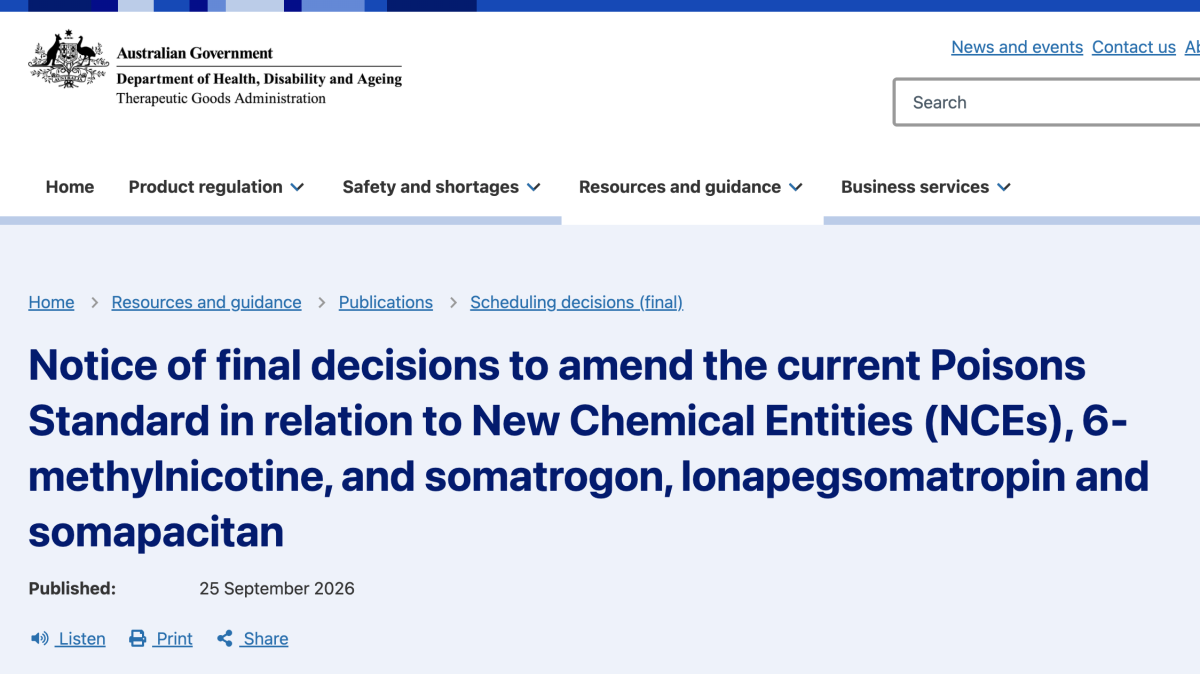
Australia Adds 6-Methylnicotine to Schedule 9 Prohibited Substances, Effective October 1
Australia's Therapeutic Goods Administration published a final decision on September 25 to classify 6-methylnicotine as a Schedule 9 prohibited substance under the Poisons Standard, effective October 1, 2026. TGA said the chemical has been reported in e-cigarette liquids sold in Australia and marketed as nicotine-free or nicotine alternatives, while evidence also indicates its use in preparations such as oral pouches. The government originally proposed a Schedule 7 classification but ultimately adopted the stricter Schedule 9 designation, citing acute toxicity, dependence risk, use in unapproved consumer products and misleading marketing.
News
Sep.29 by 2Firsts Perspectives