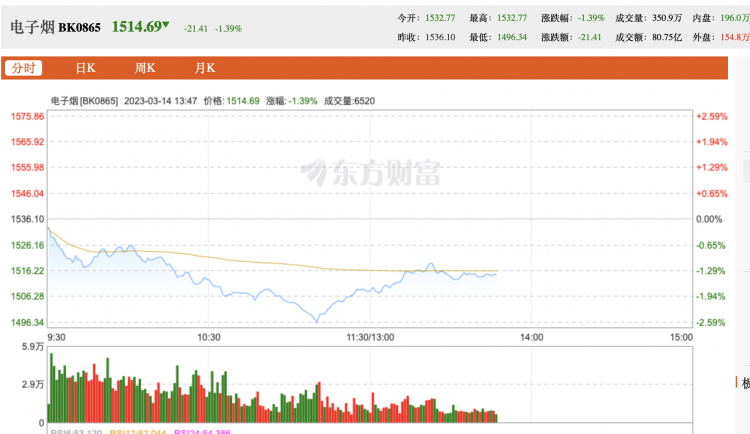
Electronic Cigarette Sector Drops 2% on March 14th

Mar.14.2023
Electronic Cigarette Sector Drops 2% on March 14th
The e-cigarette index dropped by 2% on March 14, with a turnover of 53.36 billion yuan. The top 5 stocks fell by over 3.9%.

On March 14th at 10:46 am, the electronic cigarette sector index reported at 1505.206 points, indicating a 2% decline. The total volume of trades was 53.36 billion yuan, with a turnover rate of 0.62%.


In the sector of individual stocks, the top 5 with the largest drops are as follows: Hongxin Electronics at 11.45 yuan, a decrease of 4.74%; Gionee Sound Electronics at 11.94 yuan, a decrease of 4.33%; Penghui Energy at 58.78 yuan, a decrease of 4.25%; Wog Light Power at 20.58 yuan, a decrease of 4.10%; and Xunwei Communications at 19.97 yuan, a decrease of 3.94%.


Disclaimer

This article is provided solely for professional research, industry discussion, and informational purposes. Any references to brands, companies, products, technologies, or policies are made for factual reporting and analytical purposes only, and do not constitute endorsement, recommendation, promotion, or advertising by 2Firsts.

Nicotine-containing products, including but not limited to cigarettes, e-cigarettes, heated tobacco products, and nicotine pouches, carry significant health risks. Readers are responsible for complying with all applicable laws and regulations in their respective jurisdictions, including age restrictions and access limitations.

The information contained in this article should not be regarded as investment, legal, medical, regulatory, or commercial advice. While 2Firsts strives to ensure the accuracy and reliability of its content, it does not assume liability for any direct or indirect loss arising from errors, omissions, inaccuracies, or reliance on the information contained herein.

This article is not intended for individuals below the legal age for accessing tobacco or nicotine-related information in their jurisdiction.


Copyright Notice

This article is either original content produced by 2Firsts or content reproduced, translated, summarized, or adapted from third-party sources with attribution where applicable. The intellectual property rights of the original content remain with 2Firsts or the respective original rights holders.

No individual or organization may copy, reproduce, distribute, republish, modify, translate, or otherwise use this content without prior authorization. Any unauthorized use may result in legal action.

For copyright-related inquiries, corrections, or removal requests, please contact: info@2firsts.com.


AI-Assisted Translation and Editing Notice

Portions of this article may have been translated, edited, or reviewed with the assistance of artificial intelligence tools to improve efficiency and readability. Due to the limitations of AI-assisted translation and editing, discrepancies, omissions, or inaccuracies may exist when compared with the original source.

Where applicable, readers are advised to refer to the original source for the most complete and accurate information. If you identify any errors or believe that any content infringes upon your rights, please contact us at info@2firsts.com, and we will review and address the matter promptly.


Special Report | Vape bans and tougher rules: the South Caucasus takes different paths
Azerbaijan's sweeping e-cigarette ban has raised concerns over enforcement errors and the emergence of illicit sales, while neighboring Armenia is tightening technical rules and preparing higher excise taxes. Georgia, meanwhile, has resisted calls for broader vape restrictions and introduced preferential taxes for some domestically produced cigarettes. The divergent approaches across the South Caucasus highlight a regional policy dilemma: how to curb nicotine use and protect public health without encouraging black markets or creating unintended economic consequences for businesses and consumers.
Nov.03
Smoore Seeks to Toss CCELL Price-Fixing Claim as Court Weighs Vertical Distribution Versus Horizontal Conspiracy
Smoore and four authorized U.S. CCELL distributors are asking a California federal court to permanently dismiss a core antitrust claim brought by direct purchasers. Plaintiffs allege that Smoore coordinated minimum wholesale prices, customer allocation and limits on price competition among distributors, amounting to a per se unlawful horizontal conspiracy. The defendants say the alleged conduct reflects ordinary vertical relationships between a manufacturer and its distributors. The court previously dismissed a similar claim, and the latest dispute centers on whether the second amended complaint adds sufficient facts to establish a horizontal agreement.
Sep.14
Swedish-Founded Nicotine Pouch Retailer GotPouches Shifts to U.S.-Based Operations, Reaching Over 25 States
Swedish-founded online nicotine pouch retailer GotPouches has completed the localization of its U.S. operations under UpNorth Retail LLC, with corporate operations in Franklin, Tennessee, domestic fulfillment from Nashville and U.S.-based customer support. The company says its catalog covers more than 20 nicotine pouch brands and it currently serves customers in more than 25 U.S. states.
Sep.18
Wisconsin Vape Directory One Year On: Retailer Reports Four Store Closures and 70% Staff Cuts
Wisconsin's electronic vaping device directory has been fully enforced for more than a year, and local vape retailers say the reduced range of eligible products has contributed to declining sales, store closures and layoffs. Johnny Vapes owner Ben Hall said he has closed four of seven locations and cut about 70% of his staff. State law bars the sale of vaping devices not listed on the Wisconsin Department of Revenue directory and allows penalties of $1,000 per day for each unlisted device sold or offered for sale. In April 2026, the U.S. Court of Appeals for the Seventh Circuit allowed enforcement of the law to continue.
Regulations
Oct.10
PMI Expands U.S. ZYN Portfolio With New 1.5 mg and 8 mg Strengths, Moves Toward a Unified 20-Pouch-Per-Can Format
Philip Morris International is expanding its U.S. ZYN nicotine pouch portfolio with new 1.5 mg and 8 mg strengths and plans to move its core 3 mg and 6 mg dry-pouch products from 15 to 20 pouches per can in the fourth quarter of 2026. ZYN ULTRA is also commercially available, with FDA authorization covering 10 products at 9 mg and one 11 mg Smooth product. PMI U.S. lists the new 1.5 mg and 8 mg strengths as commercially available, but as of September 10 they do not appear on the FDA’s public authorization list. Public materials do not identify which PMTA submissions cover the two new strengths or their current review status.
Sep.11
PMI Pushes Smoke-Free Business in Latin America as Argentina Lifts Heated Tobacco Ban, Mexico City Share Tops 7%
Philip Morris International (PMI) showcased IQOS heated tobacco systems and nicotine pouch products at Technovation 2026 in Buenos Aires on October 7–8, presenting research on consumer attitudes, regulatory developments and illicit cigarette trade across Latin America. PMI Chief Global Growth Officer Stefano Volpetti said smoke-free products accounted for more than 7% of the Mexico City market. Argentina repealed its heated tobacco ban in May 2026 and introduced registration requirements for tobacco and nicotine products, while local media reported nicotine pouch sales in Mendoza. A PMI-commissioned survey found that only 8% of respondents across four Latin American countries were familiar with nicotine pouches. A separate KPMG study estimated illicit cigarette consumption at 77 billion sticks across 11 markets in Latin America and Canada in 2025.
PMI
Oct.13