Escape the E-Cigarette: A Platform for Teenagers to Openly Discuss Health and Behavior

Oct.20.2023
Escape the E-Cigarette: A Platform for Teenagers to Openly Discuss Health and Behavior
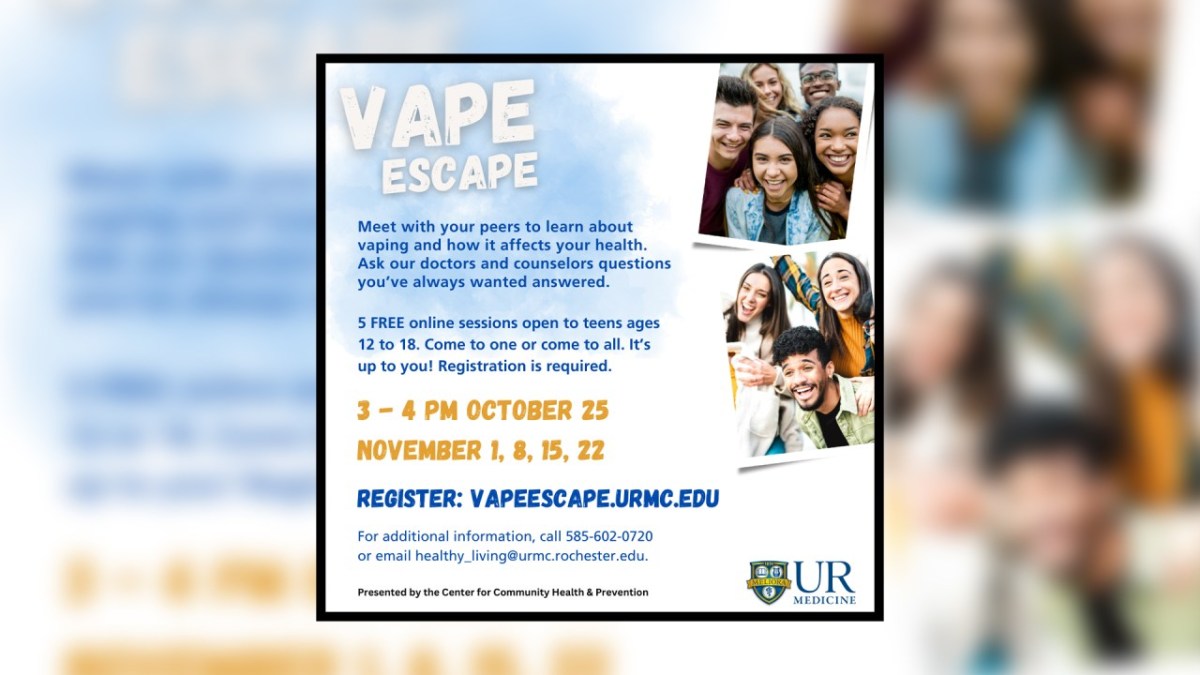
URMC is launching a free online program called "e-cigarette Escape" to provide a platform for teens to openly discuss with experts.

According to a report by WROC on October 19th, the University of Rochester Medical Center (URMC) is set to launch a free event called "e-cigarette Escape." This initiative aims to target teenagers and provide them with a platform to openly engage in conversations with health and behavior experts.


Dr. Susan Gasparino, from the Rochester Medical Center, stated in an interview, "We strongly encourage adolescents and their parents to be honest with each other. The initial marketing of e-cigarettes has incorporated attractive colors and flavors, which has sparked the interest of teenagers, unaware of its highly addictive nature.


The "Escape from E-Cigarettes" campaign will commence on October 25th, completely free and available for participation online.


We welcome news tips, article submissions, interview requests, or comments on this piece.

Please contact us at info@2firsts.com, or reach out to Alan Zhao, CEO of 2Firsts, on LinkedIn


Notice

1.  This article is intended solely for professional research purposes related to industry, technology, and policy. Any references to brands or products are made purely for objective description and do not constitute any form of endorsement, recommendation, or promotion by 2Firsts.

2.  The use of nicotine-containing products — including, but not limited to, cigarettes, e-cigarettes, nicotine pouchand heated tobacco products — carries significant health risks. Users are responsible for complying with all applicable laws and regulations in their respective jurisdictions.

3.  This article is not intended to serve as the basis for any investment decisions or financial advice. 2Firsts assumes no direct or indirect liability for any inaccuracies or errors in the content.

4.  Access to this article is strictly prohibited for individuals below the legal age in their jurisdiction.


Copyright


This article is either an original work created by 2Firsts or a reproduction from third-party sources with proper attribution. All copyrights and usage rights belong to 2Firsts or the original content provider. Unauthorized reproduction, distribution, or any other form of unauthorized use by any individual or organization is strictly prohibited. Violators will be held legally accountable.

For copyright-related inquiries, please contact: info@2firsts.com


AI Assistance Disclaimer


This article may have been enhanced using AI tools to improve translation and editorial efficiency. However, due to technical limitations, inaccuracies may occur. Readers are encouraged to refer to the cited sources for the most accurate information.

We welcome any corrections or feedback. Please contact us at: info@2firsts.com

2Firsts Exclusive Analysis | RLX Q1 Revenue Rises 96.2%, International Business Points to a More Integrated Global Strategy
RLX Technology’s Q1 net revenues rose 96.2% year over year, with international business accounting for 72.3% of total revenue. Beyond the headline growth, the results point to deeper globalization: European operations, Nexus supply-chain integration and a broader product portfolio are becoming key signals to watch.
Special Report
May.20
AP Questions FDA Rationale as Glas Fruit-Flavored Vapes Won Authorization Without Added Cessation Benefit
The U.S. Food and Drug Administration (FDA) recently authorized two fruit-flavored vaping products from Glas, but a newly released agency memo shows the products did not demonstrate greater smoking-cessation benefits than tobacco-flavored e-cigarettes. The Associated Press said the findings are likely to raise further questions about the FDA’s regulatory rationale and standards for flavored vaping products.
Jun.12
Malaysia Police Plan Saliva Tests at Roadblocks to Detect Synthetic Drugs Mixed Into Vape Liquids
Malaysian police plan to use saliva test kits at roadblocks to detect drivers using synthetic liquid drugs marketed as “Piu Piu” and “Magic Mushroom,” substances that authorities say are mixed into vape liquids and inhaled through e-cigarette devices, raising road-safety concerns and adding pressure on vape regulation.
Jun.29
FDA Sued Over Allowing Some Unauthorized Vapes and Nicotine Pouches to Stay on Market
Public health groups, pediatricians and parents sued the U.S. Food and Drug Administration on July 14, 2026, challenging a May enforcement guidance that they say allows unauthorized e-cigarettes and nicotine pouches to remain on the market while applications are under review.
Jul.15
Reuters: India Seeks to Dismiss Adani Nicotine Pouch Challenge as Mumbai Airport Dispute Moves to Court
Reuters reported on July 13, 2026, that India is seeking to dismiss Adani Airports’ legal challenge over nicotine pouch sales at Mumbai International Airport’s duty-free shops. Adani denies wrongdoing and argues that existing drug and cosmetics regulations do not apply to duty-free sales or nicotine pouches.
Innovation
Jul.14 by 2Firsts Perspectives
Special Report|South Korean Lawmaker Queries China Tobacco Regulator Over Synthetic Nicotine as Export-Rule Gaps Emerge
A South Korean lawmaker has asked China’s tobacco regulator to clarify rules for e-cigarettes containing synthetic nicotine amid questions over product declarations and possible tax losses. The dispute exposes gaps between Chinese export requirements and destination-market rules, while underscoring the global impact of China’s licensing and traceability policies.
Jul.10