FDA says Juul products can remain on the market while ban is appealed

MarketBusiness
Jul.06.2022

The Food and Drug Administration said it would allow Juul Labs Inc. to stay on the U.S. market while the e-cigarette maker appeals the agency’s ban on its products.
 

FDA says Juul products can remain on the market while ban is appealed


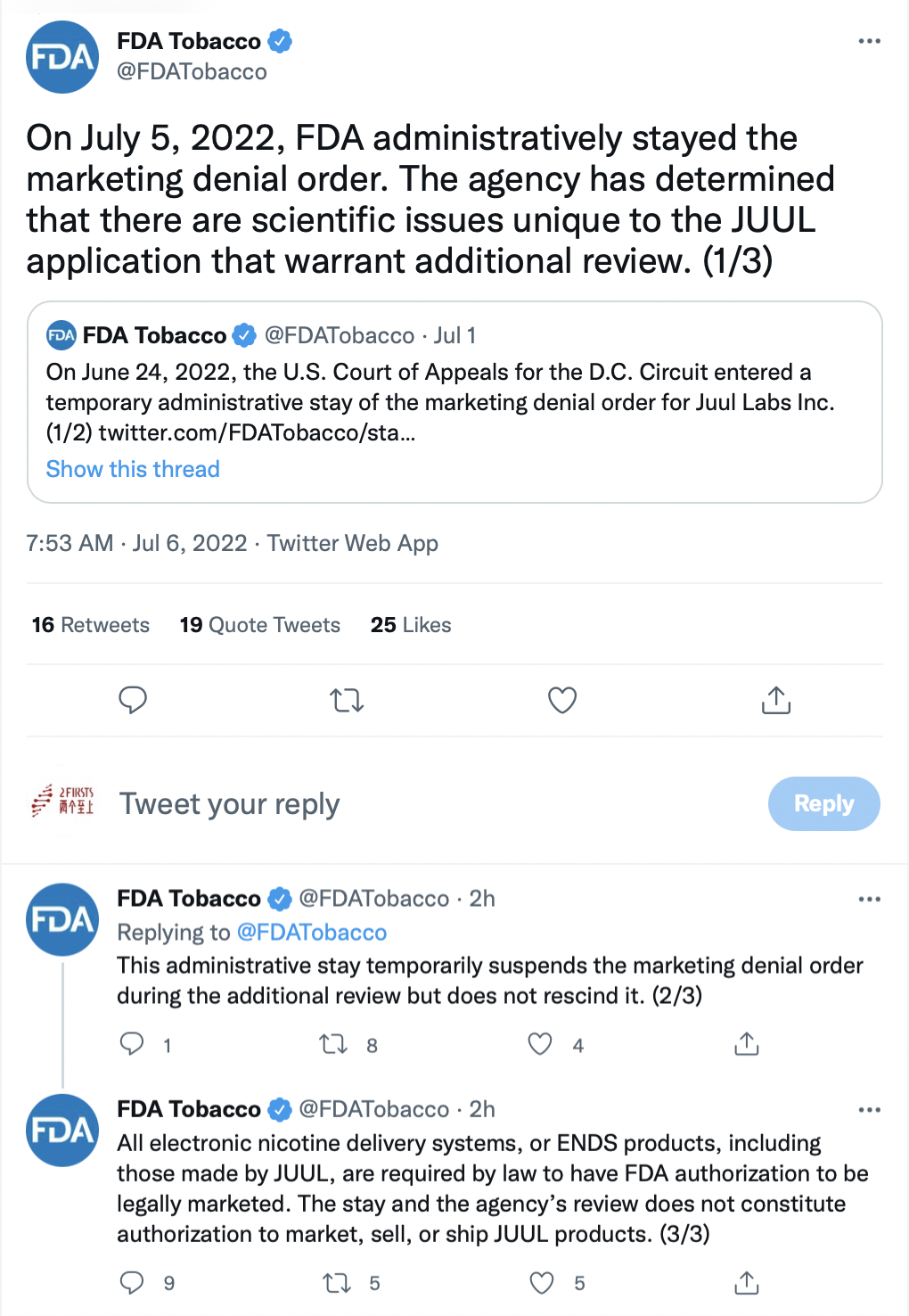
The FDA in June ordered the vaping company to pull its e-cigarettes off the U.S. market, saying Juul hadn’t submitted sufficient evidence that they were safe. A federal appeals court then granted Juul a temporary stay of the order, and Juul was asking the court for a longer stay to continue selling its e-cigarettes for the duration of the appeal process. Juul separately had asked the FDA to stay its own order pending the appeal.


In messages posted on Twitter late Tuesday, the FDA said it had stayed its marketing denial order. “The agency has determined that there are scientific issues unique to the JUUL application that warrant additional review,” the FDA said. The administrative stay temporarily suspends the order during the additional review but doesn’t rescind it, the agency said.


The FDA initially rejected Juul’s request for a stay, prompting Juul to seek a stay of the ban in court, according to Juul’s court filings.


Juul alleged in court filings that the FDA had mishandled its application. In the court filings, Juul said the agency had overlooked more than 6,000 pages of data that the company had submitted to the FDA on the aerosols that users inhale. Juul also said in court filings that the FDA’s decision was influenced by political pressure. The FDA had until July 7 to respond to Juul’s motion in federal court.


The content excerpted or reproduced in this article comes from a third-party, and the copyright belongs to the original media and author. If any infringement is found, please contact us to delete it. Any entity or individual wishing to forward the information, please contact the author and refrain from forwarding directly from here.

U.S. Fifth Circuit Vacates NicQuid Vape MDO, Says FDA Comparative-Efficacy Standard Violated APA Procedures
According to VitalLaw on August 27, 2026, the U.S. Court of Appeals for the Fifth Circuit vacated an FDA marketing denial order (MDO) against NicQuid LLC, ruling that the agency’s comparative-efficacy standard for electronic nicotine delivery system (ENDS) applications had become a substantive rule requiring notice-and-comment rulemaking under the Administrative Procedure Act (APA). The court did not reject FDA’s authority to compare the public health benefits and risks of flavored vapes, but held that the agency could not establish a broadly binding standard through informal adjudications. The case was remanded to FDA for further proceedings.
Aug.28
UK Vape Maker Riot Enters Clacton By-Election to Fight Government 'White Packaging' Proposals
British e-liquid manufacturer Riot Labs has introduced a fictional “candidate” called Riot Man around the Clacton parliamentary by-election, seeking to mobilize consumers and retailers against parts of the UK government’s proposed restrictions on vape packaging, device appearance and retail displays. Riot Man is not listed as an official candidate.
Aug.12
NATO Executive Director David Spross Sees U.S. Vape Regulation Improving, Calls for More PMTA Authorizations and Warns of 2027 State Tax Pressure
The National Association of Tobacco Outlets is calling for more FDA marketing authorizations, greater transparency in the PMTA process and continued enforcement against unauthorized e-cigarettes, even as its executive director, David Spross, points to recent regulatory developments as signs of progress. At the state level, excise taxes, flavor restrictions and vapor product directories remain major issues for tobacco retailers. By August 2026, 17 states had enacted laws establishing state-managed e-cigarette directories or similar systems.
Innovation
Sep.29 by 2Firsts Perspectives
Australia’s Victoria Steps Up Illegal Tobacco Enforcement With Store Closures and Penalties of Up to A$2.5 Million
Australia’s state of Victoria has activated new powers allowing Tobacco Licensing Victoria and police to shut premises suspected of selling, supplying or possessing illicit tobacco for up to 90 days. Longer closures can be ordered by a magistrates’ court. Businesses subject to closure orders must generally cease all trading and will be placed on a public list. Breaching a closure order can carry penalties of up to A$2.5 million and 20 years in prison.
Sep.10
Imperial Brands Acquires Helwit Owner Yoik Group for SEK 515 Million, More Than Doubling Swedish Nicotine Pouch Share
Imperial Brands has agreed to acquire 100% of Swedish modern oral nicotine company Yoik Group AB for an initial SEK515 million, equivalent to about US$53.9 million, plus a deferred payment linked to performance over the next two years. Yoik owns nicotine pouch brand Helwit, which held about 3.4% of Sweden’s modern oral nicotine market over the past 12 months. Imperial says the acquisition will more than double its existing share of the Swedish market. Helwit is also sold elsewhere in the Nordics, through European online channels and in selected UK retail outlets.
Sep.08
South Korea Constitutional Court Upholds Volume-Based E-Liquid Tax, With Challenged Rates at KRW 370 and KRW 628 per Milliliter
South Korea's Constitutional Court has upheld fixed taxes on nicotine-containing e-cigarette liquids based on solution volume, ruling that challenged provisions imposing KRW 370 per milliliter in individual consumption tax and KRW 628 per milliliter in tobacco consumption tax do not violate the Constitution. The cases stemmed from historical disputes involving importers that reported nicotine as being extracted from tobacco stems rather than leaves. South Korea has since broadened its tobacco definition to include synthetic nicotine, while current tax laws provide reduced rates for certain products not derived from tobacco.
Sep.18