FDA Warns Retailers Over Unauthorized Nicotine Pouches Resembling Candy and Everyday Products

Special Report
May.21
FDA Warns Retailers Over Unauthorized Nicotine Pouches Resembling Candy and Everyday Products
The FDA issued warning letters to eight retailers selling unauthorized nicotine pouches and dissolvable tobacco products resembling candy, breath strips and cough drops. The action highlights rising scrutiny of packaging, youth appeal and accidental ingestion risks, as the agency clarifies enforcement priorities for unauthorized ENDS and nicotine pouch products while maintaining PMTA as the legal market pathway.

Key Points

● FDA action: The FDA issued warning letters to eight retailers selling unauthorized nicotine pouches and dissolvable tobacco products.

● Child appeal: The cited products resembled candy, breath strips and cough drops, raising concerns over youth appeal and accidental ingestion.

● Regulatory signal: FDA enforcement is focusing not only on authorization status, but also on packaging, labeling, marketing and retail controls.

● Global context: WHO recently warned that nicotine pouch packaging and marketing may increase child appeal and accidental ingestion risks.


2Firsts

May 21, 2026

The U.S. Food and Drug Administration said on May 20 that it had issued warning letters to eight retailers for selling unauthorized tobacco products, including nicotine pouches and dissolvable tobacco products, that the agency said resembled candy, breath strips and cough drops.

The FDA said the products lacked authorization and were being sold in violation of the Federal Food, Drug, and Cosmetic Act. The agency said products that look like everyday items may be accidentally ingested by young children and may appeal to children seeking to conceal the products from parents, teachers or other adults.

“No tobacco product should look like candy — it’s a blatant ploy to target children and mask the true nature of these products,” said Bret Koplow, acting director of the FDA’s Center for Tobacco Products. “FDA and its partners are committed to implementing an aggressive enforcement strategy to stop illegal products like these from ending up on shelves or in the hands of kids.”

Eight Retailers Cited

The eight retailers or websites named in the warning letters were gethyppe.com, npouches.com, pouchew.com, pouchline.com, vapetrinity.com, Smoker Business, vapenovaco.com and snusguys.com.

FDA Warns Retailers Over Unauthorized Nicotine Pouches Resembling Candy and Everyday Products
Eight retailers and unauthorized products cited in FDA warning letters. Source: FDA warning letters, May 19, 2026. | Graphic by 2Firsts

The products cited in the letters included nicotine lozenges, nicotine strips, nicotine films and nicotine pouches. Product names referenced flavours or formats including toffee, mint, blue raspberry, candy, watermelon, cola marmalade and strawberry.

The FDA said the retailers were directed to address the violations identified in the letters, as well as any other violations that were the same as or similar to those described. The agency said failure to promptly correct the violations could result in further action, including injunctions, seizures and civil money penalties.

The warning letters were addressed to retailers, not manufacturers. Some products cited in the letters carried recognizable brand or product names, but the FDA action in this announcement was directed at the sellers of those products.

Candy-Like Packaging Under Scrutiny

Packaging concerns that have appeared in parts of the unauthorized e-cigarette market are now surfacing in some nicotine pouches and dissolvable tobacco products, according to the FDA’s warning letters.

For oral nicotine products, the compliance risk is not limited to nicotine content or authorization status. Products that are small, portable and designed for discreet use may attract closer scrutiny when their packaging, labelling, flavour positioning or marketing makes them resemble ordinary consumer goods or products associated with children.

FDA Warns Retailers Over Unauthorized Nicotine Pouches Resembling Candy and Everyday Products
An exhibit from FDA’s warning letter to gethyppe.com shows Hyppe Nicotine Lozenges, which the FDA said resembled cough drops. |Source: FDA warning letter.


FDA Warns Retailers Over Unauthorized Nicotine Pouches Resembling Candy and Everyday Products
An exhibit from FDA’s warning letter to pouchline.com shows Candys Sweet Nicopods packaging, which the FDA said resembled candy products. |Source: FDA warning letter.


WHO Flags Child-Appeal Risks in Nicotine Pouch Packaging

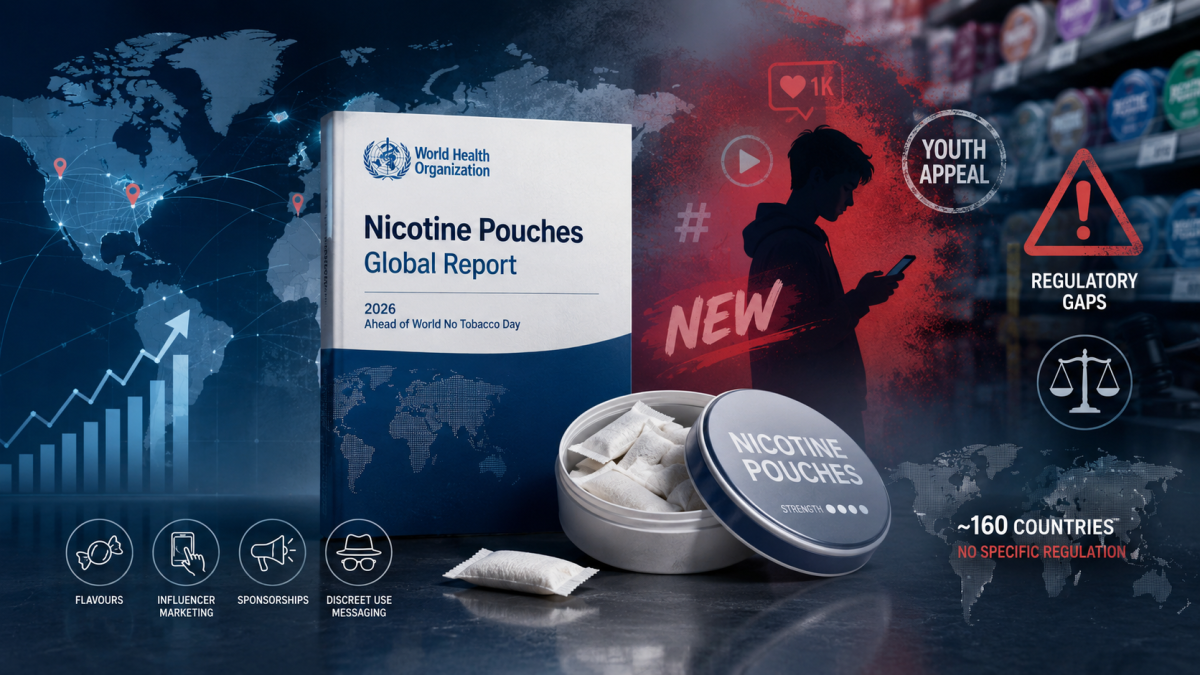
The FDA action came days after the World Health Organization released its first global report dedicated to nicotine pouches.

In that report, WHO warned that the fast-growing category is being marketed through flavours, packaging, social media promotion, influencer marketing, sponsorships and discreet-use messaging. The report also highlighted examples of nicotine pouch packaging resembling popular candy products, raising concerns about child appeal and accidental ingestion.

The FDA warning letters show how some of those concerns are appearing in U.S. enforcement against specific unauthorized products.

Legal Market Access and Enforcement Move in Parallel

The FDA said the latest actions followed the release of guidance on the agency’s enforcement priorities for electronic nicotine delivery systems, or ENDS, and nicotine pouch products that do not have premarket authorization.

The guidance clarifies enforcement priorities for unauthorized ENDS and nicotine pouch products, while the premarket tobacco product application pathway remains the route for products seeking legal marketing authorization in the United States.

For nicotine pouch brands, distributors and retailers, compliance now extends beyond authorization status to packaging, labeling, advertising and retail controls.

2Firsts will continue tracking FDA enforcement and authorization updates for oral nicotine products.

(Cover image generated by AI.)

2FIRSTS | WHO’s First Global Report on Nicotine Pouches: Harm Reduction Questions Remain Amid Global Regulatory Warning
Ahead of World No Tobacco Day 2026, WHO released its first global report on nicotine pouches, warning that rapid market growth, youth-oriented marketing and weak regulation are converging. 2Firsts views the report as an important warning, but not a complete risk assessment, with harm-reduction questions still unresolved.
www.2firsts.com


Disclaimer

This article is provided solely for professional research, industry discussion, and informational purposes. Any references to brands, companies, products, technologies, or policies are made for factual reporting and analytical purposes only, and do not constitute endorsement, recommendation, promotion, or advertising by 2Firsts.

Nicotine-containing products, including but not limited to cigarettes, e-cigarettes, heated tobacco products, and nicotine pouches, carry significant health risks. Readers are responsible for complying with all applicable laws and regulations in their respective jurisdictions, including age restrictions and access limitations.

The information contained in this article should not be regarded as investment, legal, medical, regulatory, or commercial advice. While 2Firsts strives to ensure the accuracy and reliability of its content, it does not assume liability for any direct or indirect loss arising from errors, omissions, inaccuracies, or reliance on the information contained herein.

This article is not intended for individuals below the legal age for accessing tobacco or nicotine-related information in their jurisdiction.


Copyright Notice

This article is either original content produced by 2Firsts or content reproduced, translated, summarized, or adapted from third-party sources with attribution where applicable. The intellectual property rights of the original content remain with 2Firsts or the respective original rights holders.

No individual or organization may copy, reproduce, distribute, republish, modify, translate, or otherwise use this content without prior authorization. Any unauthorized use may result in legal action.

For copyright-related inquiries, corrections, or removal requests, please contact: info@2firsts.com.


AI-Assisted Translation and Editing Notice

Portions of this article may have been translated, edited, or reviewed with the assistance of artificial intelligence tools to improve efficiency and readability. Due to the limitations of AI-assisted translation and editing, discrepancies, omissions, or inaccuracies may exist when compared with the original source.

Where applicable, readers are advised to refer to the original source for the most complete and accurate information. If you identify any errors or believe that any content infringes upon your rights, please contact us at info@2firsts.com, and we will review and address the matter promptly.


U.S. Rep. Krishnamoorthi Questions FDA Over Planned PMTA Rewrite, Seeks Communications With Altria and Reynolds
U.S. Rep. Raja Krishnamoorthi on Oct. 6 questioned the FDA over its plan to reassess and potentially replace the 2021 PMTA regulatory framework, asking the agency to identify provisions it may change or eliminate, state whether current scientific evidentiary standards will be maintained, and disclose communications with Altria, Reynolds and other parties challenging the rule. Krishnamoorthi led a congressional investigation into JUUL and youth vaping in 2019 and has since remained active on e-cigarette regulation and enforcement.
Regulations
Oct.08
GAO Audit Finds Nearly 132,000 FDA Tobacco Applications Waiting an Average 1,266 Days as Nicotine Pouch Pilot Practices Move Into Vape PMTA Reviews
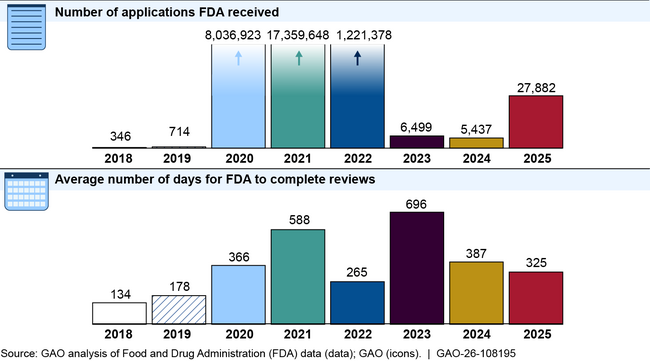
A U.S. Government Accountability Office audit found that 131,915 tobacco product applications submitted to the FDA since 2018 remained without a final review as of December 31, 2025, with pending applications waiting an average of 1,266 days. GAO also found FDA lacks the data needed to systematically determine whether scientific reviews meet applicable timelines. HHS agreed to upgrade the agency's tracking systems. At the same time, FDA has begun applying lessons from its nicotine pouch PMTA pilot to e-cigarette reviews, while changes to enforcement policy and electronic submissions are making the specific stage of a PMTA increasingly relevant to market access.
FDA
Oct.03
Indiana Halts Sales of Elf Bar, Lost Mary, MR FOG and iJOY Vapes Under Foreign-Adversary Rules; Some Products Return After Compliance Filings
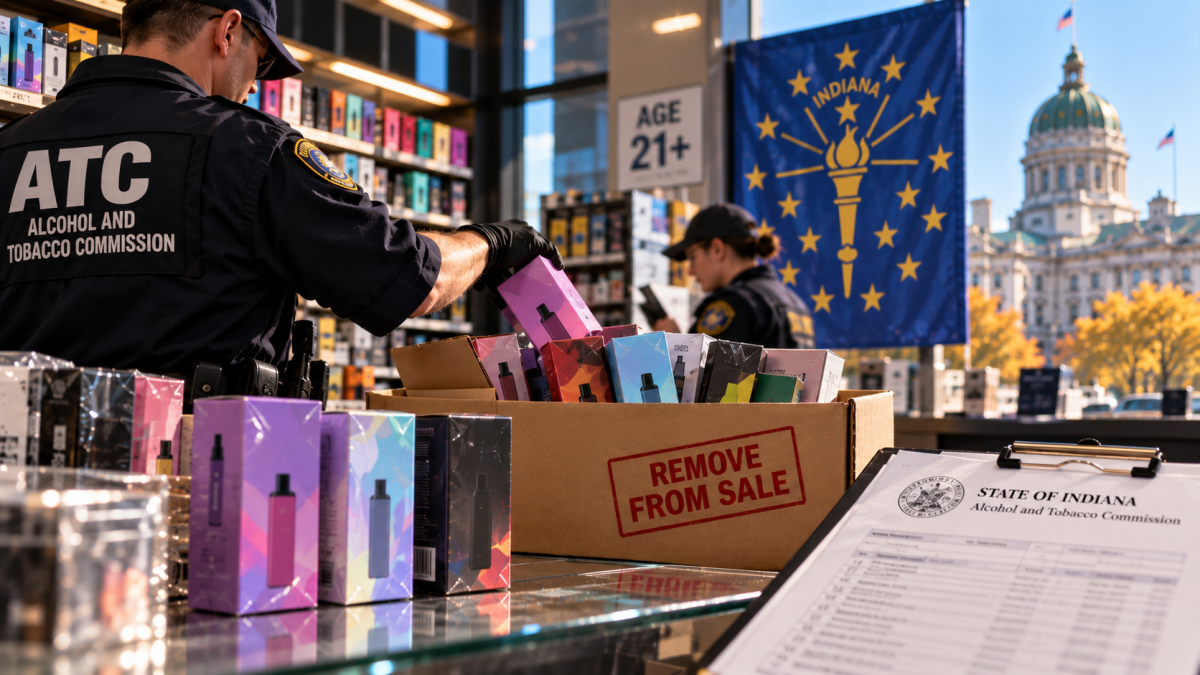
Indiana's Alcohol and Tobacco Commission (ATC) ordered tobacco certificate holders in September to remove certain vaping products marketed under Elf Bar, Lost Mary, MR FOG, iJOY and other brands from inventory under the state's foreign-adversary product law. The agency later listed 257 MR FOG products and 77 Lost Mary product entries as lawful for sale. The Lost Mary revision expressly stated that compliance evidence had been received for 20 additional products. 2Firsts compliance expert Kurt said potential filings could include e-liquid and ingredient-origin records, U.S. nicotine-analog supply-chain documentation and FDA premarket application status.
Regulations
Oct.08
Pennsylvania Vape Directory Enforcement Starts Oct. 19, Barring Retail Sales of Unlisted Products
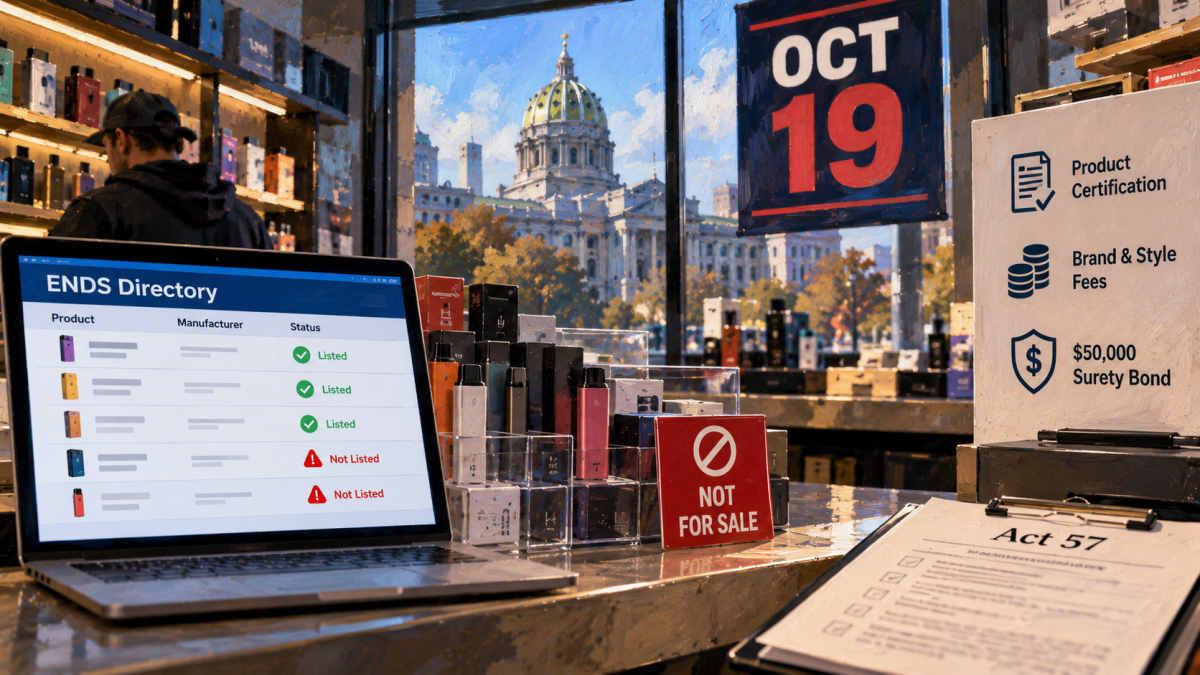
Pennsylvania's Act 57 vape directory regime will reach the end of its 120-day inventory transition period on Oct. 19. Nicotine-containing e-cigarettes intended for retail sale in the state that are not listed on the Attorney General's ENDS directory will then be barred from retail sale and treated as contraband subject to seizure, forfeiture and destruction. Manufacturers face annual product certification, brand- and style-based fees and a minimum $50,000 surety bond, while retailers and wholesalers must source through licensed channels and monitor the directory.
Regulations
Oct.08
U.S. Health Groups Seek to Overturn FDA Enforcement Discretion for Pending PMTAs as Altria's Helix, NJOY and AVM Move to Intervene
American Vapor Manufacturers (AVM) and Altria subsidiaries Helix Innovations and NJOY filed separate motions on October 7, 2026, seeking to intervene on the FDA's side in a lawsuit challenging its enforcement guidance for certain e-cigarette and nicotine pouch products with pending premarket tobacco product applications (PMTAs). Seven public health and tobacco-control organizations, including the Campaign for Tobacco-Free Kids, sued the agency in July to overturn the policy. AVM argues that vacating the guidance could disrupt orders, inventory, retail distribution and investments in regulatory submissions.
Regulations
Oct.09
Virginia Tobacco Retail Permit Takes Effect October 1, Covering Vapes as More Than 3,000 Businesses Apply in September
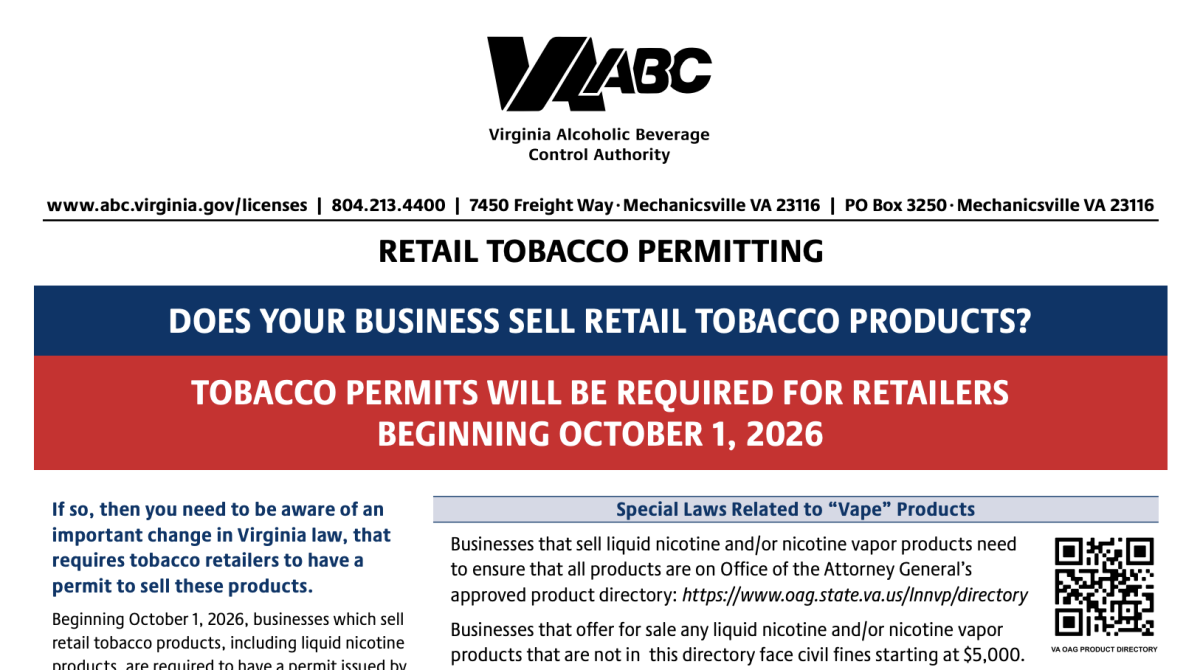
Virginia's new retail tobacco permit system took effect October 1, requiring sellers of vapes, nicotine products and related devices and accessories to obtain a Retail Tobacco Permit for each business location. Virginia ABC said more than 3,000 businesses applied in September alone, creating a processing backlog. Qualifying applicants that filed before October 1 may temporarily operate under a Letter of Authorization. The new store-level permit also sits alongside Virginia's existing vape product directory, where sales of unlisted liquid nicotine or nicotine vapor products can trigger civil penalties starting at $5,000.
Regulations
Oct.03