Key Takeaways
- Logistics operators in the China-U.S. vape trade see late April to early May as a key window for possible new U.S. border enforcement against illicit e-cigarettes.
- Recent March inspections are being read by some in the industry as an early probing phase rather than a full-scale crackdown.
- More than 150 million disposable vape units are estimated to remain in the United States, heightening market sensitivity to any sign of tighter enforcement.
- After the September 2025 seizure of 4.7 million unauthorized e-cigarettes, no similarly publicized large-scale action followed, but trade flows rebounded quickly.
- For the market, the central question is not only whether another crackdown is coming, but whether enforcement can be sustained.
2Firsts | SHENZHEN,
April 9, 2026 — A growing number of logistics operators in the China-U.S. vape trade believe U.S. enforcement agencies may be moving toward another major border crackdown on illicit e-cigarettes, as recent inspections and cargo disruption revive memories of last year’s enforcement cycle.
The view, based on interviews with logistics and industry participants, has not been confirmed by U.S. authorities, and 2Firsts could not independently verify whether a new coordinated enforcement campaign is being prepared. Still, the expectation is gaining ground in a market already strained by high U.S. inventory levels, fragile cash flows, and the re-emergence of illicit high-volume products. Several logistics operators said March may have marked an initial probing phase, with late April to early May now seen as a critical window for possible escalation. If sustained, another round of tighter border enforcement would matter not only for shipment flows, but also for the competitive balance between unauthorized and legitimate products in the U.S. market.
Logistics operators point to late April to early May as a key risk window
Several logistics operators involved in China-U.S. vape shipments are warning that late April to early May could become a critical period for U.S. border enforcement against illicit e-cigarettes, based on what they describe as a familiar pattern of advance monitoring followed by concentrated inspections.
Mark, a logistics practitioner who has long handled China-U.S. vape shipments, told 2Firsts that last year’s large-scale customs enforcement began in late April and early May, making the same period this year a closely watched window for the industry.
In his view, signs of a new cycle may already have emerged in March. Mark said customs inspections had already affected some shipments that month, but described those checks as more of a preliminary test than a full-scale crackdown. He said he viewed such inspections as part of an initial phase used to gauge market reaction and gather shipment data, rather than to trigger immediate large-scale seizures.
In Mark’s view, U.S. enforcement agencies do not typically move without preparation. Instead, they spend time building a picture of shipment flows, including how much product is moving and through which channels, before deciding whether to escalate. Based on his experience over the past several years, he estimated that this monitoring and deployment cycle usually lasts around one to two months.
Once authorities have a clearer view of import volumes and trading patterns, they are more likely to act when cargo flows are heavier, he said, allowing enforcement to have greater impact.
That expectation has been reinforced by recent disruption in the logistics market. Mark said one major logistics provider specializing in vape shipments had recently come under inspection, with more than 10 containers reportedly affected. As a result, the company temporarily stopped accepting cargo for around 10 days. The final outcome of the detained shipments remains unclear, he said.
While such cases do not in themselves confirm that a new nationwide enforcement campaign has begun, they have added to unease across the logistics sector and intensified attention on the late-April to early-May period as a potential turning point.
Inventory pressure has heightened sensitivity to enforcement expectations
Attention surrounding logistics-sector warnings has also been sharpened by inventory pressure already weighing on parts of the supply chain.
According to information gathered by 2Firsts from multiple manufacturers and brand owners, more than 150 million disposable vape units remain in the United States, equivalent to roughly two to three months of market sell-through under normal conditions, and potentially longer in the current environment. Since October 2025, much of that inventory has moved slowly, adding to pressure on Chinese manufacturers and brand owners exposed to the U.S. market.
That pressure has been compounded by the way many shipments were financed during an earlier period of intense competition. Industry participants said some Chinese suppliers shipped products to U.S. distributors with only around 10% paid upfront, leaving manufacturers heavily exposed once sell-through weakened and inventories began to build. In some cases, they said, cargoes were rejected by distributors before even reaching their final destination in the United States.
Against that backdrop, any expectation of tighter border enforcement has taken on greater significance. Industry participants said some companies holding inventory in the United States see a potential upside in stricter inspections: if enforcement once again disrupts shipments of illicit high-volume products, temporary shortages in parts of the market could help absorb stock that has been slow to move.
That does not amount to optimism about the market, they said. Rather, it reflects a defensive reading of current conditions, in which prolonged inventory pressure and renewed competition from illicit products have left some firms looking to enforcement as one of the few external factors that could alter the balance.
For legitimate players, industry participants said, the issue is not simply enforcement volatility, but the repeated ability of unauthorized high-volume products to regain market access after each round of disruption.
After the September crackdown, large-scale action faded from view, but trade rebounded quickly
For industry participants, current enforcement expectations are also shaped by what followed the last major U.S. crackdown in September 2025.
That month, the U.S. Department of Health and Human Services, acting through the Food and Drug Administration, worked with U.S. Customs and Border Protection in Chicago to seize 4.7 million unauthorized e-cigarettes with an estimated retail value of about $86.5 million. U.S. officials described it as the largest operation of its kind, and said nearly all of the products seized had come from China.
After that, however, U.S. authorities did not publicly disclose another enforcement action on the same scale. Smaller seizures continued. In November 2025, CBP officers in Chicago seized 43,200 illicit vaping products in a shipment from China bound for Mississippi. But compared with the September operation, such cases appeared closer to routine enforcement than to a coordinated, high-intensity campaign.
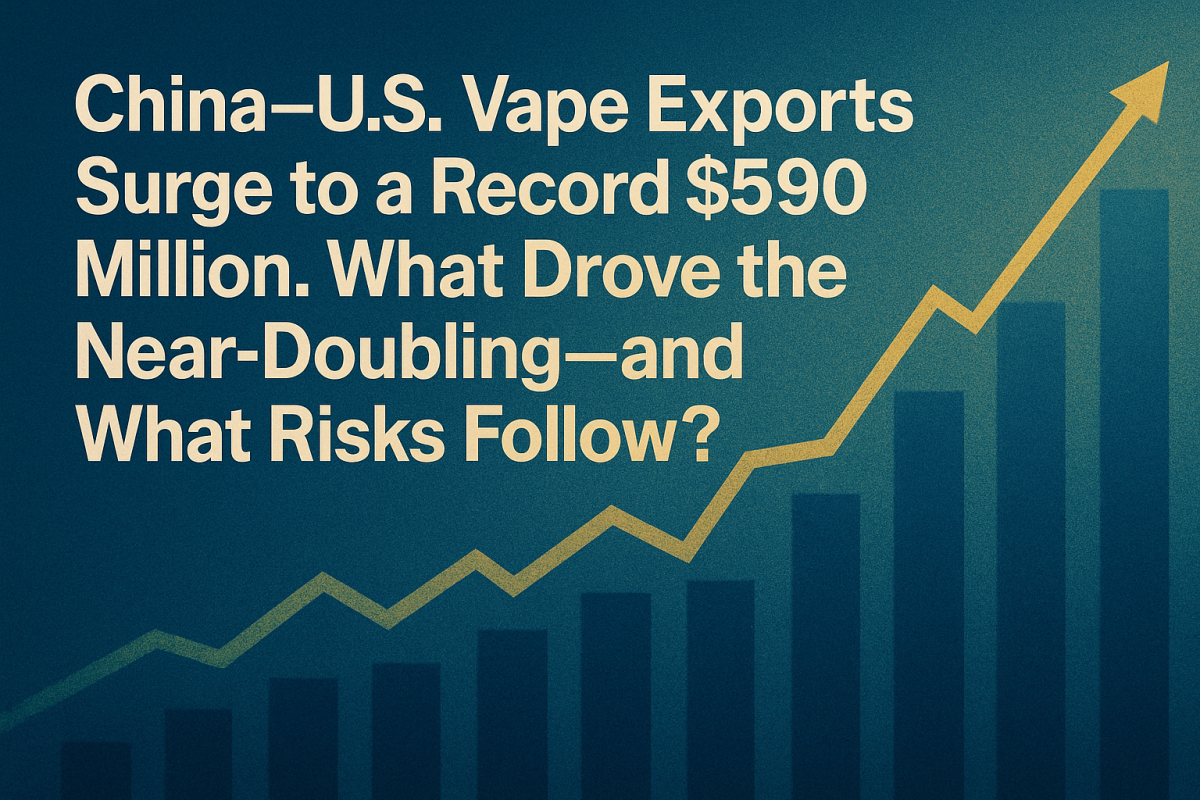
Trade flows, meanwhile, proved resilient and rebounded quickly. According to a previous 2Firsts data analysis, China’s vape exports to the United States rose to about $260 million in July 2025, then to around $380 million in both August and September. In October, exports surged to a record $590 million, nearly double the typical monthly level of roughly $300 million over the past two to three years.
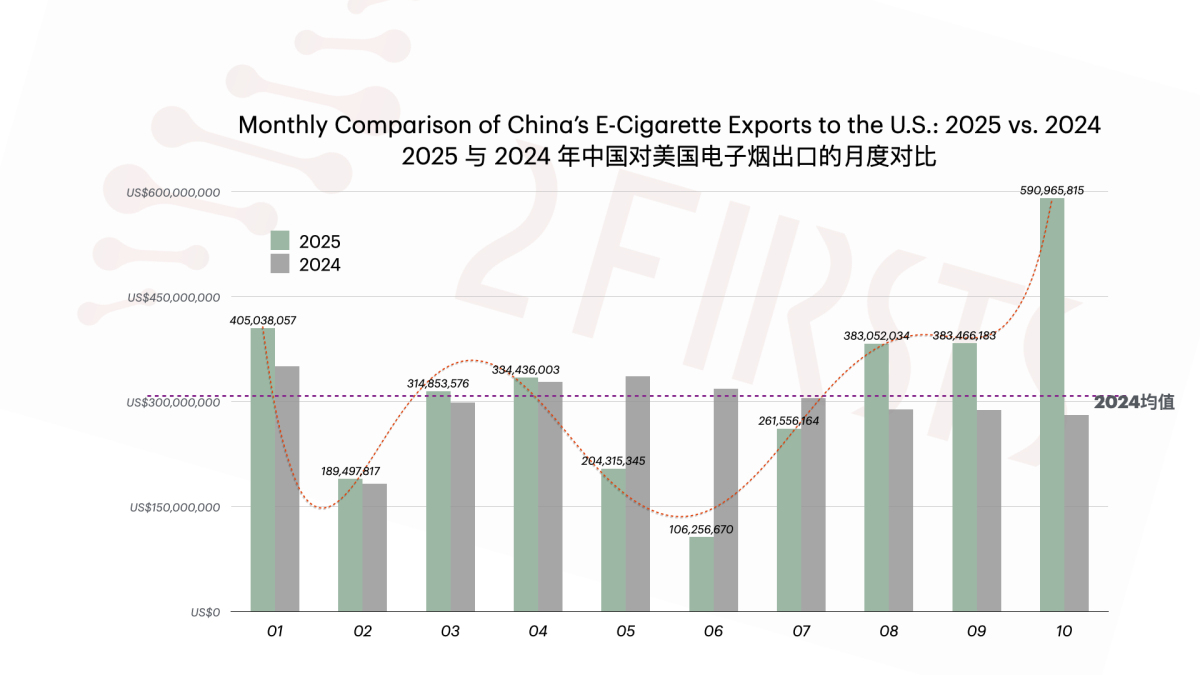
That rebound, 2Firsts previously reported, was not driven by a fundamental improvement in end-market demand. Rather, it reflected a temporary release shaped by enforcement cycles, logistics disruption, pathway reopening, and front-loaded replenishment. In other words, the September crackdown did not produce a lasting contraction in cross-border flows. Once logistics channels became workable again, shipments returned rapidly.
For many in the industry, that pattern remains central to how the current moment is being interpreted: a major crackdown, a period without another similarly publicized large-scale action, and then a sharp recovery in shipments. Against that backdrop, recent inspections and disruption in the logistics chain are being read by some market participants not as isolated incidents, but as possible early signs of another enforcement cycle taking shape.
U.S. agencies have consistently said unauthorized e-cigarette products cannot be legally marketed in the United States, framing related enforcement as part of broader public health and trade-control efforts.
For the market, the more consequential question is not whether another crackdown takes place, but whether pressure can be sustained long enough to disrupt the repeated re-entry of unauthorized products into distribution channels.
Appendix | Selected Timeline of Major U.S. Federal Enforcement Actions Against Illicit E-Cigarettes
From a timeline perspective, U.S. federal enforcement against illicit e-cigarettes began to intensify markedly from mid-2024. DOJ and FDA first established a cross-agency task force, followed by large-scale border seizures in October 2024. In 2025, enforcement extended further from ports of entry to warehouses, import declarations, and accountability across the supply chain, reaching its highest publicly disclosed intensity so far in September 2025. The overall trajectory suggests that U.S. authorities no longer treat illicit e-cigarettes as merely a routine market-compliance issue, but increasingly as a federal priority involving border control, import fraud, and supply-chain enforcement.
June 2024 | DOJ, FDA
Main action:
The U.S. Department of Justice and the Food and Drug Administration jointly announced the creation of a federal multi-agency task force aimed at combating the distribution and sale of illicit e-cigarettes. In addition to DOJ and FDA, the participating agencies included the Bureau of Alcohol, Tobacco, Firearms and Explosives, the U.S. Marshals Service, the U.S. Postal Inspection Service, and the Federal Trade Commission.
Volume and value:
Not applicable. This was an institutional milestone rather than a seizure action.
Why it mattered:
This was the key structural turning point in the enforcement timeline. Its significance lay not in cargo volume, but in the shift from fragmented agency responses to a coordinated federal mechanism. The border seizures, warehouse actions, and importer accountability measures that followed can be seen as extensions of this institutional framework. In that sense, June 2024 marked the beginning of a more systematic federal campaign against illicit e-cigarettes.
October 2024 | FDA, CBP
Main action:
FDA and U.S. Customs and Border Protection announced the seizure of about 3 million illicit e-cigarettes in a joint federal action, with an estimated retail value of about $76 million. FDA said the products were unauthorized and that many had been deliberately declared as other categories or entered at inaccurate values to evade regulatory scrutiny.
Volume and value:
About 3 million units; about $76 million.
Why it mattered:
This was the first landmark case in which U.S. federal authorities publicly showcased a very large-scale border seizure of illicit e-cigarettes. It elevated the issue from a conventional market-regulation problem to one of border enforcement and inter-agency coordination, reinforcing the message that illicit e-cigarettes were being treated as a systemic problem requiring joint action across inspection, declaration review, and federal enforcement.
January 2025 | FDA, HSI, CBP
Main action:
FDA announced that, together with Homeland Security Investigations and CBP, it had seized more than 628,000 unauthorized e-cigarette products at a warehouse in Miami, with an estimated value of more than $7 million. Official descriptions indicated that the products were first identified at the border, and enforcement then extended to a post-entry warehousing node.
Volume and value:
More than 628,000 units; more than $7 million.
Why it mattered:
The case showed that federal enforcement had expanded beyond front-end interdiction at the port of entry to warehousing and downstream circulation after entry. It suggested that U.S. regulators were building a more complete enforcement chain spanning import, storage, and distribution, rather than relying solely on one-off border interception. For the industry, it was a reminder that entry into the United States did not mean the risk had ended.
May 2025 | FDA, CBP
Main action:
FDA and CBP announced the seizure of nearly 2 million illicit e-cigarettes in a joint operation in Chicago, with an estimated retail value of close to $34 million. Officials said nearly all of the shipment came from China and highlighted issues including misdeclared imports, undervaluation, and vague product descriptions.
Volume and value:
Nearly 2 million units; about $33.8 million.
Why it mattered:
This action marked a visible extension of enforcement into the import accountability chain. FDA said it had, for the first time, sent information request letters to 24 tobacco importers and customs filers, requiring them to explain their compliance measures and warning that false declarations could trigger federal liability. The focus was no longer just on seizing cargo, but also on identifying who imported it and who facilitated the entry of illicit products through the declaration system.
September 2025 | HHS, FDA, CBP
Main action:
The U.S. Department of Health and Human Services, acting through FDA, worked with CBP in Chicago to seize 4.7 million unauthorized e-cigarettes from inbound cargo. Officials estimated the retail value at about $86.5 million. FDA described it as the largest operation of its kind publicly disclosed to date, adding that nearly all of the products seized had come from China.
Volume and value:
4.7 million units; about $86.5 million.
Why it mattered:
The significance of the action lay not only in its record size, but in what it showed about the evolution of federal enforcement: from scattered seizures to a more institutionalized, recurring, and bulk-oriented border interdiction model. FDA also said that, in 2025 alone, FDA and CBP had blocked more than 6 million unauthorized e-cigarettes worth more than $120 million from entering the U.S. market, underscoring that border enforcement had become a central federal tool in controlling illicit inflows.
Cover image generated by AI