Florida Legislature Takes Action to Regulate E-Cigarettes Market

Regulations by 2FIRSTS.ai
Apr.19.2024
Florida Legislature Takes Action to Regulate E-Cigarettes Market
Florida legislature intervenes to regulate e-cigarette products in response to federal government oversight, aiming to protect public health.

According to the Miami Herald, on April 19, the Florida state legislature is once again stepping in to fill the gap left by the federal government in regulating public health issues. During this session, Republican state representative Alex Rizo supported legislation to ensure that Florida residents are protected from harmful, unregulated e-cigarette products while not restricting safe, FDA-approved e-cigarette products that can help adult smokers quit.


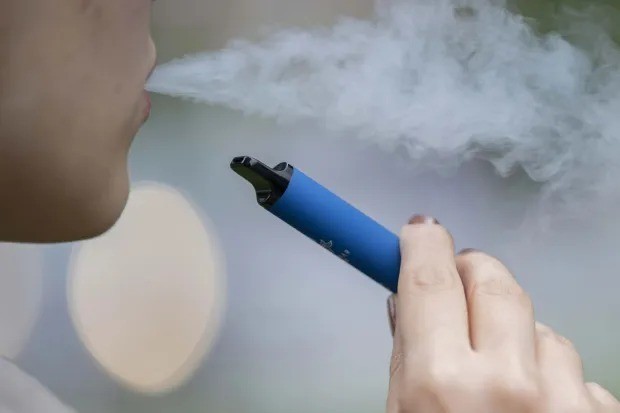
Alex Lizzo believes that the Biden administration and the U.S. FDA's regulation of the e-cigarette market is not impressive. Currently, the annual sales of illegal disposable e-cigarettes in the U.S. regulated channels alone exceed $26 billion. However, predictions show that this number could double if the unregulated market is taken into account. Florida has now become a hotspot for illegal product trafficking. These attractive flavors designed to appeal to young people, and the packaging that resembles everyday school supplies (such as highlighters, USB drives, and smartphones), have led Chinese-manufactured disposable e-cigarettes to make up 58% of all e-cigarette sales, surpassing the national average by a significant 20%.


Currently, House Bill 1007 has passed in the Florida legislature and is awaiting the governor's signature. The bill requires e-cigarette manufacturers to register in the state, ensure their products comply with federal and state laws, and establish penalties for violations. This is crucial to protect our children from the risks associated with e-cigarettes, ensure industry accountability, and promote education within the e-cigarette market to reduce harm for smokers looking to switch to e-cigarettes as a means to quit smoking. However, the legislation does not impose significant restrictions on the market, allowing adult smokers to still choose safer e-cigarette products as alternatives.


Critics point out that the FDA's complex and cumbersome approval process has resulted in only 23 e-cigarette products being granted licenses, even though there are hundreds of applicants. This has led to an ironic situation where illegal e-cigarettes from China have become the preferred choice for young people, as the FDA is unable to stop the circulation of these products.


Despite protests over the federal government's neglect of the e-cigarette issue, Alex Rizzo believes that the United States could become a global leader in helping smokers break free from traditional cigarettes and transition to safer alternatives. This would require the federal government to have better policies and leadership. Currently, the FDA's Center for Tobacco Products is struggling to regulate the market for alternative products for adult smokers while also failing to protect teenagers from illicit products coming from China.


We welcome news tips, article submissions, interview requests, or comments on this piece.

Please contact us at info@2firsts.com, or reach out to Alan Zhao, CEO of 2Firsts, on LinkedIn


Notice

1.  This article is intended solely for professional research purposes related to industry, technology, and policy. Any references to brands or products are made purely for objective description and do not constitute any form of endorsement, recommendation, or promotion by 2Firsts.

2.  The use of nicotine-containing products — including, but not limited to, cigarettes, e-cigarettes, nicotine pouchand heated tobacco products — carries significant health risks. Users are responsible for complying with all applicable laws and regulations in their respective jurisdictions.

3.  This article is not intended to serve as the basis for any investment decisions or financial advice. 2Firsts assumes no direct or indirect liability for any inaccuracies or errors in the content.

4.  Access to this article is strictly prohibited for individuals below the legal age in their jurisdiction.


Copyright


This article is either an original work created by 2Firsts or a reproduction from third-party sources with proper attribution. All copyrights and usage rights belong to 2Firsts or the original content provider. Unauthorized reproduction, distribution, or any other form of unauthorized use by any individual or organization is strictly prohibited. Violators will be held legally accountable.

For copyright-related inquiries, please contact: info@2firsts.com


AI Assistance Disclaimer


This article may have been enhanced using AI tools to improve translation and editorial efficiency. However, due to technical limitations, inaccuracies may occur. Readers are encouraged to refer to the cited sources for the most accurate information.

We welcome any corrections or feedback. Please contact us at: info@2firsts.com

Australia Adds 6-Methylnicotine to Schedule 9 Prohibited Substances, Effective October 1
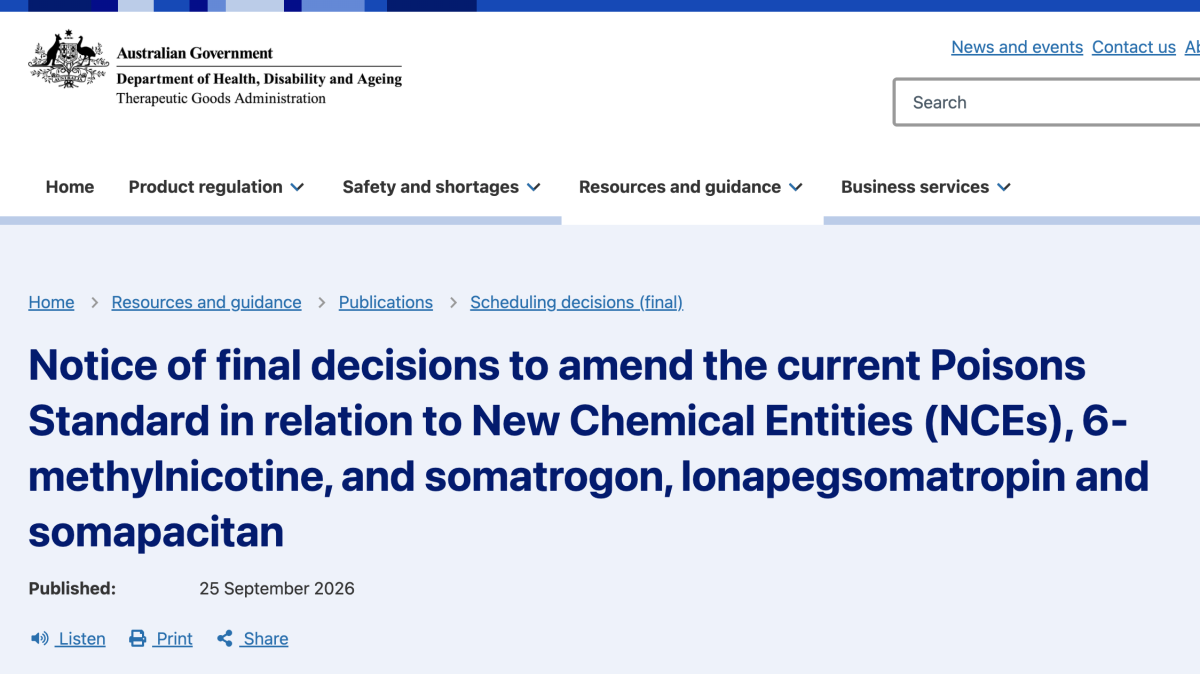
Australia's Therapeutic Goods Administration published a final decision on September 25 to classify 6-methylnicotine as a Schedule 9 prohibited substance under the Poisons Standard, effective October 1, 2026. TGA said the chemical has been reported in e-cigarette liquids sold in Australia and marketed as nicotine-free or nicotine alternatives, while evidence also indicates its use in preparations such as oral pouches. The government originally proposed a Schedule 7 classification but ultimately adopted the stricter Schedule 9 designation, citing acute toxicity, dependence risk, use in unapproved consumer products and misleading marketing.
News
Sep.29 by 2Firsts Perspectives
How Many Nicotine Pouch Factories Does Europe Need? 2Firsts Interviews AIRSCREAM on the OEM Market
At InterTabac 2026, nicotine pouch growth was visible not only in brands but across equipment, raw materials and OEM manufacturing. 2Firsts interviewed AIRSCREAM commercial head Steve Moore on how many pouch factories Europe may ultimately need and where manufacturers can differentiate, from formulation and flavour to pouch materials, production consistency and customer service. The category continues to expand, but questions remain over future capacity, consolidation and the long-term structure of the supply chain.
Sep.18
STIIIZY Redesign Fails to Escape PAX Labs Patent Import Ban as Section 337 Case Also Involves China ALD
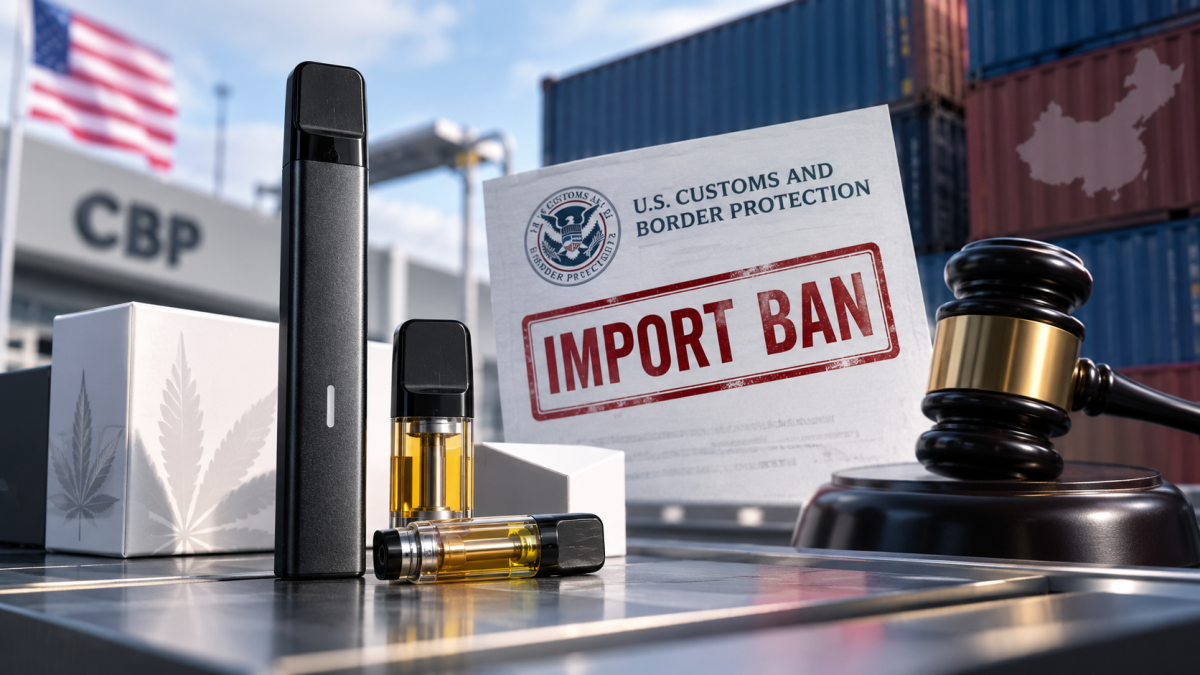
U.S. Customs and Border Protection ruled that STIIIZY had not shown that the redesigned cannabis-vape products covered by its latest request fall outside an ITC limited exclusion order tied to PAX Labs patents. CBP accepted some of STIIIZY’s claim-construction and non-infringement arguments, but the company did not address two additional claims in the same patent. Earlier STIIIZY redesigned cartridges and certain associated components imported with them had received separate CBP clearance.
Sep.16
German Tobacco Tax Revenue Falls 10.8% Through August as Tax-Paid Cigarette Volume Drops 12.6%
Germany collected €9.789 billion in total tobacco tax revenue from January through August 2026, down 10.8% from a year earlier, according to the Federal Ministry of Finance. Germany's tobacco tax base covers not only cigarettes and fine-cut tobacco but also heated tobacco and vaping liquids taxed as tobacco substitutes. The German Association of the Tobacco Industry and Novel Products, or BVTE, citing federal statistical data, said tax-paid cigarette volume fell 12.6% to 40.6 billion sticks. BVTE is using the latest figures to argue against further tax increases planned from 2027 through 2030, while Germany's parliament is scheduled to hold a first reading of the bill on September 24.
Sep.23
U.S. Expands Illicit Vape Enforcement as ATF Brings PACT Act Powers Into Trade Fraud Task Force
The U.S. Bureau of Alcohol, Tobacco, Firearms and Explosives said on September 23 that it has joined the interagency Trade Fraud Task Force to strengthen enforcement against illegal, misdeclared and smuggled vape and tobacco products. ATF will bring its authority under the Prevent All Cigarette Trafficking Act into the task force, including registration, reporting, shipping and record-inspection requirements covering interstate sales of electronic nicotine delivery systems. ATF said the move will strengthen its ability to trace illicit products from U.S. points of entry through domestic trafficking and distribution networks.
News
Sep.28 by 2Firsts Perspectives
PMI Pushes Smoke-Free Business in Latin America as Argentina Lifts Heated Tobacco Ban, Mexico City Share Tops 7%
Philip Morris International (PMI) showcased IQOS heated tobacco systems and nicotine pouch products at Technovation 2026 in Buenos Aires on October 7–8, presenting research on consumer attitudes, regulatory developments and illicit cigarette trade across Latin America. PMI Chief Global Growth Officer Stefano Volpetti said smoke-free products accounted for more than 7% of the Mexico City market. Argentina repealed its heated tobacco ban in May 2026 and introduced registration requirements for tobacco and nicotine products, while local media reported nicotine pouch sales in Mendoza. A PMI-commissioned survey found that only 8% of respondents across four Latin American countries were familiar with nicotine pouches. A separate KPMG study estimated illicit cigarette consumption at 77 billion sticks across 11 markets in Latin America and Canada in 2025.
PMI
Oct.13