According to recent data from the Global State of Tobacco Harm Reduction (GSTHR), there has been a 20% increase in global e-cigarette users from 2020 to 2021. The report was released by K.A.C. and indicates that the number has grown from 68 million in 2020 to 82 million in 2021, a 20% increase. The new GSTHR data brief is based on 49 countries and combines data from various sources, including the 2021 Eurobarometer 506 survey.
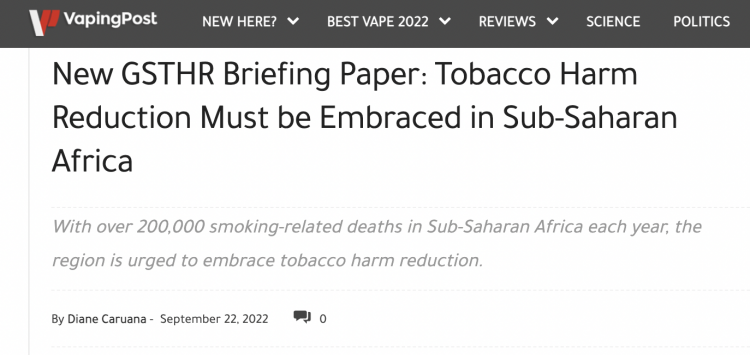
In the meantime, a recent report titled "Reducing Tobacco Harm in Sub-Saharan Africa" suggests that due to the large number of smoking-related deaths in the region every year, there is an urgent need to reduce tobacco harm. The report is according to the UK public health organization, Knowledge•Action•Change (K•A•C).
A new paper from KAC, authored by Chimwemwe Ngoma, founder of THR Malawi, investigates the state of tobacco harm reduction across 48 countries in sub-Saharan Africa. The paper argues that reducing tobacco harm could yield significant public health benefits in the region, especially considering estimates from the World Health Organization that the number of tobacco users will increase to 62 million by 2025.
At the same time, sociologist and tobacco harm reduction expert Gerry Stimson has been urging African countries to avoid disaster by shifting away from tobacco cultivation towards more sustainable crops, as the harm caused by tobacco use will persist.
On October 27th of last year, Stephen Hirst was one of the speakers at the release of the report "Ending the Tobacco Epidemic: Global Strategies for Tobacco Control" by GSTHR. In November of the same year, an event was held with the aim of raising awareness and challenging the direction of COP9.
In response to journalists' comments about some African countries relying on tobacco production, Stiglitz warned that any country that relies on tobacco and delays getting rid of their "green gold" will face disastrous economic consequences in the near future.
I know that some countries in Africa, such as Malawi, heavily rely on tobacco production. However, now, Malawi should consider agricultural transformation. The question that these tobacco-dependent countries should consider is: what does the future of tobacco production look like for them?" he emphasized.
Statement:
This article has been compiled from third-party information and is intended for industry-related exchange and learning.
This article does not represent the views of 2FIRSTS, nor can 2FIRSTS confirm the authenticity and accuracy of the article's contents. The translation of this article is only intended for industry communication and research purposes.
Due to limitations in the translation process, the translated article may not fully correspond to the original text. Therefore, please refer to the original text for accuracy.
For any domestic, Hong Kong, Macau, Taiwan or foreign issues and positions, 2FIRSTS maintains complete alignment with the Chinese government.
The copyright of compiled information belongs to the original media and author. If there is any infringement, please contact us for deletion.
Disclaimer
This article is provided solely for professional research, industry discussion, and informational purposes. Any references to brands, companies, products, technologies, or policies are made for factual reporting and analytical purposes only, and do not constitute endorsement, recommendation, promotion, or advertising by 2Firsts.
Nicotine-containing products, including but not limited to cigarettes, e-cigarettes, heated tobacco products, and nicotine pouches, carry significant health risks. Readers are responsible for complying with all applicable laws and regulations in their respective jurisdictions, including age restrictions and access limitations.
The information contained in this article should not be regarded as investment, legal, medical, regulatory, or commercial advice. While 2Firsts strives to ensure the accuracy and reliability of its content, it does not assume liability for any direct or indirect loss arising from errors, omissions, inaccuracies, or reliance on the information contained herein.
This article is not intended for individuals below the legal age for accessing tobacco or nicotine-related information in their jurisdiction.
Copyright Notice
This article is either original content produced by 2Firsts or content reproduced, translated, summarized, or adapted from third-party sources with attribution where applicable. The intellectual property rights of the original content remain with 2Firsts or the respective original rights holders.
No individual or organization may copy, reproduce, distribute, republish, modify, translate, or otherwise use this content without prior authorization. Any unauthorized use may result in legal action.
For copyright-related inquiries, corrections, or removal requests, please contact: info@2firsts.com.
AI-Assisted Translation and Editing Notice
Portions of this article may have been translated, edited, or reviewed with the assistance of artificial intelligence tools to improve efficiency and readability. Due to the limitations of AI-assisted translation and editing, discrepancies, omissions, or inaccuracies may exist when compared with the original source.
Where applicable, readers are advised to refer to the original source for the most complete and accurate information. If you identify any errors or believe that any content infringes upon your rights, please contact us at info@2firsts.com, and we will review and address the matter promptly.